
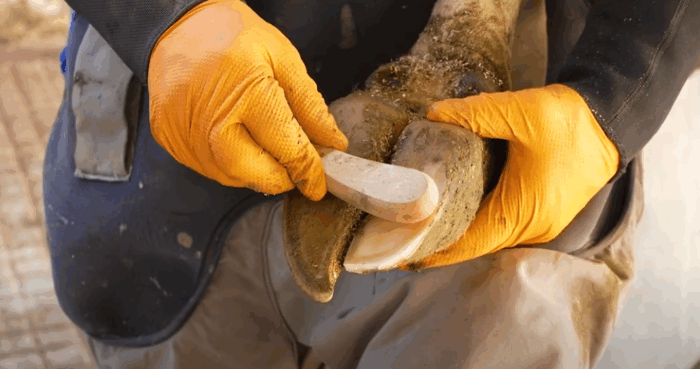
Hoof paring (trimming) and foot bathing are two of the most important tools in a lameness control plan. Both are essential for keeping cows on their feet and in good health.
To coincide with the fourth video in the Animal Health Ireland lameness series, Ned Dunphy, Irish Cattle Foot Trimmers Association, Ger Cusack, Comeragh Vets, and Eoin Ryan, School of Veterinary Medicine, UCD, take an in-depth look at both of these important tools.
Preventative hoof paring
On many farms, hoof paring is only done when cows become lame. But there is clear value in routine hoof inspection and paring to prevent lameness from developing in the first place.
Cows walking on concrete and roadways often develop excess horn growth, particularly on the outer claw of the hind feet. This overgrowth leads to uneven weight bearing and pressure, increasing the risk of white line disease, sole bruising or sole ulcers.
Routine hoof inspection helps detect these issues early. Not every cow will need trimming, but checking each cow at least once or twice per year allows targeted prevention. The Dutch Method of trimming is commonly used by trained hoof trimmers to restore even weight distribution.
Who to target
Where full herd inspections are not feasible, farmers can use mobility scoring to identify cows needing attention. Any cow scored as MS 2 or 3 should be inspected and trimmed promptly.
Other cows at risk of lameness include:
- Cows with a recent history of lameness
- Cows with visible hoof overgrowth
- Older cows
- Cows frequently walking at the rear of the herd
Targeted preventative trimming reduces the number of cows that become lame.
Foot bathing
Foot bathing is a herd-level infection control tool, not a treatment for already-lame cows. Its main purpose is to reduce the level of infection in the environment, particularly for diseases like digital dermatitis (Mortellaro), foul-in-the-foot, and slurry heel.
Foot bathing should be done regularly and correctly to be effective. Frequency depends on the infection pressure in the herd. In herds with ongoing issues, daily foot bathing may be required. In low-infection herds, once or twice a week may be sufficient.
Getting footbaths right
A well-designed footbath:
- Is placed at or near the parlour exit
- Is at least 3 m long, 750–850 mm wide, and 100–125 mm deep
- Prevents cows from side-stepping
- Has the correct solution volume and concentration
To calculate volume in litres: Length (m) × Width (m) × Depth (m) × 1000
For example, a bath 3 m long × 0.8 m wide × 0.125 m deep holds 300 L. To make a 5% solution, multiply 300 by 0.05 = 15 L of product.
Use products as per manufacturer instructions, and seek advice from your vet or advisor on product choice and regime.
A planned approach to hoof care
Every herd should have a structured approach to hoof health, including:
- Regular mobility scoring
- Prompt treatment of lame cows
- Recording of lameness cases
- Foot bathing when infection is present
- Routine hoof trimming
These simple, proven actions reduce the risk of lameness and help maintain healthy, productive cows.
Watch the ‘Hoof care and footbaths for lameness control’ video now for more details:
For more information, visit the Animal Health Ireland (AHI) website.
More from the series: Lameness and farm infrastructure
More from the series: Common causes of lameness in dairy herds
More from the series: Why dairy cow lameness matters