
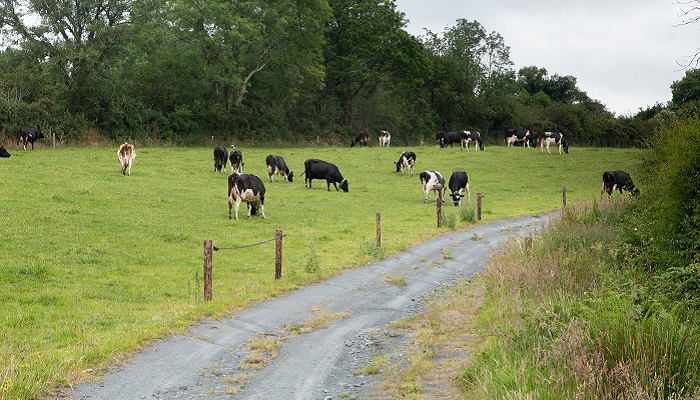
John McCabe, Advisor on the Teagasc/Aurivo Joint Programme, shares some suggestions for diverting surplus cash towards areas that can provide high returns and that help reduce exposure to price and weather shocks.
During a meeting on dairy farm financials recently, one farmer said: ‘Top line as high as you can, bottom line as low as you can’. He was referring to making the output (money in) as high as you can, and costs (money out) as low as you can to make as much profit as possible.
There is a lot of truth in this statement but with one large caveat – output must come from grazed grass and high amounts of pasture grown/utilised across the whole farm. Also, aiming for very high output usually entails much more built-in cost with higher risk and exposure which can bite in a poor year.
Average cost of production has risen over the last 3-4 years with many farms now exposed to milk price drops and relying on good years. This exposure is not entirely coming from the inflation of unit prices. For more information, Pat Gowing and Joe Patton, Teagasc have written an article on profit/cost trends. Read their article ‘Grazed grass drives profitability’ here (PDF).
Many farmers (but not all) experienced low or very low incomes in 2023 and the real cashflow pinch for many came in March/April/May 2024, during a hard spring. An upturn like 2025 is providing dairy farmers with the opportunity to prepare for a downturn like 2023. Here are some suggestions for diverting surplus cash towards areas that can provide high returns and that can help reduce exposure to prices and weather shocks / improve profit:
- Reseeding programme – apart from a few last minute jobs, reseeding is finishing up at this stage – is not too late to get a head start on next year’s reseeding programme though – you could buy in some reasonable quality silage (if you need to) for feeding to dry cows in order to have silage leftover next May, in turn allowing you to close less acres for silage and more for reseeding
- Lime all fields below 6.3 or 6.5 if chasing clover
- Spread Muriate of Potash (0:0:50)
- Spread P on fields that need it if you have an allowance (must be done before 15th September)
- New spur roadways & more gaps off existing roadways
- Tweaking sheds to gain more feed space (if tight) (target is 60cm per cow)
- Slurry storage – availing of the grant is roughly the equivalent of buying concrete at prices experienced before the hyper-inflation period in 2022. It allows you to use nutrients better and it is a win for water quality. An added bonus is that another tank situated in the right place can act as extra feed space if needed.
- Fencing – every 10 cows in the herd require 0.5 acres for 36 hr grazings (100 cows – 5 ac or 2ha)
- Bringing ground that you can walk cows to into the production of grass if is currently not producing anything.
- Map your farm – many farmers find out that your milking platform adjusted for roads/hedges/yards is actually a few acres smaller which can offer savings in paying contractors for the correct number of acres / spreading the correct amount of fertiliser (or simply have a nice map to give to relief milkers/contractors).
- Extra water pipe and troughs on heifer ground – to allow you to split up large fields and improve growth rates of the next generation of milking cows.
Be careful that you don’t spend too much in areas that will drive up the cost of production through repayments, running, maintenance, or by embedding something into your system that may not be very high return (and that you may want to or have to replace if it breaks). Where farms are not in a company and the tax bill is going to be high, it is common for a machine to be bought, however this must be paid for over the long term. It is much easier to buy a new bit of kit than to spend in the areas highlighted above but which is better for your cost of production and your ability to make profit in a tight year?
Of course there are other tactics that could be explored. Some will pay down debt or build up cash for opportunities, but as ever – seek advice first. Some farms may feel the need to invest in labour saving areas like extra units and air gates in parlour, automatic gap releases, underpasses, etc.
In summary, each farm has its own bottlenecks and desires, however investing in high return areas is a good idea and I haven’t come across a farm that will not benefit from investment in grass. Some of the areas highlighted require more planning or indeed planning permission so may not be suitable for this year – however improving grass growth potential can start straight away.
More from Teagasc Daily: Autumn focus on dairy farms
More from Teagasc Daily: Building a bill of quantities
More from Teagasc Daily: Selecting the right investments on dairy farms
More from Teagasc Daily: Dairy advice: Spending wisely in 2025