
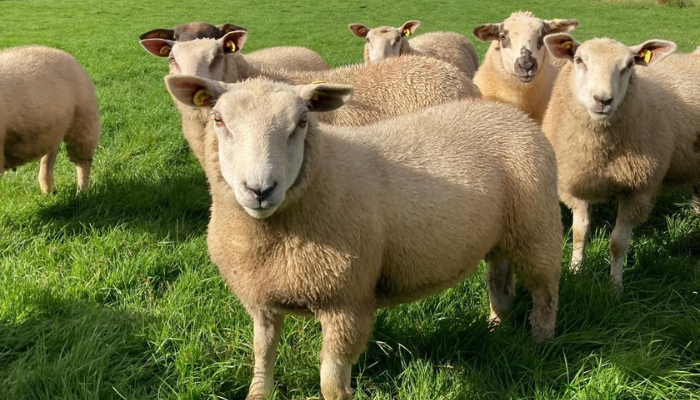
Michael Gottstein, Head of Sheep Knowledge Transfer, discusses how good management is helping the Keane family run a BETTER sheep enterprise alongside cattle and tillage.
Brian and Blathnáid Keane farm 96 hectares in conjunction with Brian’s father John, brother Eoin and young son Seán. The farm is situated in Garr, Davidstown, Enniscorthy, and is a mixed sheep, cattle and tillage enterprise. Approximately five hectares are under commercial forestry, with a further 10 hectares made up of disused quarries, groves, rivers, streams and lanes.
2025 has been a good year for man, beast and crops.
Apart from short periods of reduced grass growth due to lack of moisture, 2025 has been a good year all round. Grass growth has generally been strong and, with the exception of a few dry spells, grass supply was always adequate to meet livestock demand. Silage and hay stocks have been replenished and, provided we get a reasonable back end, there should be more than enough to see all livestock through the winter.
At the time of writing, the most recent grass measurement indicates there are approximately 30 days of grass ahead on the farm, and the rain received in recent weeks is driving growth significantly. That said, it could stop raining now.
Sheep
Approximately 190 Suffolk–Belclare cross ewes will be going to the ram this year. The planned ram turnout date is 10 October, with the hope that most ewes will be served within the first 17 days, resulting in a compact lambing period.
All ewes were body condition scored in August, and thinner ewes were marked for preferential access to good grass. The aim is to have ewes in a Body Condition Score (BCS) of 3.5, with none below a BCS of 3.0. Having ewes in the optimum BCS at mating results in a more compact mating season, higher litter size, lower empty rate and ensures ewes have sufficient body reserves for late pregnancy and early lactation.
Rams for the coming mating season consist of three mature Suffolk rams, one Charollais ram, and two Texel and two Belclare ram lambs purchased at this year’s Sheep Ireland Ram Sale in Kilkenny.
Lambs are currently being grazed in two groups. The finishing group consists of lambs over 40 kg, grazing good-quality grass and receiving 0.8 kg of concentrates per head per day, split between morning and evening feeds. The remaining lambs, i.e. those under 40 kg and ewe lambs retained for breeding, are on good grass without concentrate supplementation. As lambs in this second group reach 40 kg, they are moved into the finishing group. At present, lambs are being drafted for slaughter at approximately 50 kg liveweight.
Tillage
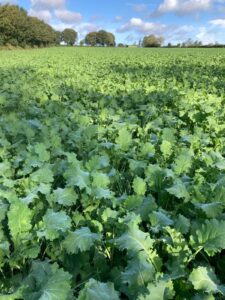
Sixteen acres (6.5 ha) of winter barley were harvested on 10 July, yielding 3 tonnes per acre and six round bales of straw per acre. On 12 July the stubble was sown with interval forage rape.
Fifty acres (20 ha) of spring malting barley were harvested on 6 August, yielding just over 3.1 tonnes per acre and seven round bales of straw per acre. A mix of forage rape and stubble turnip was sown into the stubble once the straw was cleared. The catch crops have done well and should provide plenty of forage for the sheep in the coming months.
Thirteen acres (5.3 ha) of beans have yet to be harvested, and this job will hopefully be completed once the weather dries up. This area will be sown with winter wheat after harvest.
Sucklers
A herd of 23 spring-calving suckler cows is co-grazed with the sheep enterprise. Calves are kept for their first winter and traditionally sold as yearlings the following spring. Last year’s crop was sold in April of this year, averaging over €1,800 per head for the heifers and over €1,900 per head for the bulls.
The coming calf crop will be weaned after housing, and Brian is considering keeping the bulls to finish them as under-16-month bulls in 2026. The heifers will be sold as yearlings, as in previous years.
This article first appeared in the Farming Independent.
More from Teagasc Daily: Ram management during the mating season
More from Teagasc Daily: Drench testing for anthelmintic effectiveness