
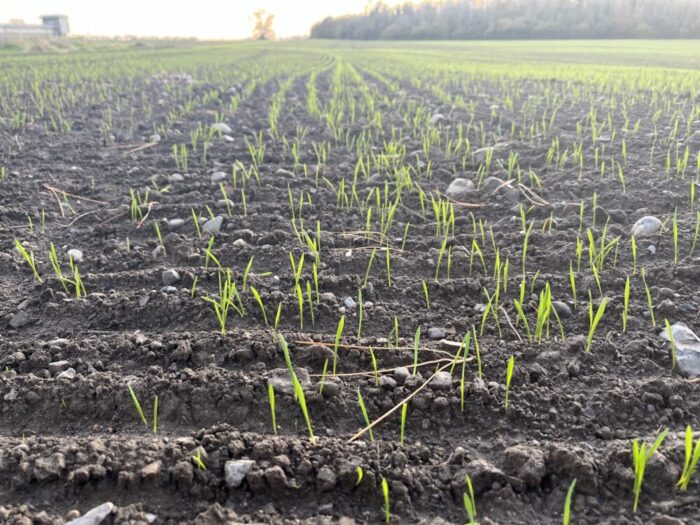
Now is an ideal time to walk crops to assess establishment and the effectiveness of weed control, Teagasc Crops Specialist, Ciaran Collins tells us more.
Following an excellent spell of autumn weather, most winter cereals were drilled in ideal conditions from the end of September through to mid-October. Establishment has generally been excellent across the country. The favourable conditions also led to a notable increase in the use of pre-emergence herbicides this season, a very positive step for effective weed control, particularly in controlling troublesome grass weeds.
Tillage farmers continue to lead the way in the use of precision technology, particularly when it comes to drilling. This has resulted in highly accurate bout widths and perfectly straight tramlines across the country. Drill calibration has become much easier, and the inclusion of the thousand grain weight on seed bags from seed companies now allows farmers to fine tune seeding rates with even greater accuracy.
Measuring plant establishment rate
The final piece of the jigsaw is measuring the number of plants that have established. This provides valuable information for future seed rate calculations. While an establishment rate of 85% is often assumed, it can vary significantly between fields and seasons. By calculating the actual establishment rate, farmers can make more accurate adjustments to drilling rates in the future.
Experienced farmers and agronomists can usually make a good visual assessment, taking actual counts gives more precise information on plant populations. This information not only helps fine tune future seed rates but also serves as a valuable management tool later in the crop’s development.
Measuring plant counts can be done in a few simple ways. One common method is to use a quadrant, for example 0.1 m², and multiply the number of plants counted by 10 to get plants per square metre. Alternatively, a circular pipe with a circumference of 158 cm gives an area of 0.2 m², in this case, multiply your count by 5 to calculate plants per square metre.
Another option is to use a 1 metre stick/tape, count the number of plants in a row over one metre, then count how many rows fit into one metre across the drill width, and multiply the two numbers together to get plants per square metre.
To work out how many seeds were drilled per square metre, you need two key pieces of information
- Seed rate (kg/ha)
- Thousand Grain Weight (TGW in grams)
Use the following formula:
Seeds/m² = (Seed rate (kg/ha) × 1000) ÷ TGW (g)
Example:
If you drilled 180 kg/ha with a TGW of 55 g, then:
- Seeds/m² = (180 × 1000) ÷ 55 = 327 seeds/m²
- This means you planted 327 seeds per square metre.
- Once you’ve measured the actual number of plants established in the field, you can calculate percentage establishment using:
- Establishment (%) = (Plants established/m² ÷ Seeds drilled/m²) × 100
Example:
If 300 plants/m² were established:
Establishment = (300 ÷ 327) × 100 = 92% which is excellent.
In the below video, Teagasc Crops Specialist, Shay Phelan walks us through the steps involved in carrying out a plant count:
Weed control
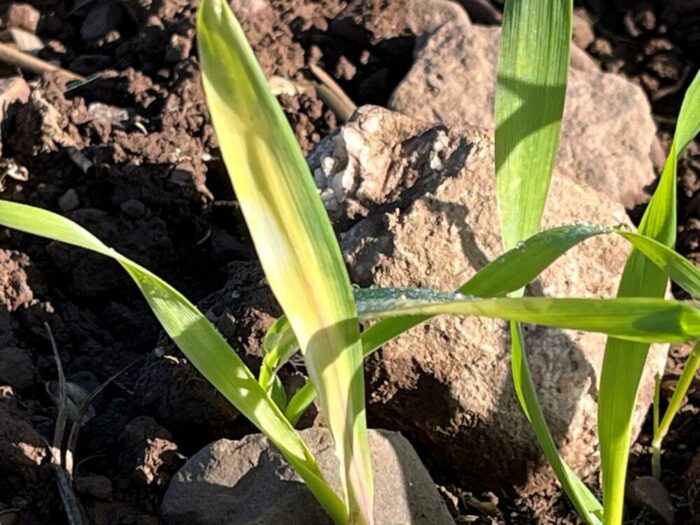
The increase in pre-emergence herbicide use in both winter wheat and winter barley this year has been facilitated by the good weather at drilling. This trend also reflects a growing awareness of the threat posed by grass weeds in these crops. In some fields, slight phytotoxic (herbicide) effects are visible, typically as leaf whitening or bleaching. This is normal and crops usually recover within a few days. The symptoms are most noticeable on overlaps and headlands.
Figure 1: Slight bleaching of leaves after herbicide application. Crops normally grow out of this in a few days.
For crops that have yet to receive a herbicide treatment, it is important to target pre- or early post-emergence applications as soon as possible. Early control of weeds, especially grass weeds, is far more effective when weeds are small. Delaying control until the spring has led to increasing challenges in recent years particularly with brome species and annual meadow grass. Resistance to ALS chemistry has now been detected in some populations of AMG, underlining the need for timely and integrated weed management.
More from Teagasc Daily: Herbicide resistance – protect your yields