
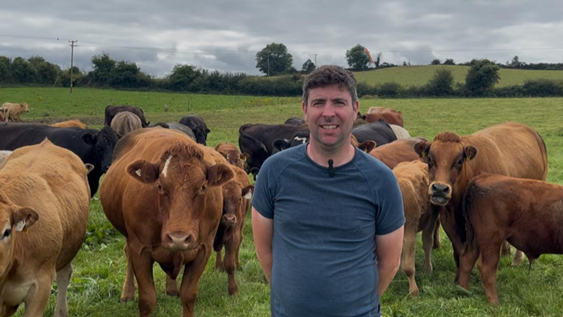
Over the last decade, John Barry has built a system focused on producing quality progeny while maximising the cheapest feedstuff available on his farm – grazed grass.
Giving a flavour of his farming system in Nenagh, Co. Tipperary, where a split spring and autumn calving suckler herd is carried, John Barry joined Catherine Egan on this week’s episode of the Beef Edge podcast in advance of his appearance at the Teagasc National Beef Conference in Athenry on November 18.
Carrying a herd of 90 cows, around 60 cows calve from February to April, with the remaining calving from August to October. A participant in the Teagasc Future Beef Programme, the mixed system suits John from a cashflow perspective.
The preferred cow type on the farm is a Limousin-Simmental cross, although Charolais and Belgian Blue crosses also feature in the herd. Most cows are R+ to U- grade animals with good milk.
As to the breeding policy, John very much focuses from within to breed the next generation of the herd. Selected cows, rated highly on the Replacement Index, are mated to maternal bulls, but a focus still remains on the sire’s beef traits, remembering that 50% of the progeny will be male. Cows not destined for maternal sires are mated to more terminal sires.
Artificial insemination (AI) is used on more than 75% of the herd. John selects sires from Belgian Blue, Charolais, and Limousin breeds, while a Limousin stock bull is used for mop-up. Red Angus sires are also used on Belgian Blue-type heifers. Investments in roadways and the use of a teaser bull greatly aid this process.
“AI has been a game changer here,” John explained, as it enables him to match each cow to an individual sire, thus increasing the likelihood of producing a quality calf.
This approach has allowed John to produce top-quality U and E grade weanlings for both the local and export markets. However, he noted that consistency can be an issue and achieving these grades is as much to do with the cow as the sire.
Using data heavily to influence his breeding decisions – both on the cow and sire side, John has now started to focus on the myostatin profile of the cows within his herd, using the information gathered on the cow’s status to inform sire choice to help prevent unnecessary calving difficulties, but still producing quality.
Away from breeding and since taking over the farm in his own right over a decade ago, John has steadily developed the enterprise with significant investments, including new sheds, upgraded laneways and fencing, and the installation of a new cattle crush to make vaccinating and dosing more efficient. Additionally, John has placed an increased focus on grassland management in recent years, focusing on growing and utilising grass more efficiently to reduce costs.
For full insights on the above, listen to the full episode of the Beef Edge podcast below:
John Barry will take to the stage as part of the fast-approaching Teagasc National Beef Conference, commencing at 5pm, at Raheen Woods Hotel in Athenry, Co. Galway on November 18, where he’ll be speaking about his suckling-to-weanling system, and how he balances shape and quality to meet both home and export market demands.
More from Teagasc Daily: High-value weanlings out west
More from Teagasc Daily: More than just ‘technical’ at the National Beef Conference
More from Teagasc Daily: Adding value, planning for profit and preparing for the future