
Aisling Molloy, Future Beef Programme Advisor, writes on the importance of ventilation in cattle sheds, focusing on the key focus areas to address if issues arise.
Proper ventilation in cattle sheds is vital for animal welfare and productivity. A well-ventilated shed continuously removes heat, moisture, stale air, dust, pathogens and noxious gases (like ammonia, hydrogen sulphide, methane) produced by the animals. At the same time, it replenishes the shed with fresh, drier outside air.
If ventilation is inadequate, there are several negative consequences. Moisture can accumulate, leading to condensation, mould growth, and damp bedding; odours and airborne contaminants build up; animals may suffer dirty hides or wet coats; and, crucially, respiratory diseases may spread more easily among the livestock. These risks not only threaten animal health, but also reduce performance and may shorten the useful life of the building itself.
The principles of good ventilation
Effective ventilation should satisfy two basic principles: fresh air in, stale air out – with air movement even and sufficient throughout the building.
There are main ways of accomplishing this are:
- Stack effect: warm air generated by the animals rises to the roof-high outlet, pulling in cooler fresh air through lower inlets.
- Wind: external wind pushes fresh air through the building, entering via side-wall inlets and exiting through roof or ridge outlets to avoid drafts.
- Combination of stack effect & wind
A well-designed shed that uses natural ventilation tends to be more efficient and less expensive to maintain than mechanically ventilated systems if inlets and outlets are correctly positioned and sized.
Signs of poor ventilation – what to look out for
Signs that a shed’s ventilation is inadequate include:
- Condensation forming on roof or walls
- Mould growth on timber
- Persistent bad odours or stuffy air inside the shed
- Animals with damp hides or soiled coats; damp bedding or manure residue in pens
On the animal-health side, poor ventilation leads to a build-up of dust, ammonia, airborne pathogens and moisture; all of which significantly increase the risk of respiratory disease, compromise welfare, and impair performance. Particularly vulnerable are young animals (for example calves), which require clean, dry, draught free air and are far more susceptible to diseases if ventilation is poor.
Moreover, repeated moisture and high humidity can also damage the shed structure over time: mildew, damp, rotting wood or corroding metal are all possible long-term outcomes of inadequate ventilation.
Key factors affecting airflow
The rate of ventilation depends on:
- Size of inlets and outlets
- Roof pitch and height difference between eaves and ridge
- Height of eaves
- Proximity of other buildings
Ideally, cattle sheds should be positioned at right angles to the prevailing wind. For open-sided sheds, orient the open side away from prevailing winds to prevent draughts. The air inlet should be twice the outlet.
Refer to Department of Agriculture SI101 for full ventilation design guidelines and calculations.
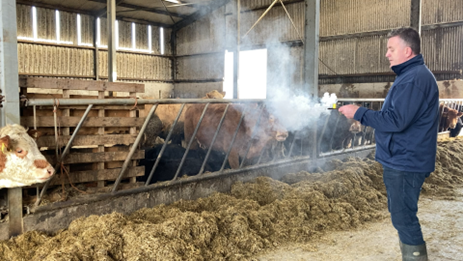
Using a smoke bomb to test shed airflow
A simple and effective way to assess ventilation is by using a smoke bomb test in calm weather:
- If smoke rises and exits through the ridge, ventilation is good.
- If smoke lingers at head height, air is stagnant.
- If smoke blows straight across, it indicates a draught.
Key design features for effective shed ventilation
1). Inlet and outlet sizing and placement
- Inlets should ideally be two times larger in total area than the outlet.
- For calf sheds, for instance, a minimum outlet area of 0.04 m² per calf is recommended.
- Air inlets should run the full length under the eaves on both long walls (or on the lower side of a single-pitch shed), rather than via gable ends, for a more uniform airflow.
2). Roof pitch and ridge outlets
- A roof pitch of at least 12–15°, and ideally up to 22°, helps ensure efficient upward movement of heat and moisture via the stack effect.
- A continuous ridge opening (or ridge outlet) along the apex of the roof is strongly recommended so warm, moist air can escape throughout the building’s length.
3). Building orientation, shape and site location
- Sheds should be positioned at right angles to the prevailing wind, and ideally be stand-alone – not adjacent to other buildings that might block airflow.
- Narrow, long sheds ventilate more evenly; width should typically not exceed about 10–11 m for optimal airflow.
4). Avoiding draughts while ensuring airflow
When designing inlets and outlets, care must be taken to avoid producing strong draughts at animal level. For example:
- Use Yorkshire boarding or vented sheeting for inlets under the eaves, which reduces air speed and limits rain ingress while allowing fresh air in.
- Place the inlets at a height that avoids draught directly on the animals (e.g. > 1.8–2.5 m above floor level for calves).
- If converting older buildings (e.g. hay sheds) to animal housing, be cautious about inlets/outlets as excessive ventilation can cause drafts for calves.
Improving poor ventilation in existing sheds
If you suspect ventilation issues, start with your air inlets – air must come in to go out.
Improving air inlets:
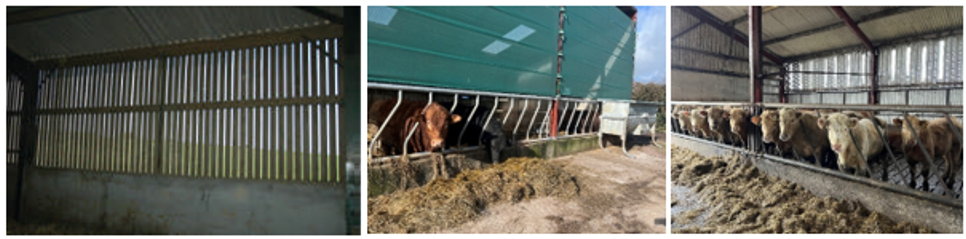
- Angle out side cladding to create a continuous gap under the eaves.
- Remove a few rows of blocks from solid side walls.
- Cut slits or install vented sheeting, Yorkshire boarding, or space boarding.
- Remove trees, hedges, or other obstacles blocking airflow.
Typical porosity levels of inlet materials:
- Vented sheeting – 11%
- Yorkshire boarding – 20%
- Gale breaker – 35%
- Mesh – 50%
Improving air outlets:
- Raise or modify ridge caps to allow air escape.
- Use spaced or raised sheeting to create a “breathing roof.”
- Calculate outlet area by multiplying total opening length by raised height, and compare to DAFM guidelines.
Consult your Teagasc adviser or veterinarian for tailored solutions.
You can read further information on the recommend guidelines for ventilation openings here.
Aisling Molloy is an advisor on the Teagasc Future Beef Programme.
More from Teagasc Daily: The challenge of high beef prices
More from Teagasc Daily: Achieving the perfect balance