
Achieving the perfect balance
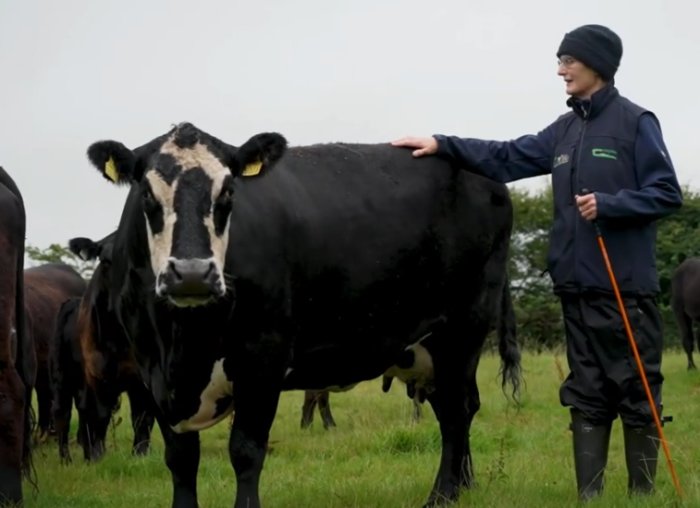
Kay O’Sullivan, farming at Mourneabbey, Mallow, Co. Cork, operates a very efficient organic farm. Fully organic for 15 years and carrying a suckler to beef and sheep flock, Kay’s farming system illustrates how it is possible to be organic and productive, while at the same time looking after the environment.
In recognition of this balanced approach, Kay O’Sullivan won the Organic Production category of the Teagasc FBD Environmental Sustainability Awards. With Irish agriculture journeying towards greenhouse gas emissions reductions, organic production is one measure highlighted in the Teagasc Marginal Abatement Cost Curve (MACC) to aid emissions reductions.
Farmers, sometimes, have misconceptions of organic beef farming, imagining the scales tipping completely away from production and technology adoption to support profitability. Kay, however, demonstrates otherwise. Profit centric technologies, such as the use of AI, nutrient management planning and pasture management and rejuvenation, and the inclusion for herbs and chicory in reseeding mixtures over the last six years, are mainstays of her farming business, while never forgetting the importance of environmental stewardship and biodiversity management.
For more on Kay O’Sullivan’s farming system, watch the below video:
Kay’s farm comprises 50.8 ha of grassland and 11.2 ha of forestry, with a stocking rate of 1.74 LU/ha. Kay farms the land herself and also makes use of hired labour. All buildings on the farm are relatively new and are all straw bedded. There are also excellent handling facilities on the farm.
What’s unique about Kay’s system is the farm that it’s completely closed, with all feed grown on the farm. Animals destined for finishing are grazed on the best multispecies swards (ideally reseeds from the previous year) and finished outdoors while grazing red start and red clover silage. Some offspring are sold live as yearlings. As steers are finished without concentrates at 19.2 months of age, Kay exceeds many conventional suckler’s farm output. This output is being achieved by good breeding management, high lifetime daily gain, good grassland management and having a good herd health plan. This is a highly profitable organic farm.
A participant in the Teagasc Future Beef Programme, working closely with Advisor James Mullane and the team, AI is used for all breeding, typically with pedigree Angus bulls. Cow replacement index is €118 while heifer replacement index is €132. Heifers calve at 22–26 months, calves per cow per year average 0.9, and beef output is 538 kg/ha (309 kg/LU) with a carbon footprint of 9.13 kg CO₂e/kg live weight. Lamb output is 159 kg/ha, with 1.7 lambs per ewe per year – a highly efficient system.
Soil fertility
She has a good loamy soil type on her farm. Soil fertility is managed with lime (90% >6.5 pH), with 25% at Index 3 & 4 for phosphorus and 58% at Index 3 & 4 for potassium. Grassland productivity averages 11.4 t DM/ha. Selected paddocks are reseeded on the farm each year. For the past six years herbs and chicory are also included in the mix.
Environmental stewardship
Kay is very proud of the hedges on the farm. She has excellent management of hedgerows and field margins, using alternative methods to synthetic sprays, fertilisers and rodenticide. Hedges are only lightly trimmed every 3-4 years. Kay also has a lot of bee scrapes for the bees on the farm. Rare breeds of bees have been recorded on the farm, and dung beetle populations are prevalent due to minimal dosing.
Biodiversity and sustainability measures include hedgerow management, grassy buffer zones (600 m total), 5 ha red clover, forestry and 6 ha multi-species. Plans include creating a pond via NPWS, importing cattle slurry to improve soil P, and improving herd Terminal and Replacement Indexes. The farm remains fully self-sufficient, producing all feed on-farm and maintaining organic, environmentally sustainable systems.
She demonstrates a commendable conscientiousness towards wildlife through her willingness to carefully consider next steps in relation to her forestry which will be due for thinning in the next short while. Kay is considering minimising the interruption to wildlife in the plantation through selective thinning.
Find out more about the Teagasc FBD Environmental Sustainability Awards here.
More from Teagasc Daily: The stand-out practices on Don Somers’ tillage farm
More from Teagasc Daily: Profit, production and performance – the Dollards’ dairy beef system
More from Teagasc Daily: Why this award-winning tillage farmer is making space for nature
More from Teagasc Daily: The out block that started it all