
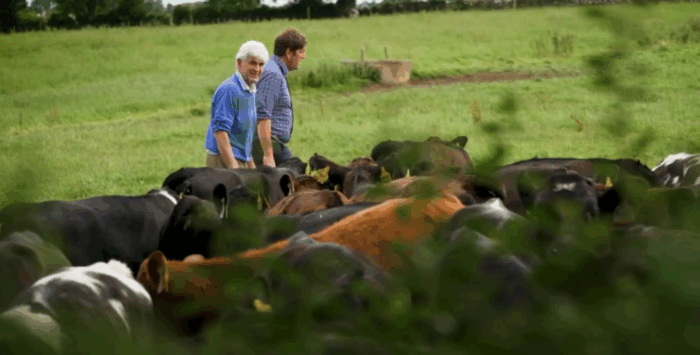
Farming 125ha at Kilmurry, Tynagh, Loughrea, Co. Galway, Conor O’Brien milks a herd of 144 high EBI Holstein cows and carries a dairy-beef enterprise in partnership with his father Vincent and mother Mary.
Recently recognised as the ‘Improving Soil Health Category Winner’ of the Teagasc FBD Environmental Sustainability Awards, Conor’s journey into farming was greatly aided by the trust bestowed in him by his parents.
Elaborating on this, Conor explained: “My father gave me the opportunity at a youngish enough age to make my own decisions. He transferred one of the outblocks to me for my suckler enterprise that was more a part-time hobby at the time.
“It would have been easier for him to keep it himself, but he took the chance on me. If he and my mother didn’t give me the chance to learn and develop together with them, we wouldn’t be where we are today,” Conor explained.
From this beginning, Conor has seen the family’s farm grow, all the while focused on being technical efficient, profitable and environmentally sustainable.
Supplying Arrabawn Tipperary Co-op and guided by Signpost Programme Advisor Liam Quinn and local Teagasc advisor, Tom Murphy, cows on the farm are on track to produce 470kg of milk solids each year, carried at a stocking rate of 2.4LU/ha.
Grass utilisation reached 8.7 tonnes DM/ha in 2024, while herd genetics continue to improve, with an EBI of €251 and Dairy Beef Index (DBI) of €74, supporting profitability and a carbon footprint of 0.9 kg CO₂eq per kg FPCM.
Nutrient management is central. In 2024, 132 kg N/ha was applied, 66% as protected urea. All slurry is spread with low-emission slurry spreading (LESS), and nutrient management planning informs applications. Soil fertility has improved as a result, 34% of soils are now optimum, up from 26%, while AgNav records a nitrogen surplus of 125kg N/ha.
Conor engages actively in sustainability programmes. As a Waters EIP participant, he has installed fencing, solar pumps, rainwater management and planted 135 metres of hedgerow. As a Signpost Demonstration Farmer, he increased protected urea use to 66%, boosted clover to 37% of the milking platform, and grows 14 acres of red clover silage.
Future plans include a new slatted shed, solar panels, and continued genetic progress, highlighted by three bulls sold to AI stations with EBIs of €343 to €358.
For more on Conor O’Brien’s farming journey, watch the below video:
Improving soil health
There has been an emphasis on soil health on this farm for many years and the main actions have been:
- While maintaining efficient dairy production, the O’Brien family have prioritised the protection of soil biodiversity by recognising and utilising the natural potential of the low-input land and extensively grazed ground. This approach shows that productivity and sustainability can go hand in hand when soil health is placed at the centre of farm management.
- 34% of this farm has good overall soil fertility i.e. pH 6.2+, P Index 3+ & K Index 3+. Over 90% of the farm is optimum for soil pH, 56% is Index 3 & 4 for P and 62% is Index 3 & 4 for K. The grazing block around the parlour is very good but the outside blocks are pulling down the average.
- Conor is very conscious of soil structure and minimising compaction on the farm. He avoids heavy machinery and livestock on the land in difficult conditions.
- Conor’s farm includes three contrasting types of grassland: conventionally managed grassland, a low-input grassland and an extensively grazed pasture. Research has shown that more diverse swards – those with a mix of different plant species – tend to support more diverse bacterial and fungal communities in the soil. This microbial diversity is important for healthy nutrient cycling, soil structure and overall resilience of the farming system.
- Conor was recently involved in a soil health project with Johnstown Castle, led by PhD student Karla Burke, and the evidence from this project is that each of Conor’s fields showed above-average bacterial and fungal abundance compared to 72 grassland sites sampled across Ireland last year. High microbial abundance indicates an active, living soil system that works with the farmer to grow grass efficiently and sustainably.
Find out more about the Teagasc FBD Environmental Sustainability Awards here.
More from Teagasc Daily: The stand-out practices on Don Somers’ tillage farm
More from Teagasc Daily: Profit, production and performance – the Dollards’ dairy beef system
More from Teagasc Daily: Why this award-winning tillage farmer is making space for nature