
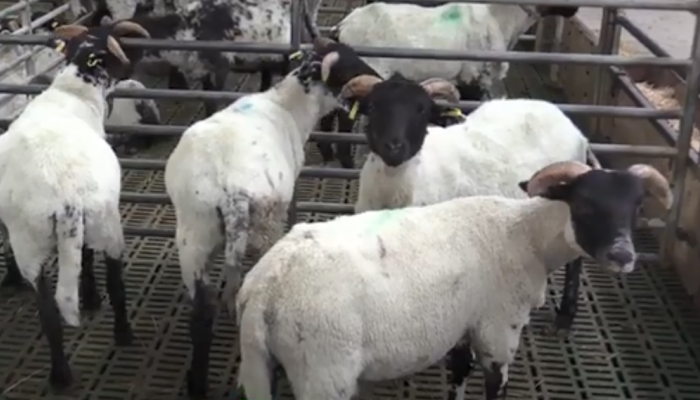
From housing to meal feeding and health, Noel Claffey from Teagasc Athenry shares 5 tips to achieve better performance when finishing lambs indoors.
Indoor finishing of lambs over the winter months is often needed as the grazing season comes to an end and our attention turns to preparing for next year’s crop of lambs. The feeding of lambs indoors can aid in achieving consistent growth rates and producing uniform carcasses. Factors that are within the farmer’s control that can affect the system’s profitability and efficiency are outlined below.
1). Housing
Management at housing is critical to providing an environment in which the animal can perform efficiently. Sheds should be well ventilated, bird proof, and bedding should be clean, dry and topped up regularly. Where slats are available, these will help reduce labour and aid with the control of lameness issues.
It is important to pen lambs according to live weight. This will help to facilitate an all-in all-out strategy and allow for cleaning and disinfection of housing between finishing lots. Mixing of ewe and ram lambs within pens should be avoided. Each lamb should be allocated at least 0.5m² (25kg lambs) to 0.8m² (45-50 kg lambs) of floor space per lamb.
2). Introduction of lambs to meal feeding
If finishing lambs on an all concentrate diet, initially offer the specially formulated diet at 300 g/lamb/day and increase by 200 g/lamb/day every 3 days until full feeding, and continue to offer a small quality of roughage (hay, silage, or straw). Growing lambs (less than 35kg) have an additional requirement for protein and should receive a diet containing 13-14% crude protein. Lambs that are well-grown and in the finishing phase, will not benefit from dietary crude protein levels above 12%. It’s strongly recommended to include ammonium chloride at 0.5% or 5 kg per tonne to prevent urinary calculi in male lambs. Ensure that there is adequate trough space for lambs – especially during the time that they are being built up to ad-lib concentrates; 30cm of trough space is needed per lamb depending on size of lambs.
3). Water
Water needs to available at all times. Lambs will consume between 4 and 8 litres of water daily depending on diet dry matter levels and intake. All water pipes should be protected from frost to prevent freezing. All drinking points should be checked daily for cleanliness and supply.
4). Health
A flock health plan in conjunction with your vet is an essential tool. Purchased lambs should, on arrival on the farm, follow a strict biosecurity protocol including farm specific treatment for worms and liver fluke, foot bathed and housed for 48 hours. Ensure lambs are up to date on vaccinations and booster shots for clostridial diseases and Pasteurella pneumonia. Lameness can be a significant issue in many systems, particularly if slatted housing is not available for finishing lambs. When animals are housed, lameness spreads quickly as sheep are in close proximity to each other. Regular foot bathing is advisable.
5). Drafting
Drafting weight will depend on market specification, particularly the maximum carcass weight paid. Kill out rate (KO%) will vary depending on breed, gender, diet and degree of finish. For lambs on an all concentrate diet, KO % will increase by approx. 5 percentage points by comparison to un-supplemented lambs. Ram lambs reach heavier carcass weights before adequate fat cover is achieved. Regular weighing is advised to ensure that lambs are drafted in the most efficient manner.
For further insights on indoor lambing finishing, listen to an episode of the OviCast podcast below where host Ciaran Lynch was joined by Michael Gottstein to discuss the essential elements of successfully finishing lambs:
More from Teagasc Daily: Why ewe body condition score matters