
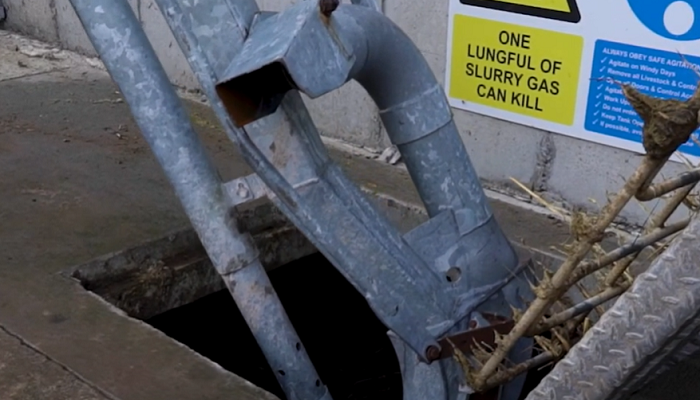
With slurry season commencing in many parts of the country this week, it is once again important to think about the dangers associated with handling slurry and to plan this work with safety in mind. John McNamara and Francis Bligh, Teagasc Health and Safety Specialists, advise caution with safety tips.
Watch the Managing farm safety and health video on slurry spreading below:
Wind speed
While we will all think deeply about weather and ground conditions before we spread slurry, many of us may not think about the importance of having good air movement. Air movement helps to keep fresh air in and around the shed which helps to dissipate poisonous gas. A wind speed of at least Beaufort Scale 2, where wind ‘is felt on exposed skin and leaves rustle’, and has a speed of 7 Km per hour or higher is required. Slurry agitation on a clam day has high risk. Agitation in an area where air movement is restricted is also high risk.
Take animals out of sheds before commencing slurry agitation
Never agitate slurry when animals are in the shed. Before you or a contractor commences slurry agitation, take time to move animals to a safe location outside the shed. Do not give in to the temptation of leaving cattle in the shed.
- Move animals to another shed or cattle handling unit during agitation,
- Set up temporary fencing to hold animals in an outside area during agitation.
- Up to 60% Department of Agriculture, Food and the Marine TAMS 3 grant funding is available for animal handling facilities. Make a plan now to put facilities in place if you need them. It may take a year from TAMS 3 application, and the final gate is erected.
Slurry drowning
When we think about slurry, we usually think about gas, but it is important to remember drowning is also a frequent occurrence with slurry. Working around an agitator or slurry tanker is demanding and it is possible to lose concentration and ‘step-back’ into a slurry tank if precautions to prevent access to tanks are not in place.
Key safety tips
- Safety grids and barriers must be in place to prevent falling into slurry
- Maintain high vigilance when placing slurry agitators into position.
- Agitation should fully cover the agitation point.
- Use access holes for slurry pipes
- Keep slurry tanks and pits securely covered or fenced.
Watch a video from the HSA below on slurry tank near drowning:
Slurry gassing
Slurry produces a range of gases based on the nature of the fermentation which occurs.
Facts on slurry gas
- Poisoning occurs ‘above ground’ due to the release of Hydrogen Sulphide (H2S).
- H2S can be detected by smelling at 0.1 ppm
- At 150 ppm the olfactory nerve which detects smell in the nose is desensitised and then H2S cannot be detected by smell
- The gas produces adverse health effects at increasing concentration and is rapidly fatal above 700ppm.
- Teagasc measurements have indicated that fatal levels of gas can occur in the period after agitation commences.
Watch a video from the HAS below on the ‘Dangers of Slurry Gas – Just One Breath Will Kill’:
Key safety tips
- Always wait for a breezy day
- Open all doors and vents
- Remove all animals from the shed
- Ensure persons, particularly children or older persons, do not enter during/after agitation
- At least two people should be present at all times
- Make sure machinery is in good repair and guards are in place
- Make sure tank access points are guarded
- Stay away from the agitation point for at least the first 30 minutes after agitation commences
- Slurry gas concentration can rise each time you move the agitation to a new agitation point
- Remember poisoning can occur either outdoors or indoors in calm conditions
BEWARE: Slurry gas can travel into linked tanks or buildings that are connected by drainage pipes or channels. This means you or others in the yard may be unaware that milking parlours, store sheds or even workshops could have high concentrations of potentially fatal gas present.
Indoor agitation is very dangerous
Indoor agitation has high risk. It is important to consider methods of avoid the need to use indoor agitation points.
Consider:
- Department of Agriculture TAMS 3 60% grant aid to extend tanks to allow outdoor agitation.
- Tams 3 Grants are also available to help with the financial cost of installing a slurry circulation pipe so that more areas of the tank can be agitated from outside agitation pipe or installing a slurry aeration system that uses air bubbles to churn the slurry and avoid the development of pockets of highly concentrated slurry gasses.
Pumping slurry
Pumping slurry using umbilical systems is becoming increasingly common due to speed of application and reducing soil compaction, but it also has risk due to the presence of slurry under high pressure and also the potential of unexpected movement of a heavy slurry pipe.
- Slurry pipes must be in good condition
- Be vigilant and plan pipe runs to avoid high risk areas and sharp edges
- Make sure pressure is released before disconnecting pipes
- Only experienced operators should manage umbilical pipe slurry application
Slurry gas meters
The HSA /Teagasc guidance does not recommend the use of gas detection systems by farmers. These meters typically are set to alarm at 10ppm which is the Occupational Exposure Limit Value (OELV) for a 15 minute exposure under the Code of Practice for the Safety, Health and Welfare (Chemical Agents) Regulations. This is considered to be the maximum exposure that will not cause a health issue.
Beware
- Fatality can occur in an instant – H2S emissions from slurry (over 1000ppm).
- Gas detection systems can only be used safely along with full breathing apparatus and should not be used as a substitute for the safety guidelines outlined in the HSA Teagasc Slurry handling guidance.
Never enter a tank
Entering a slurry tank or any tank with organic material in it can be lethal and is not advised. Doing this work is covered by Confined Space entry regulations and a Code of Practice giving guidance on these regulations is available on the HSA website.
Remember
- Gas such as H2S, methane, carbon dioxide or ammonia may be present
- These gasses also deplete oxygen levels which can cause asphyxiation and instant death
- Rescue is not possible. Multiple fatalities have occurred when this has been attempted
- Always hire persons or firms with the requisite training and equipment if the need to enter a tank arises
Further Information on slurry safety
Further Information on safety with slurry is available from the H.S.A. website and Teagasc Farm Health & Safety
More from Teagasc Daily: Advice when spreading slurry and protecting our waters