
Research for change
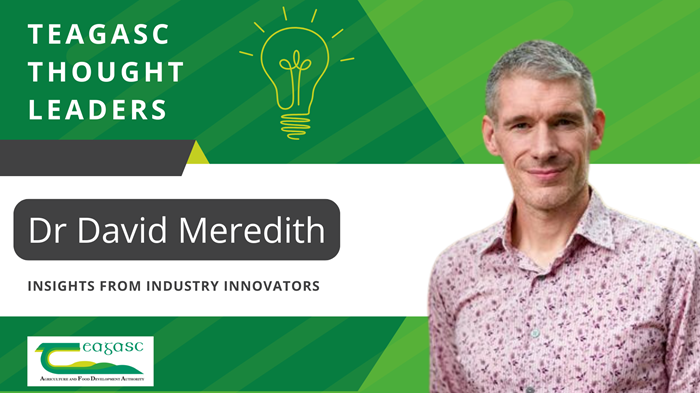
As part of the Thought Leaders series, Catriona Boyle spoke with Dr David Meredith about his team’s research, which explores how the interaction how the interaction between people and their environment shapes farming practices, farmer decision-making, and the development of the bioeconomy.
Dr David Meredith, Head of the Department of AgriFood Business and Spatial Analysis at Teagasc leads a multidisciplinary team exploring how the interaction between people and their environment shapes farming practices, farmer decision-making, and the development of the bioeconomy.
His team’s work focuses on two fundamental areas: understanding what influences farmers’ adoption of new knowledge or technology and producing research to inform evidence-based agricultural policy. David is also the Principal Investigator and co-ordinator for SafeHabitus, a €4.8 million Horizon Europe project examining occupational safety and health across European agriculture.
What drives your research approach?
Whether we are looking at farmer safety, adoption of new knowledge or practices, or policy implementation, the goal is the same: bridging the gap between scientific evidence and what can work in practice.
In my view, if we are to be successful in bridging this gap we need input from a range of research perspectives, combined with the knowledge and experience of farmers, farm advisors, policy stakeholders, and retailers/consumers to understand the social, economic, ecological, policy and governance contexts that surround farmers.
This understanding is critical to the development of meaningful solutions which must consider not only the end-user’s needs, but also the types of resources they require if they are to take action.
What are your research priorities for rural development and the bioeconomy over the next year?
My department’s long-term priorities centre on understanding how farmers can transition toward more resilient and sustainable diversified farming systems that underpin the development of the bioeconomy. To this end, we are focused on examining the behavioural and contextual factors that influence adoption of farm safety practices or pro-environmental practices, such as enhancing water quality, climate-smart practices, and circular economy approaches.
You can find out more in the video below:
What factors are most likely to shape farmer behaviour and practices in the near future?
We see a number of key drivers of change including climate, markets, and demography. Climate change is fundamentally altering the risk landscape for farmers, creating unprecedented uncertainty around production systems. Generational renewal remains critical as aging farmer populations, coupled with challenges in farm succession, affect decisions to invest in farm infrastructure and innovation capacity. We are also seeing changing consumer expectations around sustainability, creating market pressures.
These dynamics do not operate in isolation; they interact with farm-level factors such as soils, climate, hydrology, access to finance, labour, life-stage of the farmer and farm household and, particularly, successor(s).
In addition, policy is evolving in the face of these drivers, with the EU Common Agricultural Policy (CAP) proposals signalling a shift toward enhancing competitiveness and food security within an unstable geopolitical environment; while continuing to support initiatives focused on supporting the social, economic and environmental sustainability of farming and food production.
Which policy developments, at national or EU level, have the most significant implications for your team’s research agenda?
The EU’s CAP 2028-2034 proposals represent a huge change in the policy and governance framework shaping farming and food production, with direct implications for human-environment interaction in agricultural systems. This is going to drive demand for more research to inform policy and practice, particularly as the CAP takes greater consideration of the social sustainability of farming.
Tell me about your work on the SafeHabitus project?
I’m currently Principal Investigator and Coordinator for SafeHabitus, a €4.8 million Horizon Europe project focused on occupational safety and health across European agriculture. It’s the largest EU farm safety project ever funded.
Our goal is to improve working conditions by reducing injuries and fatalities, ultimately enhancing the social sustainability of Irish and EU food systems. We’re developing policy recommendations at both national and EU levels, while supporting innovative bottom-up initiatives and exploring how corporate social responsibility can play a role in farm businesses.
What excites me most is the collaborative nature of this work. Farmers and farm advisors are central to identifying and sharing good practices within their communities. This knowledge is translated into policy recommendations that are informing the development of EU initiatives, some of which are included in the current CAP post-2027 proposals.
To receive notifications about articles from our Teagasc Thought Leaders series please subscribe to our LinkedIn newsletter.
More from Teagasc Daily: Advancing environmental science
More from Teagasc Daily: Accelerating bio-based innovation
More from Teagasc Daily: Unlocking the full potential of grassland
More from Teagasc Daily: Technology transforming food value