
Explaining Climate Change Mitigation Uptake and Behaviour Change Dynamics: Farmers’ Attitudes, Motivations, and Barriers
Project Summary
Agriculture is the largest contributor to Ireland’s greenhouse gas (GHG) emissions. The sector is set to reduce emissions by 25% relative to 2018 levels by 2030, requiring farmers to adopt a variety of mitigation measures.
The adoption of these measures is influenced not only by technical/technological and financial supports but also by social, cultural, and psychosocial factors. Farmers’ motivations, including attitudes, perceptions, norms, and beliefs as well as the barriers they face within their social farming context, are crucial to understand when designing policies, initiatives, and advisory programmes that support farm-level adoption of gaseous mitigation measures.
The EMIT-CHANGE project, led by Teagasc in collaboration with University College Cork (UCC) and funded by the Department of Agriculture, Food and the Marine (DAFM), applies a farmer-centric, bottom-up mixed-methods approach to explore the key determinants of farm-level adoption and provide evidence-based recommendations to improve climate mitigation uptake.
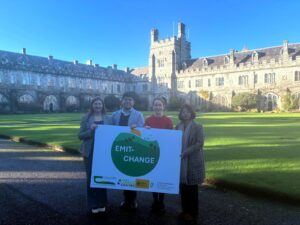
The EMIT-CHANGE project team. L-R: Dr Nicola Watson (Teagasc), Dr Mohammad Mohammadrezaei (Project PI, Teagasc), Dr Claire O’Neill (UCC), Dr Priya Chetri (UCC).
Why EMIT-CHANGE Matters
Understanding the drivers, barriers, and behavioural dynamics of climate mitigation adoption is key to achieving Ireland’s agricultural emissions reduction targets. EMIT-CHANGE provides policymakers, advisors, and the farming community with practical, evidence-based guidance to support effective farm-level climate action.
Project Goals
The EMIT-CHANGE project applies a multi-actor, systems-based approach to understand how Irish farmers adopt climate mitigation measures. Its main objectives are to:
- Map Decision-Making Pathways
Identify which mitigation measures are perceived as ‘effortless’ versus ‘effortful’, and how attitudes, values, norms, and perceptions influence these choices. - Assess Adoption Levels and Behaviour Change Stages
Examine which measures farmers are leading and which are lagging, and how adoption of different practices is interconnected. - Identify Key Drivers and Barriers
Understand how decision-making is initiated, consolidated, and sustained, and how motivations, perceptions, and social norms shape behaviour across different stages of adoption. - Analyse Farmer Typologies
Categorise farmers into adopters, ongoing adopters, considerers, willing non-adopters, and unwilling/non-adopters, and determine which motivations, barriers, influential bodies, and knowledge-exchange strategies should be targeted for each group.
Research Approach
EMIT-CHANGE combines multiple research methods, including:
- Systematic literature reviews of scientific and grey literature
- Multi-actor survey (n=83)
- In-depth interviews with 35 farmers
- Focus groups with 3 groups of farm advisors
- A nationally representative survey of 300–400 livestock and tillage farmers, guided by socio-cognitive behavioural frameworks
This mixed-methods, bottom-up approach ensures the findings reflect farmers’ lived experiences and perspectives, while integrating insights from advisors, policymakers, and industry stakeholders.
Project Partners
Teagasc (led by Dr Mohammad Mohammadrezaei), University College Cork and the Department of Agriculture, Food and the Marine

What’s New
Multi-Actor Engagement & Knowledge Exchange
A core strength of EMIT-CHANGE is its multi-actor, collaborative methodology. Researchers, farmers, advisors, policymakers, and industry representatives are engaged throughout the project to ensure the research addresses real-world challenges.
Project lead Dr Mohammad Mohammadrezaei explains:
“Through this project, we aim to better understand not only the technical or financial trade-offs involved in adopting climate mitigation measures, but also the social, cultural and environmental factors that shape farmers’ decisions. By engaging actors from policy, industry, advisory services and farming communities, we can identify which practices are perceived as most challenging and where additional knowledge or policy support is needed.”
He added:
“Our goal is to move beyond simply identifying barriers and motivations. By applying a systems-based policy-oriented behavioural approach, we want to understand how policy and knowledge-exchange mechanisms can more effectively address the challenges associated with the climate actions considered most difficult to implement.”
To translate research into actionable solutions, the project will develop an evidence-based interventions map to inform policies, initiatives, and knowledge exchange strategies. A multi-stakeholder workshop in March 2027 will bring together farmers, advisors, policymakers, and researchers to review findings and discuss practical interventions.