
Leveraging all farm Nitrogen (N) sources
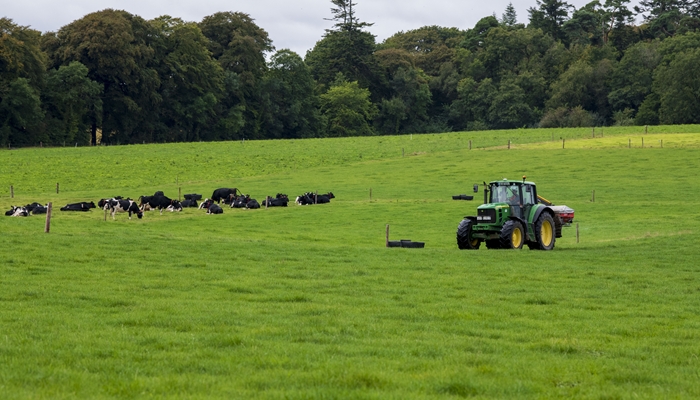
With fertiliser prices elevated, Mark Plunkett, Training and Development Specialist on the Signpost Programme, shares five practical steps that can be considered to reduce impacts of high fertiliser prices both in the short and longer term.
Over the last month the war in the Middle East has pushed up global energy costs, shipping and disrupted the normal input supply chains.
As a direct result, fertiliser N (Urea and CAN) prices have increased by up to 50%. In addition, weather conditions over the last number of months have been very challenging on farm resulting in poor grazing conditions to delayed slurry applications.
In the last fertiliser crisis back in 2022/2023, fertiliser N usage reduced significantly due to high prices. Alternative strategies were implemented on farms by combining several practices to control costs while meeting major nutrient (N, P & K) requirements on grassland and tillage farms.
Here are five practical steps that can be considered to reduce impacts of high fertiliser prices both in the short and longer term.
1). Optimise organic fertiliser use
Target cattle slurry back to silage fields, as it is the ideal fertiliser for grass/maize silage. For example, 33m³/ha (3,000 gals/ac) can supply ~33kgN/ha, thus reducing crop chemical fertiliser N requirements by 30%. Apply with LESS technology to maximise N recovery, under suitable conditions (cool, calm and damp days) at time of application. The typical N-P-K values for 1,000 gallons of cattle slurry is equivalent to one 50kg bag of 9-5-32 available nutrients. Consider pig slurry where available locally as it has a super nutrient N-P-K profile where 1,000 gallons contains a N-P-K of 19-7-20.
2). Apply recommended lime
One of the major lessons learned from the last fertiliser crisis was that we spread more lime. There is a large lime requirement nationally, especially on drystock farms. Correcting soil pH brings many benefits from releasing up to 70kgN/ha/year (56 units N/ac/year) to improving the availability of soil P and increasing grass production by up to 20%. Correcting soil pH from pH 5.5 to 6.5 can increase soil P fertility by one full P Index (3mg/l). This is the most cost-effective way to build soil P fertility on acidic soils. Lime is a relatively small cost and will bring short- and longer-term benefits at least cost.
3). Balanced fertiliser supply
Aim to apply a balanced supply of both major nutrients (N, P and K) and secondary nutrients (Ca, Mg and S). For example, in grazed swards a fertiliser such as 18-6-12+S is a very well-balanced fertiliser to supply sufficient levels of nutrients to drive grass growth. In addition, it will provide a good quality grass for beef or milk production systems. Don’t forget sulphur (S) as it is proving to be an essential nutrient to drive grass yields through better N use efficiency while reducing N leaching losses in both grazed and silage swards by 22 to 50kgN/ha/year, respectively. In 2026, aim to apply at least a maintenance (Index 3) P & K dressing to ensure sufficient grass and crop production.
4). The four Rs and nutrient applications
- Select the Right product – research has shown that protected urea is a more efficient N source compared to ordinary urea and N rates can be cut by up to 12% where protected urea is applied.
- Right rate – tailor N applications based on sward quality and yield potential. For example, newly reseeded swards can utilise 25% more N compared to old permanent grassland swards.
- Right Time – adjust fertiliser N rates based on soil and weather conditions to ensure that N is taken up and utilised as efficiently as possible. Avoid spreading fertiliser N where heavy rainfall events are forecasted and aim for 48hrs of dry weather after applications to reduce N losses.
- Right Place – set up and calibrate the fertiliser spreader to ensure nutrients are applied accurately and evenly.
5). Check / Incorporate White / Red Clover / Multispecies
White clover, where present in grazing swards, has an enormous capacity to fix N and reduce our dependence on chemical N fertilisers. Nitrogen rates can be reduced by up to 100kg N/ha where paddocks contain 20 to 25% white clover.
April is a good month to check clover levels in paddocks and adjust/reduce fertiliser N rates. When reseeding, select suitable clover varieties and aim for good soil fertility (pH 6.5 to 6.8 and P and K Index 3). Red clover offers major fertiliser N savings for silage swards with cattle slurry the main source of major nutrients (P & K) during the growing season.
Mark Plunkett is the Signpost Programme Training & Development Specialist. For more from the Teagasc Signpost Programme, visit here.
More from Teagasc Daily: 10 tips: Dealing with higher fertiliser prices on grassland farms
More from Teagasc Daily: Reducing N inputs with multi species swards