
Our Organisation Search Quick Links
Toggle: Topics

Soil Functions and Ecosystem Services

Soils are living, dynamic systems that perform a wide range of essential functions that support agriculture, the environment, and society. They provide the foundation for crop production by supplying water, air, nutrients, and physical support for root growth, while also acting as habitats for a vast diversity of soil organisms. Healthy soils regulate water movement, cycle nutrients, store carbon, and help protect water quality, underpinning many of the ecosystem services upon which sustainable agriculture depends.
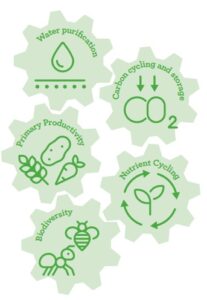
Illustration of five interlocking gears representing key soil functions and ecosystem services. Each gear contains a green icon and label: “Water purification” with a water droplet, “Carbon cycling and storage” with CO₂ symbols and arrows, “Primary productivity” with crops and vegetables, “Nutrient cycling” with a sprouting plant and circular arrows, and “Biodiversity” with soil organisms and an insect. The connected gears highlight how soil functions are interdependent and support agriculture and environmental health.

This diagram illustrates some of the key soil functions and ecosystem services provided by healthy soils. The interlocking gears emphasise that these functions are connected and depend on one another to keep agricultural and environmental systems working effectively.

  • Water purification – Soils act as natural filters by trapping sediments, breaking down contaminants, and regulating the movement of water through the soil profile. Healthy soils improve infiltration and reduce runoff, helping to protect rivers and groundwater quality.
  • Carbon cycling and storage – Soils play a major role in the carbon cycle by storing large amounts of organic carbon in soil organic matter. Well-managed soils can sequester carbon, helping to reduce atmospheric CO₂ levels and improve climate resilience.
  • Primary productivity – Soil provides the physical support, nutrients, water, and biological environment required for plant growth. Productive soils underpin crop yields, grass production, and overall agricultural output.
  • Nutrient cycling – Soil organisms break down plant residues and organic matter, releasing nutrients such as nitrogen, phosphorus, and sulphur into forms available for plant uptake. Efficient nutrient cycling supports fertility and reduces reliance on external inputs.
  • Biodiversity – Soils are home to a vast range of organisms including earthworms, fungi, bacteria, and insects. This biodiversity supports soil structure, nutrient cycling, organic matter decomposition, and overall soil health.

Together, these functions highlight that soil is not simply a growing medium, but a living ecosystem that supports food production, environmental quality, and climate regulation.
The relevance of a healthy soil

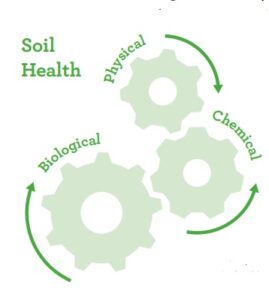
The ability of soils to perform these functions depends on their biological, chemical, and physical condition. Checking these aspects of soil health can help identify constraints, guide management decisions, and improve the long-term productivity and resilience of farming systems. Much like regular health checks for machinery or livestock, soil assessment provides valuable insight into how efficiently soils are functioning and where improvements may be needed.

Poor soil structure can hinder crop establishment, restrict rooting, reduce water infiltration and storage, increase the risk of compaction and erosion, and negatively affect nutrient cycling and crop yield. Chemical assessment, including soil fertility and pH analysis, helps optimise nutrient use efficiency, reducing input costs while minimising nutrient losses to the environment. Biological health is equally important, as healthy soils are living soils. Active soil biology drives organic matter breakdown, nutrient cycling, and overall soil function, supporting productive crops and resilient soil systems.

Maintaining healthy soils therefore supports not only crop productivity, but also wider ecosystem services such as carbon sequestration, biodiversity, water purification, and climate resilience.

Diagram illustrating the three interconnected components of soil health using three linked gears. The gears are labelled “Physical,” “Chemical,” and “Biological,” with curved arrows showing their interaction and continuous relationship. The title “Soil Health” appears on the left. The image emphasises that soil health depends on the balance and interaction of physical structure, chemical properties, and biological activity.