
Newford reproductive performance
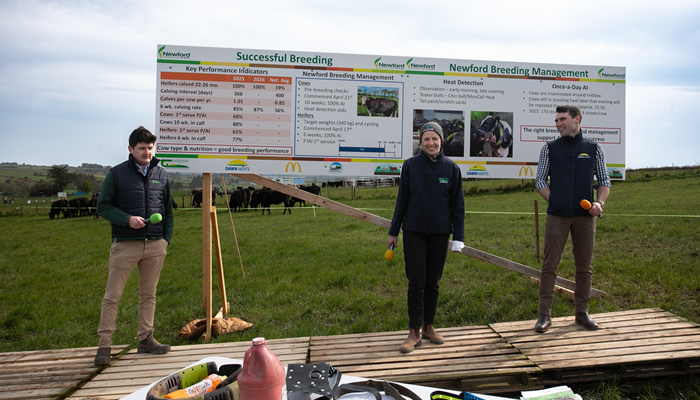
As part of the recent Newford Demonstration Farm Open Day, Emily Sitko, Nicky Byrne and Stephen Frend discussed the measures being outlines to improve the herd’s reproductive performance.
Reproductive performance in suckler herds is a major driver of both farm productivity and profitability. Careful management across several key areas, such as genetics, herd health, nutrition, and breeding practices, is essential to achieve high performance.
To optimise reproductive efficiency, farmers should monitor a range of key performance indicators (KPIs), including:
- Age at first calving
- Conception rate to first service
- Calving interval
- Calves per cow per year
- Six-week calving rate
- Replacement rate
At Newford, all heifers calve at 24 months of age without any negative impact on lifetime cow performance or mature cow bodyweight. Calving heifers at 24 months is critical for farm profitability, as it reduces rearing costs, accelerates the return on investment in replacement heifers, increases the lifetime productivity of cows and ensures that non-productive animal groups are not hanging around the system.
The breed of the replacement heifer plays an important role in achieving this target. Beef × dairy animals, such as Angus and Hereford crosses, typically reach puberty up to six weeks earlier than larger continental breeds from suckler systems. Heifers should reach approximately 65% of their mature body weight by the start of the breeding season.
At Newford, where mature cows average 580 kg, this equates to a target breeding weight of approximately 370-380 kg. Achieving this requires high early-life and first-winter growth performance to ensure heifers reach their target breeding weight and calve successfully at 24 months of age.
Heifers are bred to easy-calving bulls with high calving reliability figures to ensure they calve easily and return to oestrus without delay.
At calving, the body condition score (BCS) of Newford cows was 3.0-3.25 (on a 1–5 scale), which is recommended for suckler cows. Achieving this requires careful management during the dry period to increase or reduce BCS as necessary. Maintaining cows within this range helps minimise calving difficulty, particularly in over-conditioned cows, while ensuring sufficient energy reserves for early lactation and the resumption of oestrus. Cows in the correct BCS are more likely to return to oestrus within approximately 50–60 days post-calving, which is essential for maintaining high submission rates and the farm’s compact calving pattern.
The breeding season
The Newford cow herd operates a 10-week breeding season, beginning on April 21st, and uses 100% artificial insemination (AI). In 2025, the herd achieved a six-week calving rate of 85%, a calving interval of 366 days, and 0.98 calves per cow per year. After the 10-week breeding period, 88% of the cow herd was confirmed in-calf. Heifers, managed under a shorter seven-week breeding season beginning April 18th, achieved an in-calf rate of 77%.
Heat detection
At Newford, a combination of practical reproductive management strategies are used to maximise heat detection and submission rates during the breeding season. Tail paint is applied for approximately three weeks before the start of breeding to help identify non-cycling animals. This process helps identify cows or heifers that are not expressing heat activity and allows for early intervention, which may include a veterinary examination where necessary. Completing this three-week pre-breeding assessment is a valuable management step and likely contributes to the strong reproductive performance consistently achieved at Newford, where the six-week calving rate has exceeded 85% in recent years.
The farm’s breeding policy is relatively simple yet highly effective. Three vasectomised teaser bulls are purchased annually, arriving on-farm during the first week of April, and are quarantined for three weeks prior to use.
During the breeding season, heat detection in the cow herd is supported through the use of tail paint and vasectomised teaser bulls fitted with both a chin-ball harness and a MooCall Heat collar. The chin-ball harness helps identify cows that have been mounted by leaving a visible paint mark on their backs. The MooCall Heat system is fitted to the teaser bull and works by recording the bull’s activity and interactions with cows. When the bull shows repeated interest in or mounting behaviour towards particular cows, this information can be used to help identify animals that are likely in heat. The combined use of teaser bulls and tail paint helps minimise the risk of heats being missed.
Heifer management
In the replacement heifers at Newford, reproductive management is more intensive to maximise conception early in the breeding period. Heifers are synchronised and bred using fixed-time AI for the first service, reducing reliance on heat detection at the beginning of the season and ensuring that a high proportion are served promptly. Following the first service, heifers are then monitored for returns to heat and inseminated based on observed heat activity. This approach helps improve submission rates within a shorter breeding window and supports the target of calving heifers at 24 months of age.
AI
At Newford, AI is carried out daily at midday. If a cow is inseminated at 12 noon and continues to display standing heat that evening, she is inseminated again the following day. This approach helps ensure that insemination timing aligns with ovulation, thereby increasing the likelihood of successful conception. Maintaining a compact breeding season is essential to support a tight calving pattern, which is aligned with the grazing season and ensures that calving is completed before the next breeding season begins.
Automated monitoring systems
A range of automated behaviour-monitoring technologies fitted directly to cows or heifers are now available to assist reproductive management in suckler herds, although these are not currently in use at Newford. Unlike the MooCall Heat system, which relies on the behaviour and activity of a teaser bull, these technologies monitor the cow herself. They typically consist of collars, ear tags, leg tags, or rumen boluses equipped with accelerometers that continuously record behavioural changes associated with heat, such as increased movement, mounting activity, and changes in feeding or rumination patterns. As a result, they can detect heat independently of a teaser bull and provide continuous monitoring throughout the breeding season. These technologies have been shown to achieve high levels of heat detection accuracy and may improve submission rates and reproductive performance, particularly where visual observation is difficult or labour availability is limited.
For suckler systems, these types of automated monitoring systems may offer significant labour-saving benefits, especially where cows are managed in larger groups or where labour demand during the breeding season is high. These systems generally involve a relatively high upfront cost, and some may also require ongoing subscription or maintenance charges. For many suckler farms, the financial return must therefore be weighed against the scale of the enterprise, labour availability, and potential improvement in reproductive performance as well as the potential costs and health and safety implications of a bull in the system. Many of these technologies can provide benefits beyond heat detection alone. Depending on the system, they may also support health monitoring, calving alerts, and in some cases, virtual fencing. This wider functionality may enhance their overall value, particularly where improvements in labour efficiency and health management may be achieved alongside reproductive performance gains.
For further insights from the Newford Demonstration Farm Open Day, visit here.
More from Teagasc Daily: Why Newford places such an emphasis on bull selection
More from Teagasc Daily: EIP measures implemented on Newford Farm
More from Teagasc Daily: A new focus for Newford