
Diverse fields, better yields
Higher plant diversity in grasslands can boost yields while reducing fertiliser use. Findings from a global network of 26 sites highlight the potential of multispecies swards for productive, climate-resilient farming.
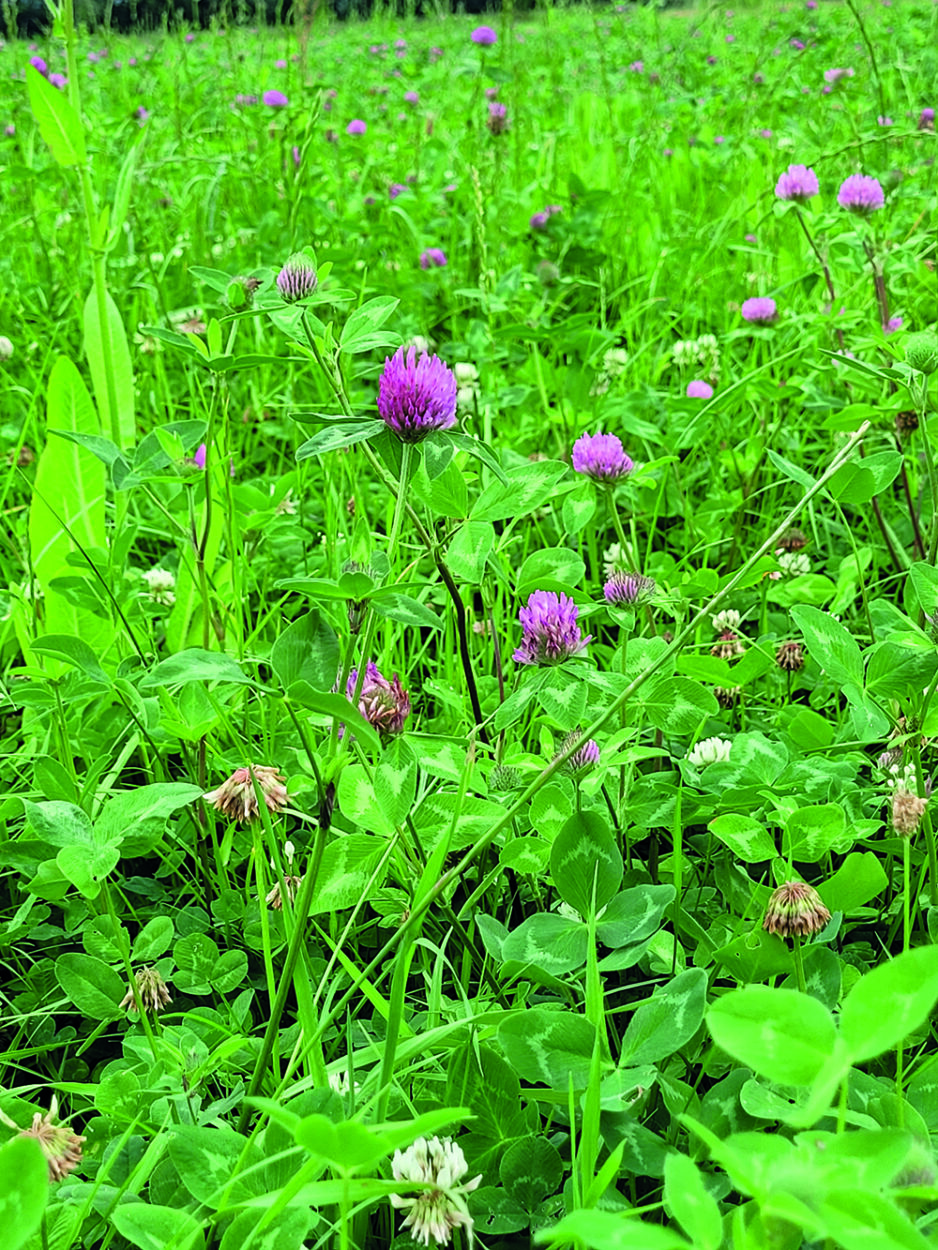
Research suggests that improved grass-legume and legume-herb interactions can improve grassland yields while reducing reliance on fertiliser. Photo credit: Teagasc.
Productive grasslands are widely used to supply forage for livestock, either in permanent grassland systems or as part of crop rotations. These swards are typically low in plant diversity.
Two common management approaches dominate. The first involves growing a single grass species, usually supported by high levels of chemical nitrogen fertiliser. The second uses a grass-legume mix, such as perennial ryegrass and white clover, which requires lower fertiliser inputs.
Increasingly, farmers and researchers are exploring multispecies swards: mixtures that include grasses, legumes and herbs. These systems may offer benefits such as improved yields, better forage quality and more efficient use of nutrients.
While many studies have examined multispecies swards, few have directly compared them with widely used conventional grassland systems. Even fewer have tested these systems across a wide range of environmental conditions to ensure results are robust and applicable to different farming regions.
However, key questions remain: which species should be included, how many species are needed, and in what proportions should they be sown?
Going global
These questions were addressed as part of LegacyNet, a common field experiment led by scientists from Teagasc, Trinity College Dublin and Aarhus University. The LegacyNet sites include locations in Ireland and across continental Europe, as well as sites further afield in China, the US, Canada and New Zealand.
John Finn, Research Officer at Teagasc Johnstown Castle, explains the benefits of this international approach. “Conducting this research across 26 international sites allows us to assess a wide range of temperate climates and local conditions.
“LegacyNet is remarkable in that it’s a voluntary research network. Participants and their respective institutions agree to implement the scientific protocol at their own cost and submit their data for analysis by the LegacyNet statistics team.”
Yield increases
Researchers combined grassland forage species, in combinations of up to two each of grasses, legumes and herbs. The aim is to assess whether multispecies mixtures could maintain or improve yields while reducing reliance on nitrogen (N) fertilisers, which have negative environmental impacts.
Each research site contained 52 grassland plots, with each plot ranging from one to six forage species, managed with moderate levels of chemical N fertiliser – average 109kg/ha/y across all 26 sites. For control, researchers included plots with a single grass species managed with at least double the fertiliser (261kg/ha/y average across all sites).
Across all sites, multispecies mixtures achieved high yields, thanks to strong grass-legume and legume-herb interactions. This resulted in mixture yields greater than the sum of their parts. The results showed that sowing two grasses, two legumes and two herbs in roughly equal proportions can optimise yield and N-saving benefits.
On average, the six-species mixture produced a yield of 12.3t/ha per growing season. Compared to the grass monoculture treated with over double the N fertiliser, this is an 11% increase in yield. Compared to the two-species grass-legume combination, it’s an 18% increase.
“These findings confirm that multispecies mixtures can outperform two widely used conventional grassland practices,” explains John.
The six-species mixture showed an increased yield of 11% vs higher nitrogen grass monoculture, and 18% vs a two-species grass clover.
To optimise yield and reduce reliance on nitrogen fertiliser, the researchers identified a range of functional group proportions defined by 30–70% legumes, a minimum of 15% grasses, and at least 10% herbs.
“We also found that although legumes are important in multispecies mixtures, additional benefits arise from including herbs, and from having two species within each plant group (grass, legume and herb) rather than one,” he continues.
“For example, at a sown legume proportion of 40%, the six-species mixture outperformed the four-species grass-legume mix, which in turn outperformed a two-species combination of one grass and one clover.”
Climate adaptation
The international distribution of sites allowed the researchers to investigate whether climate had a strong influence on yield, and whether the effects of climate on yield depended on plant diversity. They found that sites with warmer average temperatures showed increased yield benefits from more diverse grasslands relative to less diverse grasslands.
“This finding highlights the climate adaptation potential of multispecies mixtures at a time when the global climate crisis is driving rising temperatures,” says John.
Overall, this research provides new knowledge on how to better design grasslands by sowing approximately equal proportions of grasses, legumes and herbs. Across the sites, the grasslands were studied for an average of 24 months.
For longer-duration grasslands, these results highlight the importance of maintaining relatively balanced proportions of grasses, clovers and herbs over time, along with effective grassland management strategies to support these proportions.
“Ultimately, this research shows that multispecies mixtures can deliver more yield with less nitrogen fertiliser,” John concludes. “Further work from LegacyNet will investigate forage quality and what we call the ‘legacy effect’ – the effect of grassland diversity on the subsequent crop in a rotation.”
Funding
Research Ireland Frontiers for the Future program, grant no. 19/FFP/6888; TCD Postgraduate Research Studentship, code 1252; Multi4More (ref. 21R456) funded by DAFM and DAERA; the European Union’s Horizon 2021 doctoral network programme under the Marie Skłodowska-Curie grant agreement no. 101072579 (LegumeLegacy).
Acknowledgements
Participating institutions and researchers in LegacyNet contributed research resources that made this voluntary network possible. This research was conducted as part of the Teagasc Climate Centre.
Contributors
John Finn, Research Officer, Teagasc Johnstown Castle.
Contact: john.finn [at] teagasc.ie
James O’Malley, PhD researcher, Trinity College Dublin.
Carsten Malisch, Assistant Professor of Agroecology, Aarhus University, Denmark.
Caroline Brophy, Professor of Statistics, Trinity College Dublin.
You can find out more information about the LegacyNet project at the link below: