
FLEET of foot
A landmark Teagasc report says Irish farmers are well placed to pave the way for anaerobic digestion feedstock adoption, with biomethane production offering potential economic gains alongside lower agricultural greenhouse gas emissions.
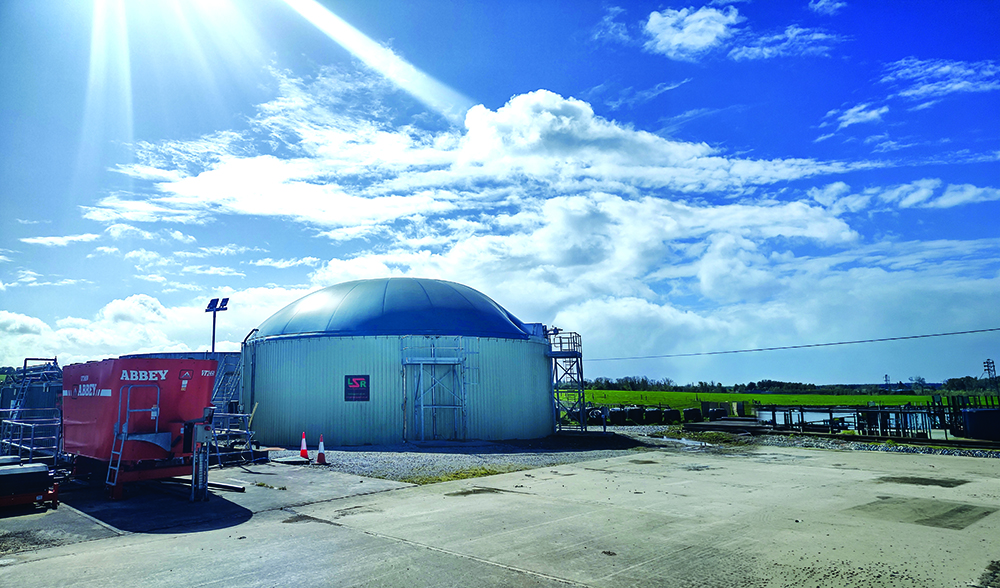
The Anaerobic Digestion (AD) plant at Teagasc Grange: adopting AD feedstocks may increase agricultural sector income while reducing greenhouse gas emissions. Photo credit: Teagasc.
A research report from Teagasc’s Rural Economy and Development programme is making a strong case for the use of anaerobic digestion to support Ireland’s growing biomethane industry. Anaerobic digestion (AD) is a sequence of processes by which microorganisms break down biodegradable material to ultimately produce biogas.
The report sums up the findings so far of the research project ‘Farm Level Economic, Environmental and Transport Modelling of Alternative Feedstocks for Regional Anaerobic Digestion’ (FLEET). This joint venture, led by researchers from Teagasc, is funded by Gas Networks Ireland and the Sustainable Energy Authority of Ireland through the latter’s National Energy RD&D Programme.
Fiona Thorne, Principal Research Officer at Teagasc Ashtown and coordinator of FLEET, says that the report represents a significant step forward in the understanding of agricultural feedstocks’ potential to support the burgeoning biomethane industry.
“This project delivers the most comprehensive assessment to date of the economic viability, environmental impact and logistical challenges involved in using grass and animal waste as a feedstock for biomethane production at a national scale.”
Supplying silage
To better understand barriers to adoption, the FLEET project conducted microeconomic and environmental modelling, using micro-data from Teagasc’s National Farm Survey (NFS).
“While supplying grass silage to AD plants represents a competitive alternative to traditional cattle and sheep enterprises, profitability varies significantly by farm and depends heavily on the price paid to farmers for silage,” notes Fiona.
The study also assessed potential environmental benefits from increased AD adoption. Grass-based AD feedstock systems show potential to reduce farm-level greenhouse gas (GHG) emissions by 50-98% per hectare on participating farms, driven largely by reductions in livestock numbers. Additionally, slurry-based AD feedstock systems were found to deliver emissions reductions up to 11% per hectare.
As part of FLEET, farmers were surveyed on their willingness to supply silage. Results were positive, with farmers showing strong willingness to supply 175,000ha of silage, an amount far exceeding the 110,000-130,000ha required to meet Ireland’s 2030 biomethane production target of 5.7TWh.
A sense of space
Part of FLEET entailed mapping potential sources of biogas. The researchers used location-allocation modelling with a Geographic Information Systems technology framework to examine the geographic structures underlying the sources of biomass products and manures.
Part of this analysis involves analysing specialised datasets: high-resolution spatial datasets, including individual farm parcel information from the Land Parcel Identification System, and a spatially detailed roads dataset from Tailte Éireann.
This analysis was headed up by Teagasc Senior Research Officer Réamonn Fealy, who notes promising results from these datasets.
“The spatial transport analysis, which uses national road network data, indicates that, under constrained typical conditions, most AD feedstocks could be sourced within 10km of potential AD plant locations,” says Réamonn.
“Under more constrained conditions, this range could extend to 15km or more, with resulting implications for both associated costs and the emissions reductions achieved.”
Model behaviour
Aggregate impact assessment modelling was also carried out as part of the project, which used the FAPRI-Ireland model, which was developed under the auspices of the FAPRI Ireland Partnership, a joint venture between Teagasc and the Food and Agriculture Policy Institute (FAPRI) in the USA.
The overall model is comprised of a set of individual, econometrically estimated agricultural commodity models – e.g. beef, dairy, sheep, pigs and crops. These models are linked and solved simultaneously under different policy scenarios.
The modelling would suggest that AD feedstock adoption shows strong potential for both increasing sector income and reducing GHG emissions, says Fiona.
“Compared to a scenario without this feedstock use, the modelling estimates that developing a national level biomethane industry using grass silage and animal slurry to meet 2030 targets is projected to increase agricultural sector income by around 1.25% or €50 million, while reducing GHG emissions by 2.3%.”
With the publication of the final FLEET report, Teagasc and project partners will continue to advance research in this area. Future work will assess additional feedstocks, explore alternative business models, and update economic and environmental analyses in line with evolving market and policy conditions.
Funding
This research project was jointly funded by the Sustainable Energy Authority of Ireland (SEAI) and Gas Networks Ireland (GNI) through the SEAI National Energy RD&D Programme, grant number 19/RDD/493.
Acknowledgements
The authors thank the following colleagues for the contributions to this research: Cathal Buckley, Trevor Donellan, Kevin Hanrahan (Agricultural Economics and Farm Surveys Department), and Réamonn Fealy (Agri-Food Business and Spatial Analysis Department).
Contributors
Fiona Thorne, Principal Research Officer, Teagasc Ashtown. Contact: fiona.thorne [at] teagasc.ie
Maurice Deasy, Postdoctoral Researcher (former), Teagasc Ashtown.
Sadhbh Mahony, Technologist (former), Teagasc Ashtown.
You can read the final project report at the link below: