
From pasture to plate
Ireland’s grasslands could supply a new source of dietary protein if processed into protein-rich ingredients, supporting agricultural diversification while increasing output and lowering livestock-related emissions.
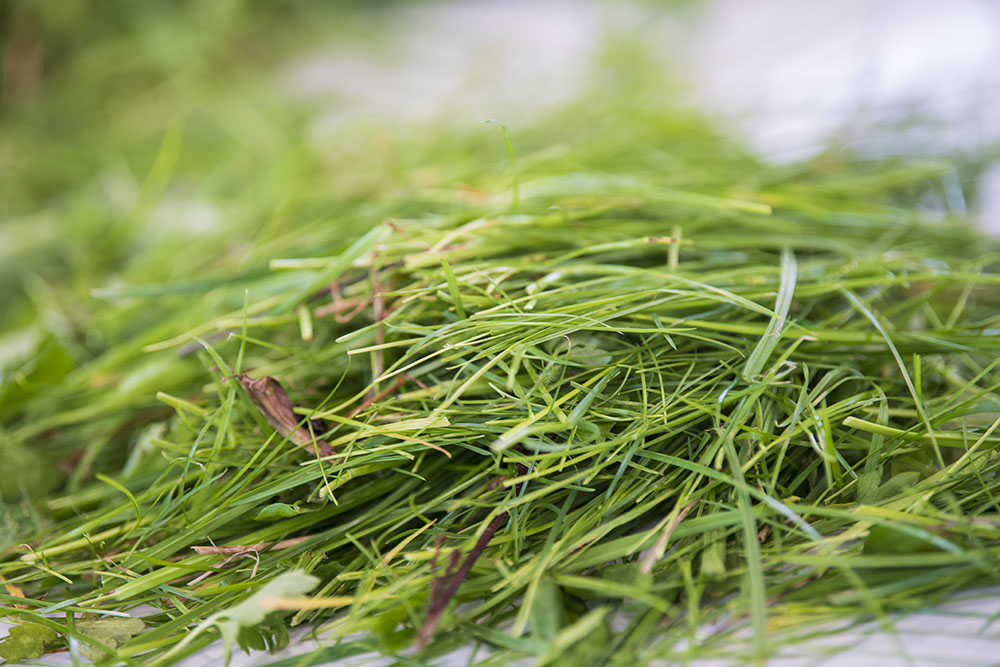
Repurposing grassland not suitable for arable production may provide a new source of dietary protein, if correctly harnessed. Photo credit: Andrew Downes.
Processing grass into protein-rich ingredients could allow Ireland’s grasslands to produce more digestible protein per hectare than some existing livestock systems.
More than 90% of agricultural land in the Republic of Ireland is under permanent grassland or rough grazing, with the remainder under arable production. Approximately 24% of the country’s agricultural land is suitable for tillage.
While grass is primarily used as a low-cost feed source in pasture-based dairy and cattle systems, processing perennial ryegrass or white clover using single-stage or multi-stage maceration can produce a protein concentrate suitable for direct human consumption. Crude protein content represents between 47%–53% of the final product when a perennial ryegrass-only sward is processed, and between 53%–55% when a mixture of perennial ryegrass and white clover is processed.
This presents a potential opportunity, as part of a national agricultural diversification strategy, to repurpose grassland that is not suitable for arable production. Research at Teagasc Athenry has been assessing the economic, environmental and nutritional considerations of such a repurposing.
“Land under grassland with biophysical constraints could therefore still contribute to food and protein production in a scenario where livestock production is reduced,” highlights Marie Merlo, Research Officer at Teagasc Athenry. “However, producing grass-based protein for human consumption would involve nutritional and environmental trade-offs compared with current livestock systems.”
With agricultural diversification scenarios increasingly being explored in Ireland and elsewhere, potential transitions that would safeguard protein security is an important consideration.
Nutritional potential of grass protein concentrate
Protein is a macronutrient composed of amino acids. Of these, nine are considered essential, meaning they cannot be synthesised by the human body and must be obtained through the diet. The Digestible Indispensable Amino Acid Score (DIAAS) is the measure recommended by the Food and Agriculture Organization of the United Nations to correct protein yield for quality. This score represents the share of amino acids available for the body after ileal digestion is complete.
Assuming a low-yield grass production system and accounting for digestibility using the DIAAS of the final product, processing a perennial ryegrass-only sward could generate between 151kg–301kg of digestible protein per hectare of repurposed grassland, depending on the processing technology used.
Under a high-yield system, where grass management is optimised to maximise yields within biophysical constraints, potential protein output increases to between 266–529kg/ha. Processing a mixture of perennial ryegrass and white clover into a protein-rich concentrate would generate between 447–888kg/ha of protein.
By comparison, current milk production systems generate, on average, 407kg/ha of digestible protein, while current beef production systems generate 51kg/ha. One hectare dedicated to milk and beef production could meet the yearly protein requirements of 24 and three individuals respectively, while grass systems could meet the requirements of between 18–52 individuals.
The protein in grass protein concentrate does not have the same amino acid composition as that found in beef or milk.
“While grass protein is rich in the essential amino acids leucine and valine, it is relatively deficient in methionine and cysteine, which would need to be obtained from other dietary sources,” explains Marie.
Hence, while processing grass can yield more protein than livestock-based systems, the amino acid composition warrants further investigation.
52
Digestible protein yields from 1ha of dedicated grassland could meet the annual protein requirements for up to 52 adults.
Environmental benefits
The main gains from repurposing grassland and processing grass into a protein-rich ingredient for human consumption lie in the environmental dimension of sustainability.
Producing perennial ryegrass without livestock generates between 0.68–0.9t of CO₂ equivalent per hectare, depending on production intensity. Producing a mixture of perennial ryegrass and white clover generates 0.39tCO₂e/ha, due to the ability of white clover to fix nitrogen in the soil and thereby reduce synthetic nitrogen fertiliser requirements.
In comparison, dairy and beef production generate 10.2tCO₂e/ha and 4.7tCO₂e/ha respectively (as reported in the Teagasc National Farm Survey), mainly due to methane emissions from enteric fermentation and manure management.
The comparison also holds when emissions are expressed relative to protein production. Producing a perennial ryegrass-only sward for human consumption generates between 0.17–0.45kgCO₂e per 100g of digestible protein, while producing a mixture of perennial ryegrass and white clover generates between 0.04–0.09kgCO₂e per 100g of digestible protein. In contrast, producing milk and beef generates 2.6kgCO₂e and 13.1kgCO₂e per 100g of digestible protein respectively.
It should be noted that these results account only for emissions up to the farm gate and do not include emissions associated with processing.

Repurposing grassland not suitable for arable production may provide a new source of dietary protein, if correctly harnessed. Photo credit: Andrew Downes.
Economic compensation for farmers
“In any scenario where dairy or livestock farms substitute away from current activities towards a diversification pathway, economic returns would need to be at least comparable to the status quo, if not higher, to incentivise the switch,” notes Marie.
Given the gross margins of milk and beef production (€2,913 and €456 per hectare respectively, on average between 2016 and 2023 according to the Teagasc National Farm Survey), it is estimated that, if grass yields are optimised, dairy farmers would require a price of between €310 and €396 per tonne of grass dry matter, depending on whether a perennial ryegrass-only sward or a mixture of ryegrass and white clover is produced. For beef farmers, the price required for equivalence is lower, at between €121 and €206 per tonne, due to lower relative gross margins.
“The amino acid composition of grass protein concentrate warrants further research, as it is relatively rich in some essential amino acids and relatively deficient in others, unlike milk and beef,” explains Marie.
Finally, grass systems that can compete with livestock products in terms of protein yield assume the optimisation of grass yields, which would require changes in current grassland management.
Funding
The U-Protein project (Unlocking Protein Resource Opportunities to Evolve Ireland’s Nutrition) is funded by the Irish Department of Agriculture, Food and the Marine (grant number 2019PROG702).
Contributors
Marie Merlo, Research Officer, Teagasc Athenry.
Contact: marie.merlo [at] teagasc.ie
Cathal Buckley, Senior Research Officer, Teagasc Athenry.
Thia Hennessy, Head of College of Business and Law, University College Cork.
Seamus O’Mahony, Professor, School of Food, and Nutritional Sciences, University College Cork.
You can read more about the U-Protein project at the link below: