
Interview: The right ingredients
From dairy to digital innovation, Mark Fenelon, Head of the Food Programme at Teagasc, explains how applied research, industry collaboration and emerging technologies are supporting Ireland’s position as a global leader in sustainable food production.
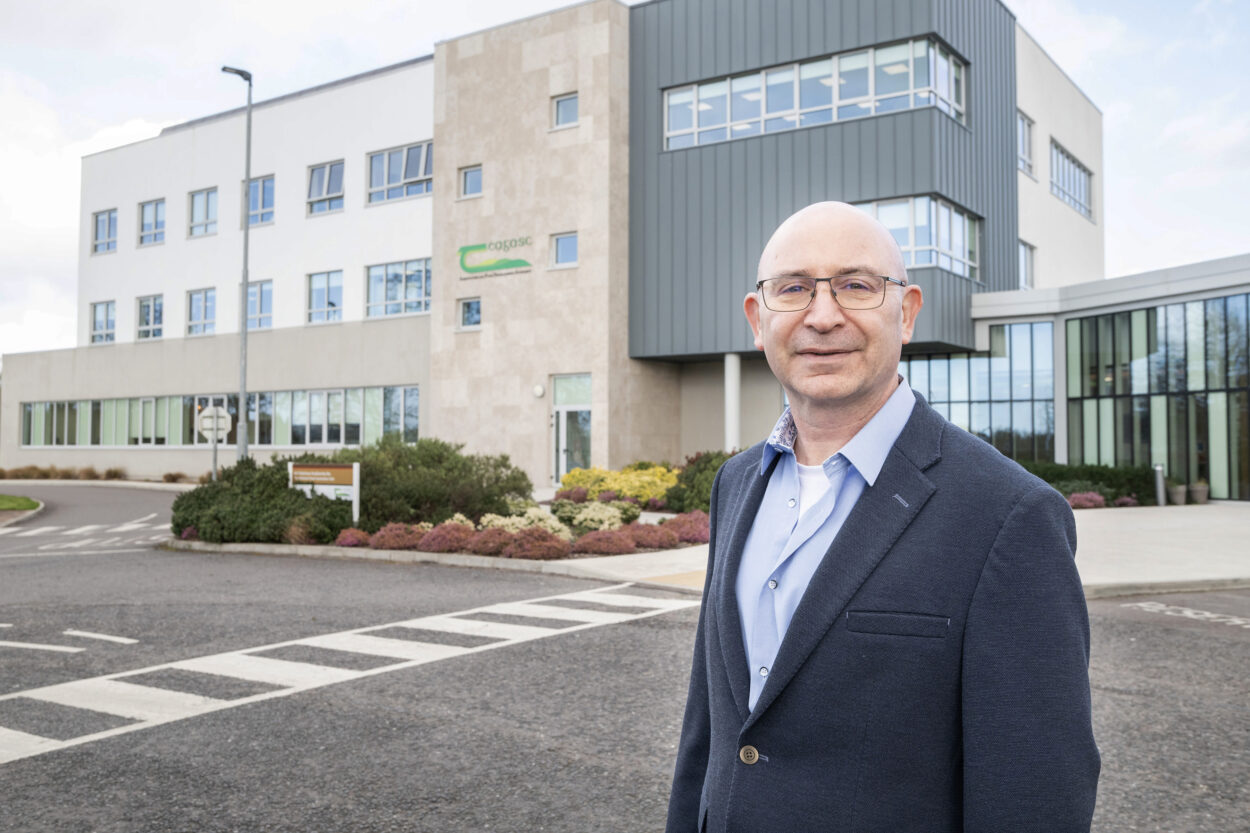
As Head of the Food Programme at Teagasc, Mark Fenelon is helping lead the science that underpins Ireland’s global status as a food-exporting nation. Photo credit: Fergal O’Gorman.
Could you tell us about your research background?
I started out at the Institute of Technology in Carlow, completing a Diploma in Industrial Biology, followed by a Higher Diploma and Degree in Food Science & Technology at UCC, and then a PhD at Teagasc (and UCC) in the cheese area. I then took up research and project management roles in the infant formula sector.
After a few years, I returned to Teagasc, while taking night classes to get my Diploma in Process and Chemical Engineering. Since returning to Teagasc, I have held research roles, transitioning into Head of Department and now Head of the Food Research Programme.
I’m responsible for the programme across both our Ashtown and Moorepark sites, as well as for the programme’s facilities at Moorepark. My own research area is in food science: functionality and processing, as well as manufacturing and the chemistry of food itself, including compositional and nutritional properties. My work has focused mainly on dairy, and in recent years has broadened to include the plant-based area as well.
What is the purpose of the Food Roadmap?
The purpose of the Food Roadmap, which includes the programme itself, is to provide a best estimate projection of where the sector is heading. Teagasc prides itself on delivering science-based innovation for the food industry, both nationally and internationally. Ireland is a significant food-exporting nation, and that requires us to produce sustainable, nutritious food. While our research is primarily applied, we use the latest analytical methodologies to evaluate product quality, safety, nutrition and sensory properties.
The global food ecosystem is undergoing significant change, with an increasing focus on health and the role of diet in supporting both. Working across all food sectors – meat, dairy, marine and crops – a common question remains: how do we deliver nutrition in a sustainable way?
We look at circularity within our food system: reducing waste and adding value from sidestreams. This increases economic value and viability in the food manufacturing space while continuing to provide safe, high-quality nutrition. We look at technologies in this space, such as drying, heating and packaging solutions to maintain food safety and extend shelf life for export. Our applied science approach keeps focus on the end-use application for both fresh food and ingredients.
Overall, our science underpins value-add, nutrition and safety, while supporting ongoing investment in the food sector – both indigenous and international.
How has this field developed over the years?
One of the key research areas in our programme focuses on ingredient applications – both their functionality and how they link to health. Food for health, including the gut microbiome, nutritional value, digestive health, and how foods impact metabolism, is now a much stronger focus.
In meat science, research has connected animal genetics to specific quality traits, supporting the production of the highest-quality fresh meat – coupled with the technology focused on ensuring good shelf-life and minimal waste. We have research on the development of ingredients from marine biomass. In the dairy space, there’s lots of work on ingredients – cheese, butter, fermented foods – and the technology associated with these. There is a renewed focus on fermentation and the valorisation and circularity it enables.
Other scientific areas include sequencing, microbiology, flavour development and troubleshooting less viable market flavours and textures.
Digital is another important area for the Food programme. Many of our processes, analytical capabilities, bioinformatics and sequencing are digitally enabled.
This includes tools such as co-bots, vision recognition, spectral analysis, and virtual reality (VR) to look ‘inside’ our products and understand their structure. We also leverage AI models for data analytics. Sensors and AI are used to monitor processes, understand efficiencies and give operators a heads-up on potential problems.
What are the challenges surrounding this topic?
One of the key challenges is the increasing consumer awareness and access to nutritional information, which is driving the need for reformulation across many food sectors. This is not a challenge per se, but consumer choice is increasing, and trends are moving more quickly.
Manufacturing processes are set up for specific products, but the wider ecosystem is changing as knowledge and expectations evolve. This means there is innovation happening, which is positive, but it does take time.
Adding value and reducing waste are important outcomes, and the valorisation of side streams offers significant economic benefits. If you are developing new food products, you need to be able to utilise all by-product streams.
What impacts is this topic having?
Within the programme, we work at the interface between lab, pilot and commercial, providing the expertise to support industry in developing new products or processes, or adjusting existing ones. We also support policymakers and government agencies, and support both national and international investment in the food sector.
Our work also helps further the development of new products, new processes, links to policy, new analytical techniques and highly skilled graduates, while leveraging Ireland’s capability to bring in foreign investment.
We also support smaller companies, start-ups and SMEs, giving them an advantage through knowledge transfer. Teagasc provides specialist expertise and because we’re independent we can run pilots and provide scientific validation and advice.
Across Ashtown, Moorepark, and through our involvement in the Bia Innovator Campus at Teagasc in Athenry, we support a wide range of companies, from artisan producers to SMEs and multinationals.
Teagasc is unique in being cross-programme. We work closely with colleagues in production – dairy, beef, crops – so we’re working from animal or field through to finished products, providing deeper expertise and the full ‘farm-to-fork’ view.
What research have you been doing in this field?
I’ve continued working in dairy – such as the digital milk map, mapping compositional changes across the country through the VistaMilk research centre – and working on dairy ingredients and their functionality.
I’m also working on plant-based projects, both in terms of process and nutrition, developing new ingredients from plants, for example, fava beans.
Another area is looking at how dairy processes can be applied to plants. The plant space is quite new, so we’re developing an economic model for plant processing as an enterprise complementary to meat and dairy, providing novel ingredients such as fibres, and building pilot-scale systems for sidestream processing.
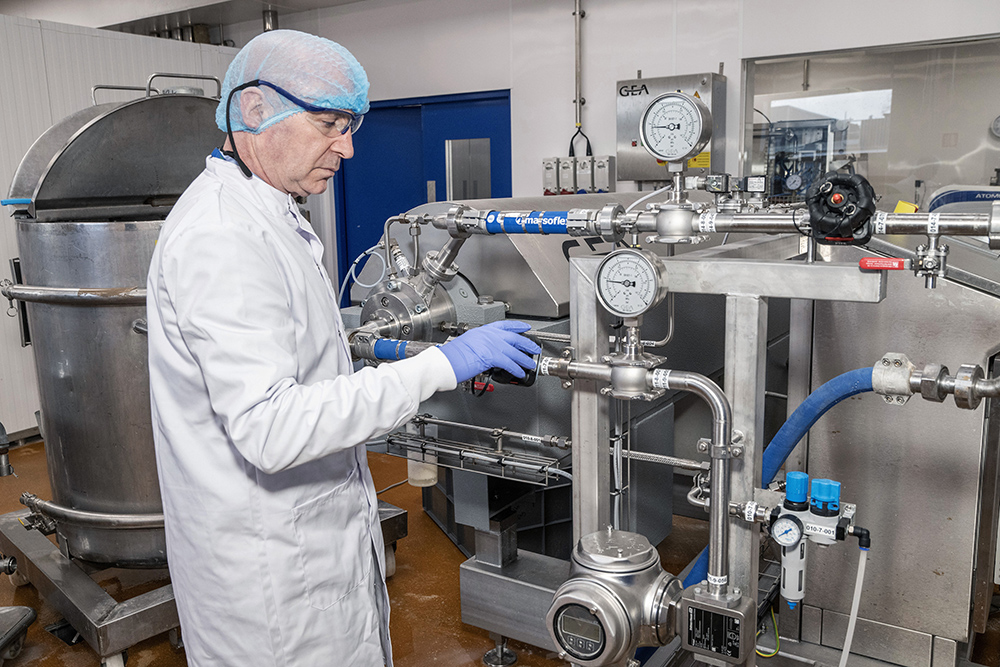
Mark pictured at Moorepark Technology, Ltd., a pilot plant facility for food industry development, located onsite at Teagasc Moorepark. Photo credit: Fergal O’Gorman
What benefits does this research have?
Social benefits include strengthening the food industry by supporting production and manufacturing innovation that contribute to the broader economy and community well-being. For consumers, it’s about food safety, health, nutrition, the sensory experience and the medicinal side of food. The importance of quality, traceability, and sustainability cannot be overstated – our food must not only taste great but also be nutritious and safe to eat.
Economically, our work supports Ireland’s position at the top of the food chain, if you’ll pardon the pun! Our food output is valued for its nutritional and sensory qualities, coupled with our green image of sustainable production, grass-fed beef and dairy.
There’s also the people aspect – providing livelihoods, expertise and human capital.
What has the industry response been?
We’re often acknowledged for our accessibility as a partner in applied research – Teagasc has a USP in the food research sector, where our pilot facilities are considered scalable and commercially relevant.
The unique blend of research expertise and pilot facilities provides practical and applied support to the food industry. Our researchers continue to publish in leading scientific journals and are duly recognised by both the academic community and industry.
We have a high return rate for companies engaging with our research programme and facilities; the National Food Hub at Moorepark has reached full capacity. As a result, we are exploring options for expansion to accommodate increasing demand.
What’s next for the programme?
We will continue to advance our research into the functional, sensory, safety, and nutritional characteristics of food throughout our programme. We want to increase our footprint in the national food bio-circularity space at our Ashtown centre. We’ll continue to extend and expand our infrastructure and research in the key areas of fermentation, sustainability and the digital space. Coupled with this, we’ll continue our close industry collaboration, with initiatives tied to focus areas of dairy, meat, marine and prepared consumer foods.
Up close and personal
What’s your favourite animal?
I should say the cow, but I will go with the dog!
If you hadn’t ended up in research, what other job would you have wanted to give a go?
Working in engineering in the digital space.
What are you most proud of professionally?
Being part of such a team of world-leading experts within the food area.
You can read the full Teagasc Food Roap Map 2030 document at the below link