
Milking solar power
A new study shows that solar photovoltaic systems can reduce emissions and energy costs on dairy farms, with spring-calving systems showing slightly stronger economic and environmental performance.
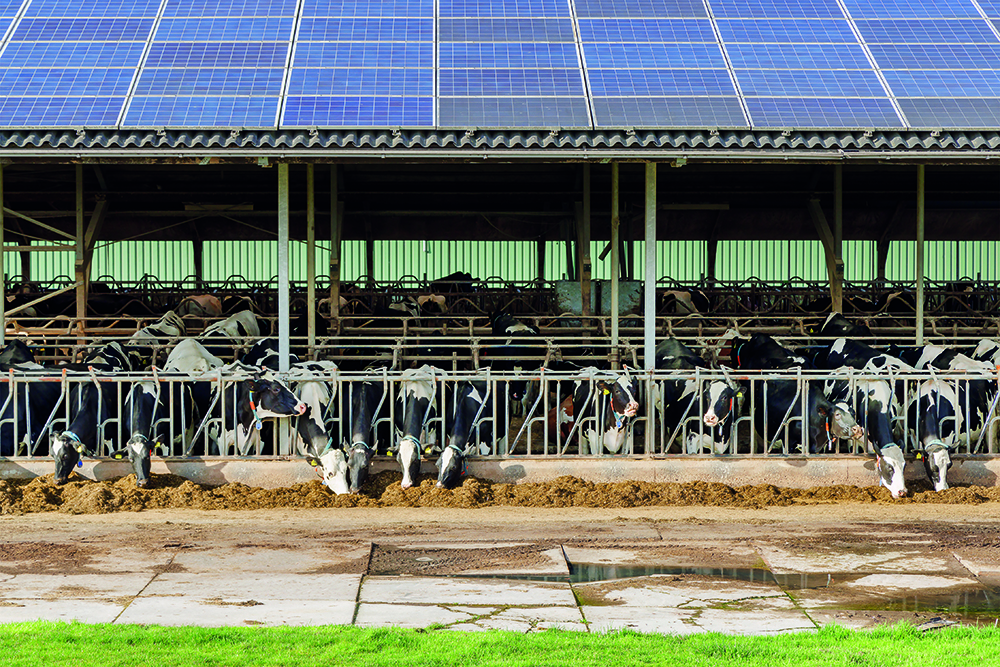
Integrating renewable energy into agricultural systems is important for reducing the sector’s greenhouse gas emissions. Ireland is targeting a 22-30% reduction in agricultural emissions, a 62-81% reduction in the electricity sector, and an 80% renewable electricity share by 2030 (relative to 2018 levels).
A recent study conducted at Maynooth University and Teagasc, funded by the Sustainable Energy Authority of Ireland, carried out a comprehensive techno-economic and environmental assessment of grid-connected solar photovoltaic (PV) systems for two types of dairy farm operations: spring-calving and winter-calving.
Anne Kinsella, a Senior Research Officer in Teagasc’s Rural Economy and Development programme, says that results are promising.
“The findings demonstrate that solar PV systems are both economically viable and environmentally beneficial for dairy farms. Spring-calving operations tend towards achieving slightly better results, owing to better seasonal alignment between solar generation and electricity demand.”
Case farm analysis
Taking Ireland’s policy framework into consideration, this study sought to model and optimise solar PV systems to meet farm energy needs. The basis for the modelling was two real-life case farms, from which the study gained detailed energy consumption profiles and data on solar irradiance – the power per unit area received from the sun (measured as watts per m2).
Ireland’s policy framework includes the Targeted Agricultural Modernisation Scheme (TAMS), which offers up to 60% capital grant aid for solar PV systems (maximum investment ceiling of €90,000 per farm), and the Clean Export Tariff, which allows small-scale generators (6-50kWp) to receive €0.15–€0.25/kWh for surplus electricity exported to the grid (contracts of up to 15 years).
Two representative dairy farm operations were evaluated in County Galway, western Ireland: a spring-calving farm at Ballymoe and a winter-calving farm at Athenry. The spring-calving operation uses an automated milking and grazing-management system for 80 cows under a largely pasture-based regime, which raises electricity demand during peak milking periods. The winter-calving operation, with 74 cows, uses robotic milking and continuous indoor housing during colder months, increasing electricity demand.
Monthly electricity consumption profiles based on actual farm electricity bills were analysed. Major energy-consuming operations common to both farms include milking machines, milk cooling, water heating, water pumps, manure scrapers and lighting. Monthly solar irradiance data were also obtained for both locations, with the Athenry site receiving slightly higher annual solar irradiance than Ballymoe.
Solar PV system design
The proposed PV system consists of three main components: a solar PV array, a battery bank and an inverter. The battery system mitigates the intermittent nature of solar generation, while the inverter converts direct current (DC) from both the solar PV array and the battery into alternating current (AC) suitable for farm operations.
As the dairy farms are connected to existing low-voltage grid infrastructure, there is no requirement for additional high-voltage conversion equipment. This simplifies system integration and reduces installation costs.
The analysis involved collecting all required input data, including solar irradiance, farm-specific energy consumption profiles, component efficiencies, capital and operating costs and relevant policy schemes. The operating strategy prioritises on-site solar PV utilisation to meet farm electricity demand, with any surplus charging the battery until it is full. Additional excess electricity is exported to the grid at the applicable tariff.
During periods of insufficient solar PV generation, the battery discharges to support the load, and the grid supplies electricity only when both solar PV and battery outputs cannot meet demand.
The solar PV model for the spring-calving operation (utilising 30.4kWp) consisted of 76 solar PV panels and 20 battery units. The model developed for the winter-calving dairy operation (utilising 27.6 kWp) consisted of 69 panels and 25 battery units.
Energy and economic performance
“In terms of energy generation, total annual solar PV generation was comparable for both dairy operations,” explains Anne. “The spring-calving operation generated 29,882kWh while the winter-calving operation generated 29,687kWh. However, their utilisation patterns differ significantly.”
On the spring-calving farm, 72% of solar PV energy (21,635kWh) was consumed directly on site, 23% (6,685kWh) was stored in batteries, and only 5% (1,562kWh) was exported to the grid. This means that 95% of solar PV energy was effectively used on the farm, reflecting strong on-site utilisation and reduced grid dependence.
Direct solar energy consumed:
Ensuring reliable pollination in your orchard 72% for spring-calving vs 51% for winter-calving
In contrast, the winter-calving farm consumed 51% (15,040kWh) of solar PV energy directly, stored 25% (7,512 kWh) in batteries, and exported 24% (7,134kWh) to the grid. “During low-irradiance months, i.e. winter, peak electricity demand limits self-use and increases exports,” Anne notes.
For the spring-calving operation, solar PV, battery storage and grid imports contributed 59%, 18% and 23% of total energy, respectively, compared to 41%, 20% and 39% for the winter-calving operation. The winter-calving farm also contributed a higher grid export of 19%. These findings highlight the lower utilisation of on-site solar PV energy due to seasonal mismatch in winter-calving systems.
To evaluate the performance of the proposed system, three indicators were assessed:
- Levelised Cost of Electricity (LCOE),
- Payback Period (PBP), and
- CO₂ emissions reduction.
“Economic results show that both types of dairy operations benefit from solar energy integration,” explains Michael Hayden of Maynooth University, “although the spring-calving operation performs more favourably due to the stronger alignment between solar generation and electricity demand.”
Under current Irish policy conditions, the spring-calving operation achieved a payback period of 3.25 years and an LCOE of €0.091/kWh, compared with 3.83 years and €0.099/kWh for the winter-calving operation.
Sensitivity analysis identified solar irradiance, grant funding and grid electricity prices as the most influential factors affecting financial performance.
Environmentally, the proposed systems achieved significant emissions reductions of 77% for the spring calving operation and 61% for the winter-calving operation.
Overall, the findings confirm that solar PV systems offer a practical and sustainable pathway for improving energy self-sufficiency, profitability and environmental performance in dairy farming.
“These results provide useful insights for farmers and policymakers seeking to promote renewable energy adoption and emissions reduction in agriculture,” Michael concludes.
“Greater adoption of solar PV technologies across the agricultural sector could help develop more economically and environmentally sustainable farm enterprises – creating a win-win scenario for all stakeholders in agriculture.”
Funding
Project funded by Sustainable Energy Authority of Ireland (SEAI), grant number 23/RDD/920.
Contributors
Michael Hayden, Assistant Professor of Accounting Maynooth University.
Anne Kinsella, Senior Research Officer, Teagasc Athenry.
Contact: anne.kinsella [at] teagasc.ie