
Nothing to (cellu)lose
Renewable packaging materials are becoming increasingly important for the food sector. Research from Teagasc Ashtown’s Food Research Centre is making a strong case for cellulose and nanocellulose as next-generation options.
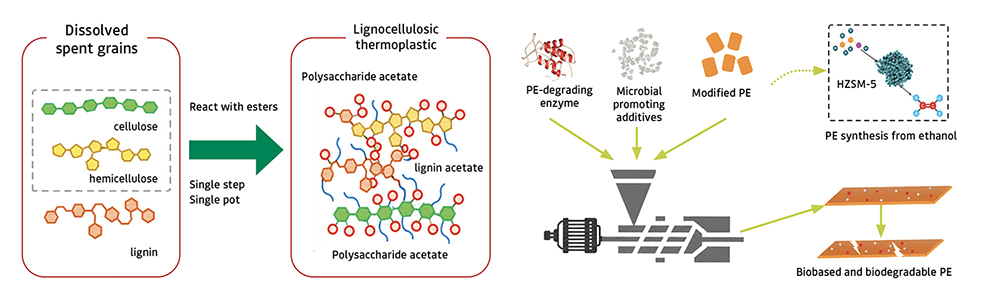
Reducing dependence on fossil-based plastics has become a priority for the food and packaging sectors, driven by environmental concerns and EU policy targets. As industries seek renewable, high-performance alternatives, cellulose and nanocellulose have emerged as leading candidates.
Derived from plant biomass, these materials offer biodegradability, excellent mechanical properties and strong alignment with Europe’s transition towards a circular bioeconomy. Their relevance is further underscored by EU-funded initiatives such as the Bio2PEs project, which aims to develop next-generation bio-based polyethylene and polyesters from biomass waste.
Advancing renewables
Cellulose is the Earth’s most abundant biopolymer and can be sourced from forestry residues, agricultural byproducts and food processing waste, all widely available in Ireland. Processing it into nanoscale structures yields nanocellulose, materials with exceptional strength and barrier performance.
Nanocellulose combines excellent oxygen-barrier properties, high tensile strength and natural biodegradability, making it a viable replacement for petroleum-based plastics in food packaging. Nanocellulose films can rival commercial oxygen barrier polymers, while remaining compostable and free from microplastic formation.
Applications in packaging
Nanocellulose is being explored for films, coatings, laminates and reinforced biocomposites.
Its transparency, grease resistance and compatibility with biodegradable polymers such as polylactic acid, polyhydroxyalkanoates and starch enable the development of stronger, lighter and more sustainable packaging materials.
Dense, layered nanocellulose “nanopapers” offer tuneable mechanical and barrier properties. Antimicrobial additives and hydrophobic coatings could also support active and smart packaging.
Innovation framework
The Bio2PEs project provides a strategic framework for cellulose-based materials. Its objectives include:
- Producing biodegradable polymers from biomass waste.
- Developing eco-friendly packaging prototypes for food, textiles and agriculture.
- Assessing full-lifecycle social, ethical and environmental impacts.
- Testing biodegradability across soil, freshwater and marine environments.
- Enhancing circularity through self-repairing coatings.
- Improving recyclability using fluorescence markers.
- Supporting consumer adoption through interactive labelling.
- Using AI to optimise material performance and biodegradation.
- Advancing the EU Circular Economy Action Plan.
Nanocellulose supports these goals through its renewable origin, compatibility with compostable systems and potential for circular, smart packaging.
Ireland’s agricultural and forestry sectors generate significant cellulose-rich residues suitable for nanocellulose production.
Opportunity for Irish bioeconomy
Regional biorefineries could create new value chains, reduce waste and support rural development, while Teagasc’s expertise can help drive European research efforts and industrial adoption.
Challenges include moisture sensitivity, energy-intensive production processes and standardised food-contact safety testing. Research is advancing on humidity-stable films, greener extraction methods and scalable production technologies.
Cellulose and nanocellulose combine renewability, performance and environmental compatibility. As Europe moves towards a circular bioeconomy, initiatives like Bio2PEs highlight their strategic potential. Ireland’s biomass resources and research expertise position it well to lead this transition.
Funding
The project is funded by the European Union, Grant no. 101221903. You can read more about the project on the Bio2PEs project website at this link.
Contributors
Jenna Warby, Research Officer, Food Chemistry and Technology, Teagasc Ashtown.
jennawarby[at]teagasc.ie
Monjurul Hoque, Research Officer, Food Chemistry and Technology, Teagasc Ashtown.
Yuanyuan Chen, Principal Investigator, Technological University of the Shannon, Athlone Campus.
Brijesh Tiwari, Principal Research Officer, Food Chemistry and Technology, Teagasc Ashtown.