Pasture, present, future
Future grazing systems can play an important role in producing healthy foods more sustainably and profitably. A Teagasc-led, multi-year farm systems experiment is evaluating how sward diversity could improve dairy system performance.
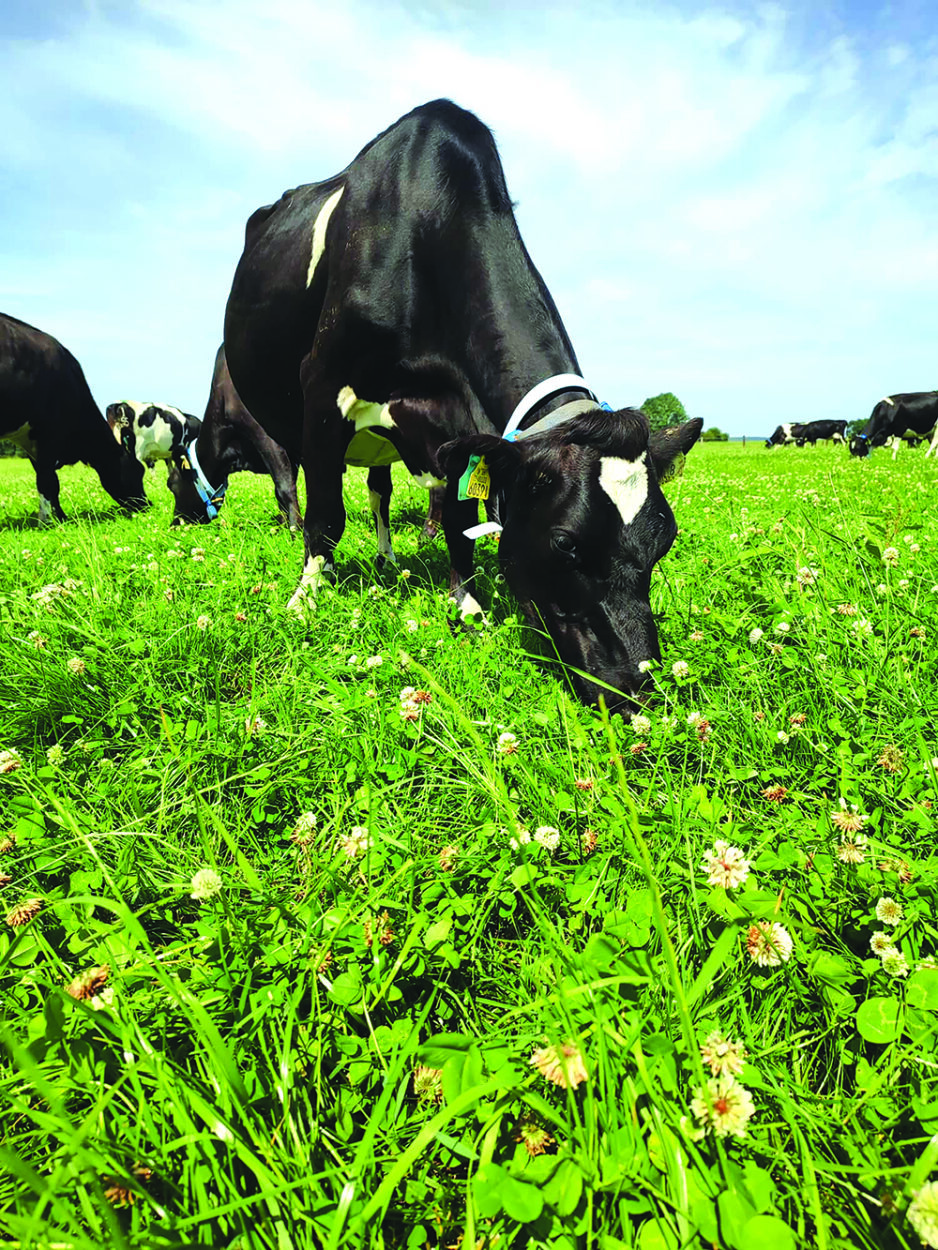
Improving dairy efficiency means meeting food demand while adapting to climate and ecosystem changes. In Ireland, pasture-based systems often rely on perennial ryegrass (PRG) monocultures for their nutritional value and resilience to grazing. However, PRG requires high levels of chemical nitrogen (N) fertiliser. Lower-input alternatives must also work economically for farmers.
Researchers have examined legumes and forbs (flowering plants) as ways to reduce chemical N use while maintaining productivity.
Multispecies swards (MSS) may increase pasture yield and feed quality while reducing gaseous and nutrient losses. However, longer-term evidence is needed, explains Brendan Horan, Research Officer at Teagasc Moorepark.
“Much of the evidence comes from short-term grazing evaluations or grazed or cut plot protocols,” he says. “Neither accurately reflects longer-term performance under commercial grazing conditions.”
Intensive evaluation
To tackle this knowledge gap, Multimilk, a three-year (2021–2023) systems-scale study, was conducted at Teagasc Moorepark.
Multimilk compared PRG white clover (PRGWC) and MSS swards receiving intermediate chemical N with PRG monocultures receiving higher levels.
For its base, the Multimilk project compared three 20-hectare farmlets:
- PRG, receiving 250kg N/ha/year
- PRGWC (comprising PRG and white clover), receiving 125kg N/ha/year
- MSS (comprising PRG, timothy, meadow fescue, white clover, red clover, hybrid clover, plantain, and chicory), receiving 125kg N/ha/year.
Each farmlet was stocked at 2.5 livestock units per hectare and managed under rotational grazing. Researchers measured pasture, animal and environmental performance:
- Pasture measures: herbage yield, botanical composition, nutritive value
- Animal measures: milk yield, composition, dry matter (DM) intake
- Environmental measures: enteric methane emissions, soil nitrate concentrations
Each system also underwent an economic appraisal using the Moorepark Dairy Systems Model (MDSM).
System results
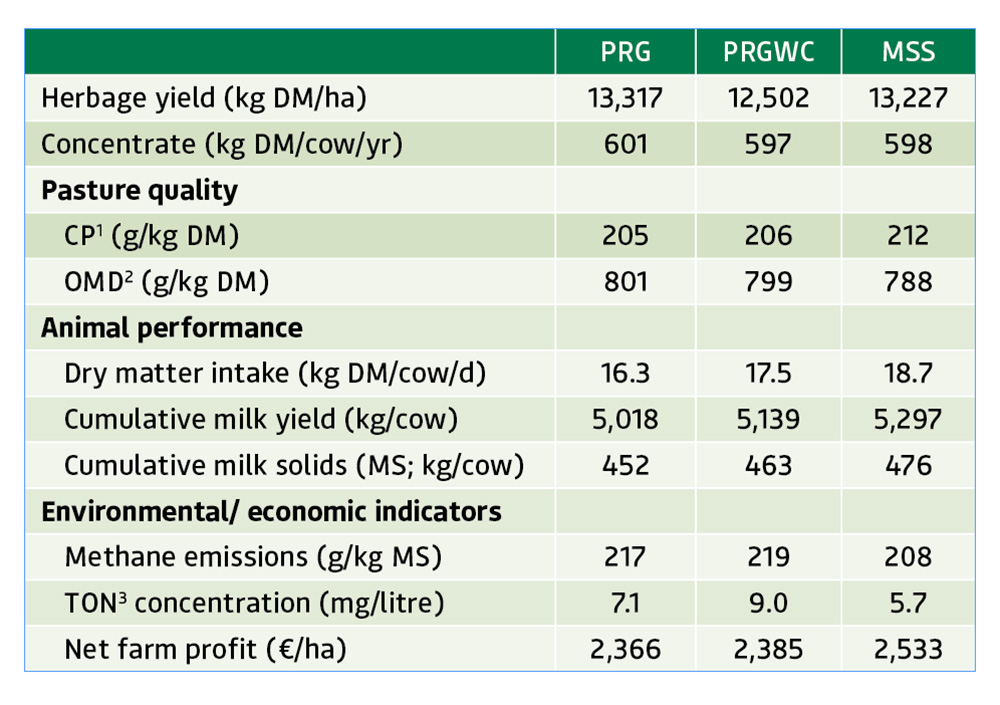
“Across the three years, MSS delivered the best overall balance of production, environmental performance and profitability, despite using half as much chemical N as PRG,” Brendan explains.
- All cows received around 600kg of concentrate per year. The three swards had similar chemical composition and no significant difference in crude protein.
- Despite receiving half the chemical N of PRG, MSS produced 13,227kg DM/ha, almost matching PRG at 13,317kg. PRGWC produced 12,502kg.
- Dry matter intake rose from 16.3kg DM/cow/day on PRG to 17.5kg on PRGWC and 18.7kg on MSS. As concentrate use was similar, the difference came from pasture intake.
- Milk production also rose, from 5,018kg/cow/year on PRG to 5,139kg on PRGWC and 5,297kg on MSS.
- Fat and protein composition was similar, so milk-solids results followed the same pattern.
- MSS had slightly lower organic matter digestibility than PRG and PRGWC.
Measuring methane
Using GreenFeed technology, enteric methane emissions were measured during year 3 of the study. PRG and PRGWC cows had similar methane yields (17.3g/kg DMI), while PRGWC produced more total emissions because of increased DMI (294 and 310g/cow/day).
Total MSS emissions were similar to PRG (297g/cow/day), while methane yield (15.7g/kg DMI) and intensity (208g/kg MS) were lower than the other treatments. With higher milk production, MSS therefore had lower emissions per unit of total milk solids produced.
In addition, across the three-year period concentrations of total oxidisable N (nitrate plus nitrite; TON) were measured in soil solution using ceramic cups. These measurements, taken during the autumn-spring soil drainage period, indicate that the MSS swards have lower TON losses to soil solution (5.7mg/L TON) compared to both PRG and PRGWC systems (7.1 and 9.0mg/L, respectively).
Finally, the modelled economic results using MDSM show similar net farm profits for both PRG and PRGWC systems (€2,366/ha and €2,385/ha, respectively). Although PRGWC had lower costs linked to N fertiliser savings, lower overall pasture growth required additional silage purchases, which largely offset the fertiliser savings achieved.
In contrast, the MSS system outperformed both PRG and PRGWC systems in terms of net farm profit (+€167/ha and +€148/ha, respectively), primarily due to increased milk output and reduced N fertiliser costs.
Beyond production
To deliver additional benefits to farmers, consumers and society at large, future pasture-based systems must be redesigned beyond just milk production metrics, Brendan concludes.
“Such systems will need to rely less on imported feeds and chemical inputs, and more on high-quality grazed pastures, while consistently reducing impacts on environmental outcomes.”
The Multimilk project demonstrates the potential for modest increases in sward species diversity in grazed pastures to maintain pasture production and quality, increase dairy system performance and profitability, while significantly reducing chemical N fertiliser use and associated nutrient losses to the environment.
“At the same time, further long-term research trials are required to reduce the variability in PRGWC and MSS sward botanical contents between paddocks, seasons and years,” notes Brendan. “Such research will help identify management opportunities to increase the persistency of both swards under grazing within varying soil types and climatic conditions.”
Funding
This work was funded by VistaMilk and Dairy Research Ireland.
Acknowledgements
The authors wish to acknowledge Alann Jezequel (Teagasc Walsh Scholar) and the staff of Teagasc’s Curtin’s Research Farm, Fermoy, Co. Cork, for their care of the experimental animals and assistance with this experiment. This work was supported by the Teagasc Walsh Scholars Programme and University College Dublin.
Contributors
Brendan Horan, Research Officer, Teagasc Moorepark.
Correspondence: bhoran[at]farmersjournal.ie
Elodie Ruelle, Research Officer, Teagasc Moorepark.
Charles Dwan, Research Officer, Teagasc Moorepark.
Luc Delaby, Research Engineer, INRAE, Saint Gilles, France.