
Systemic surveillance
Systemic surveillance
Climate change and insecticide resistance are increasing the threat posed by plant viruses. Gaining a more systemic understanding of crop virus transmission is crucial for protecting the future of food production in Ireland.
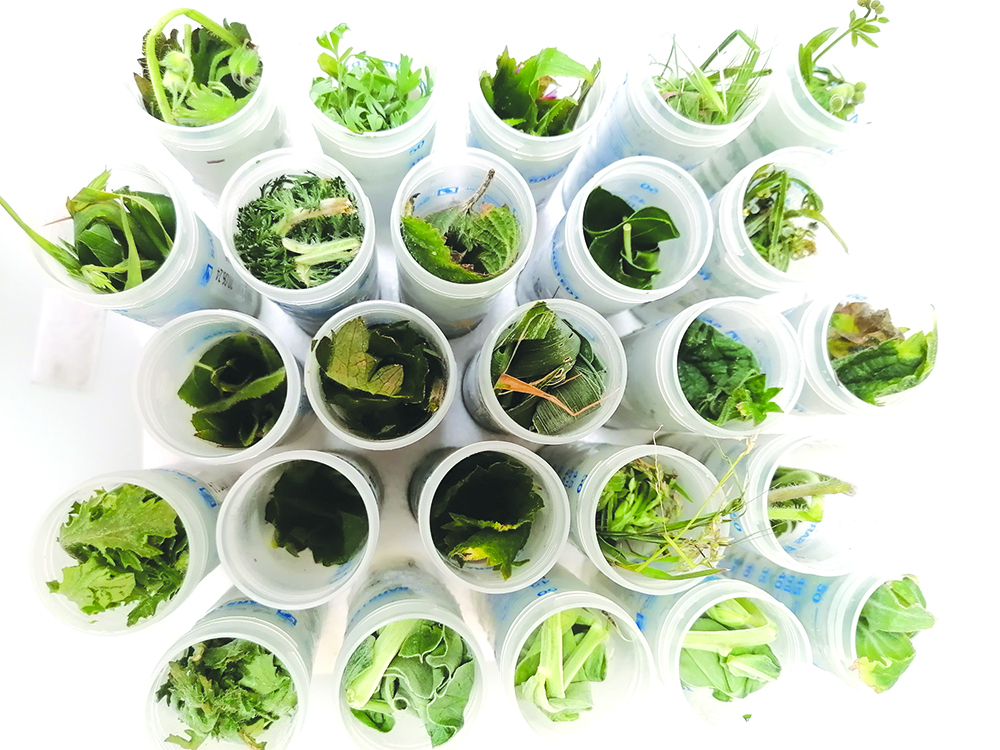
Closer monitoring of plant viruses will play a vital part in safeguarding Ireland’s agricultural future. Photo credit: Teagasc.
Pest plant viruses pose an increasing threat to food production globally, and Ireland is no exception. Virus transmission can occur in different ways, but many are transmitted by vectors like insects, nematodes or mites, with aphids being one of the most common. Viral threat is growing, due to the ubiquity of insects and particularly aphids, alongside climate change and emerging insecticide resistance.
Traditionally, plant virus management relied on controlling insect vectors with insecticides. However, a shift towards more sustainable farming practices and reduced insecticide use requires a deeper, systemic understanding of which viruses are present in Ireland, where they reside, and how quickly we can detect them.
Teagasc research is addressing this gap by conducting the first surveys of viruses in both crops and their surrounding agricultural landscape, leading to the development of new and rapid diagnostic tools.
The project uses High-Throughput Sequencing (HTS) to conduct untargeted surveys of viruses present in sampled plants and to improve available diagnostic methods.
Viral reservoirs
To protect crops from viral diseases, researchers first need to look beyond the fields themselves, explains Marta Niedzicka, a Researcher on the project.
“Many plant viruses survive in the wider farm environment, in pastures, hedgerows, and field margins, even when no crops are growing. These areas can act as hidden “virus reservoirs”, allowing diseases to persist and later spread into crops by insect vectors like aphids.”
The researchers surveyed a wide range of plants growing along the margins of different fields in Ireland. Using advanced DNA sequencing tools, they identified the viruses present in these non-crop plants and determined their prevalence. This kind of early detection is a vital first step in understanding whether those reservoirs could pose a future risk to food crops.
One of the most important discoveries was the first-ever detection in Ireland of soybean dwarf virus (SbDV) – known to cause serious yield losses in soybean in parts of Asia. SbDV is transmitted by two aphid species that are already widespread in Ireland, the pea aphid and the foxglove aphid, meaning the virus has clear pathways for future spread.
SbDV was confirmed in white clover and detected in red clover samples in Ireland. Both are crucial components of Irish grassland agriculture, making them an abundant potential reservoir for SbDV. Its presence should be considered when assessing the risks of introducing other legumes, including soybean varieties adapted for cool environments.
“This discovery highlights the critical role of systematic surveying in identifying pre-existing viral threats in non-crop plants, which can then be transmitted to high-protein crops like faba beans and field peas,” notes Marta.
Increasing pulse
Pulse crops like faba beans and field peas are primarily used in animal feed and as break crops in cereal rotations, with faba beans constituting around 85% of the total pulse crop area. Greater production in Ireland increases the need to understand their viral threats, says Marta.
“We investigated symptomatic pea and faba bean plants with potential viral infections, collected from fields. This is the first investigation of viruses in Irish legumes. Our analysis identified a total of eight viruses in the sampled plants, with three viruses identified as potential threats to legumes.”
“While PEMV resistance mechanisms are known and resistant varieties have been developed, there are currently no known resistance lines for TuYV and PNYDV, underscoring the urgency for molecular surveillance and new management strategies in Irish farming,” Marta explains.
“While none of these threats create an immediate danger to legume crops’ health, identifying and researching potential threats is the best possible prevention, allowing us to prepare and implement proper pest management strategies.”
“Beet” the system?
Another goal of the project was to develop fast, practical diagnostic tools for major crop diseases. This included beet yellows virus (BYV), a serious threat to sugar beet production across Europe.
BYV isn’t caused by just one virus, but by four different aphid-transmitted viruses, with different ones dominating in different regions. In 2020, the UK experienced a severe outbreak with some growers losing up to 80% of their crop. Given this risk, Irish beet growers were keen to understand whether these viruses were already present at home.
To evaluate the viruses’ spread and presence, researchers collected sugar beet samples showing yellowing symptoms from Irish fields. Laboratory testing confirmed the presence of BYV in Ireland. The researchers then assembled the full genome sequence of the Irish BYV strain, providing crucial genetic information about the virus present locally.
Using this genetic data, the researchers developed a new rapid test based on a technique called Reverse transcription loop-mediated isothermal amplification (RT-LAMP). Unlike the traditional Polymerase Chain Reaction (PCR) method, RT-LAMP is faster, simpler, and does not require expensive laboratory equipment. It uses a colour-change reaction, allowing results to be read by eye within a short time. This makes it a powerful tool for rapid screening of insects or plants.
Monitoring the future
From uncovering hidden virus reservoirs in clover to identifying emerging threats in legumes and developing rapid detection tools for viruses like beet yellows virus, this research shows just how vital plant virus monitoring is for Ireland’s agricultural future.
“By combining field surveys with modern molecular tools, scientists are building the knowledge needed to spot problems early, respond faster to outbreaks, and reduce the risk of major crop losses,” Marta concludes. “This work is especially important as farming adapts to a changing climate and moves towards more sustainable production systems with lower chemical inputs.”
Three viruses identified as potential threats to legumes
Pea enation mosaic virus (PEMV): Identified in most samples, this viral complex causes symptoms like stunted growth and mosaic virus. Severe cases can cause yield losses up to 50%. Widespread in Europe, lots of effort has gone into development of tolerant or resistant varieties.
Turnip yellows virus (TuYV): Detected in both symptomatic peas and healthy looking faba beans. TuYV can infect a broad range of plant species but is most known for its economic effect on global yield of oilseed rape. One Australian study suggested that TuYV may impact yields even without visible symptoms of viral infection. Further investigation is warranted.
Pea necrotic yellow dwarf virus (PNYDV): Identified in a faba bean sample, this virus can cause severe symptoms like yellowing, leaf curling, and stunting. Reported yield losses range from 9%–90%+ in early infections, depending on the area affected. PNYDV caused a severe outbreak across legume crops in Germany and Austria in 2016 and has since continued to affect legume crops in Europe.
Funding
The HealthyPlants project is funded by the European Union’s Horizon Europe research and innovation program under the Marie Skłodowska-Curie grant agreement no. 101106728.
Acknowledgements
The authors would like to thank Liam Sheppard and Gerry Nolan for the help with field samplings, and Virgile Ballandras for the help with laboratory experiments.
Contributors
Marta Niedzicka, Marie Skłodowska-Curie Actions Researcher, Crop Science Department, Teagasc Oak Park.
Contact: marta.niedzicka [at] teagasc.ie
Louise McNamara, Research Officer, Crop Science Department, Teagasc Oak Park.
Sheila Alves, Research Officer, Crop Science Department, Teagasc Oak Park.
Stephen Byrne, Research Officer, Crop Science Department, Teagasc Oak Park.