
Trust transforms tomorrow
Across the globe, countries already possess many of the technologies needed to cut farm emissions affecting climate change, but success depends less on available solutions than on getting the sequence right: measurement, on-farm demonstration and credible incentives delivered through trusted advisory systems.
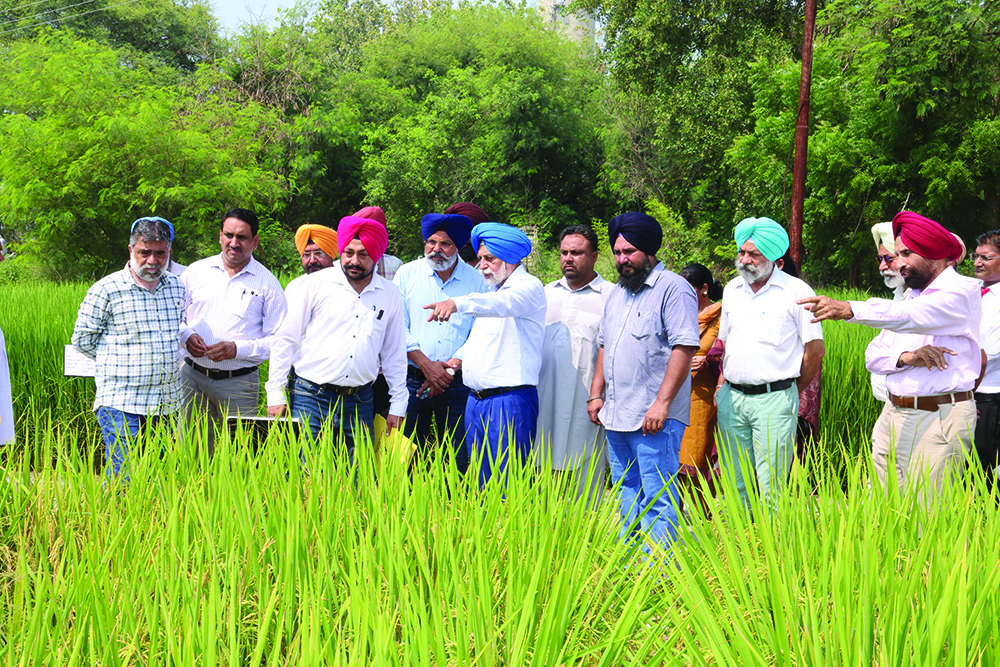
Satbir Singh Gosal and colleagues undertake a field inspection of short-duration rice trials at Punjab Agricultural University, Ludhiana. Photo credit: Punjab Agricultural PolicyAchieving the methane reduction targets set out in several international commitments, such as the EU Effort Sharing Agreement and the COP26 Global Methane Pledge, will require nothing less than a transformation of existing agricultural systems.
Fortunately, the transformation needed in terms of component solutions has largely been established by research. However, the ultimate success of this transformation hinges less on the range of available component solutions than on their sequencing – i.e. the order in which they are implemented.
Thus, a successful transformation programme will need packages of interventions that embrace capability, trust and incentives, implemented in the correct order.
Transition determines global stakes
The transition of agriculture to a low-carbon system fails less from a lack of solutions than from getting the order of implementation wrong. Ireland has been learning this lesson on nitrogen. The Netherlands is still working through it, and New Zealand has learned it on emissions pricing.
The technologies to cut agricultural emissions exist. Protected urea reduces nitrous oxide and ammonia emissions compared with conventional fertiliser. Precision nitrogen application, cover cropping and managed grazing reduce emissions in livestock and arable systems. Alternate wetting and drying in rice cuts methane emissions by 24-38% while saving 15% of water. Short-duration varieties, direct seeded rice and laser land levelling add further gains.
The question is why deployment has been uneven, slow and, in some cases, politically contested.
In the right order
Practice change requires three things: measurement, demonstration on real farms and incentives/disincentives. The latter only work once evidence, trusted advice and on-farm experience are in place. The correct sequencing of actions does not mature quickly. Even when the phases overlap, they are measured in years, not in seasons, and in lower-readiness settings, often over a decade or more.
Ireland’s experience with protected urea illustrates the principle of getting the phases of implementation in the correct sequence. Uptake was uneven for several years. Sustained advisory campaigns, on-farm demonstration through the Teagasc-led, stakeholder-driven Signpost farm programme, and trusted technical guidance helped to accelerate adoption. Where capability and trust matured alongside the policy signal, the instrument did its work.
When trust breaks, transition fails
The experience of The Netherlands illustrates what happens when the key adoption steps get out of kilter. Dutch nitrogen policy set reduction targets so severe that many farmers believed their operation could not survive them and the entire implementation process resulted in a collapse of trust rather than in a managed transition. The policy has been reopened, redesigned, and contested for several years running. A transition demanding sacrifices on this scale required trust and political acceptability that were not in place.
In New Zealand, government and the major farm organisations spent several years co-designing an agricultural emissions pricing scheme. The government departed from the partnership’s final recommendations in the design phase and the trust built through consultation broke down. The change of government in late 2023 led to agriculture being removed from the emissions trading scheme altogether. Ultimately, the political and farmer buy-in built during consultation did not survive through to implementation.
There is a common thread in the three examples. The order in which the trilogy of implementation elements (measurement, demonstration and incentives/disincentives) are introduced, and the trust and transition arrangements that accompany them, determine whether the outcome results in a durable change or a disruptive backlash. Trust lost in political confrontation lengthens the timeline further and is harder to rebuild than the capability that was missing in the first place.
Advisory systems build trust
Measurement requires both hardware and software (the people to use the equipment properly). Incentives/disincentives work best when farmers understand the information concerning the transition, meet the verification requirements, and believe the political commitment behind it will hold. If these requirements are not in place, there is the potential for resistance to set the process back years.
Advisory systems house the disciplines the transition requires. Where they have built deep farmer engagement over decades, they also carry the credibility that makes farmers willing to test, discuss and adapt difficult changes on their own farms. Ireland’s ongoing protected urea transition has relied on this credibility.
India’s rice – global stakes
Globally, India’s rice sector is critical to determining whether the Global Methane Pledge target of 30% reduction by 2030 will be achieved. Rice generates 17% of India’s agricultural greenhouse gas emissions, and solutions to reduce them are already available, including Punjab Agricultural University’s short-duration varieties and Direct Seeded Rice (tar wattar). Key pillars are in place: strong agricultural universities, active extension systems and farmer communities with a history of adopting demanding technologies when they are properly supported.
In many other countries, the science to implement the transition is in place. The real question is whether countries will begin at the end of the curve or begin where durable transitions always begin: with the skills, the institutions and the trust that lets everything else work.
Words by:
Gerry Boyle, former Director, Teagasc, Ireland, and
Satbir Singh Gosal, Vice Chancellor, Punjab Agricultural University (PAU), India.
Satbir Singh Gosal and colleagues undertake a field inspection of short-duration rice trials at Punjab Agricultural University, Ludhiana. Photo credit: Punjab Agricultural Policy