

Our Organisation Search Quick Links
Toggle: Topics

John Pringle November/December Update 2026

    Performance

    Bulls gained 1.85 kg/day between 12 September and 9 November.

    View

    Breeding

    • 46 of 47 cows scanned in calf. Thirteen of 17 heifers held to one AI service.
    • Five rams ran with 230 mature ewes for five weeks.
    • One ram ran with 75 ewe lambs for two weeks.
    View

    Health

    • All weanlings were vaccinated and dosed before housing.
    View

Performance

Despite the drought in the summer, the bull and heifer weanlings have performed well. Their 200-day weights from ICBF show the bulls were back 15 kg on last year and the heifers were back 38 kg.

Table 1. ICBF calf performance figures for 2025 and 2026.

Calf performance 2025 2026
Bulls at 200 days 312 kg 297 kg
Heifers at 200 days 301 kg 263 kg
Bull daily gain 1.33 kg 1.25 kg
Heifer daily gain 1.29 kg 1.10 kg

But the bulls really have made up ground since. I weighed 27 of them on 12 September and they averaged 275 kg. On 9 November, I weighed 26 and they averaged 384 kg. Looking just at the 26 on the scales both days, they put on 108 kg in 58 days. That’s 1.85 kg/day. It’s a short period, but that’s compensatory growth. On average, they’ll be a year old on 17 March 2027, so they have 128 days to put on 116 kg to reach that old target of 500kg at a year of age. I reckon mine will make 500kg at 11 months, they usually do 1.3 -1.4kg/day up to January.
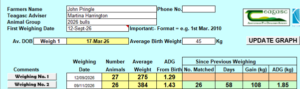
Demonstration farm weighing update for 2026 bulls. The first weighing on 12 September 2026 recorded 27 animals averaging 275 kg, with an average daily gain from birth of 1.29 kg. The second weighing on 9 November 2026 recorded 26 animals averaging 384 kg, with an average daily gain from birth of 1.43 kg. The 26 matched animals gained 108 kg over 58 days, averaging 1.85 kg per day. Average birth weight was 45 kg.

Figure 1. Bull weanlings weighed in September & November

Before weaning, I had the bulls creeping ahead of the cows and eating 3 kg of meal per day. I brought them in on 17 October, earlier than planned. They went onto straw with the same 3 kg of meal and good-quality silage. They settled well. After ten days, I moved them onto slats and went up to 4 kg of meal.

Video 1 Bull weanlings on silage and 4kg of mean in November

The heifers have caught up well too. I haven’t weighed them yet, but they’re a super bunch again this year. Looking at my Euro-Star report, 17 of the 22 heifers born in 2026 are rated four or five stars on the Replacement Index. That gives me plenty of choice when I’m picking replacements next year, but they’ll need to keep gaining weight as I want my replacements to be 60% of their mature body weight at breeding next April/May, that approx. 420kgs.

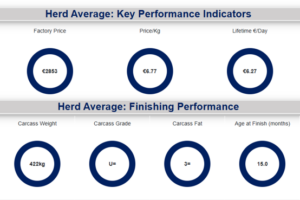
Last year’s bulls averaged a 422 kg carcass at exactly 15 months and graded U=, 3=. I’m happy with that weight. What I’d like to see now is whether I can get them there a little younger. I’m hoping the Limousin bull will bring a bit more shape and give me more U+ cattle. I’ll balance his use with my two Simmental bulls, I don’t want too much shape in the cows because I want to keep the cows easy-calving.

Table 2. Last year’s bulls at slaughter (ICBF Finishing Profile).

Measure Herd average
Carcass weight 422 kg
Conformation U=
Fat score 3=
Age 15.0 months
Herd average performance dashboard showing a factory price of €2,853, price per kilogram of €6.77 and lifetime return of €6.27 per day. Finishing performance shows an average carcass weight of 422 kg, carcass grade U=, carcass fat class 3= and age at finish of 15 months.

Figure 2. ICBF Finishing Profile for last year’s bulls.
Breeding

That brings me on to the breeding season, which went really well. I had 46 out of 47 cows in calf and 13 out of 17 heifers in calf. I’m very impressed with the heifers, as they were synchronised and had just one round of fixed-time AI with conventional semen.

I used two easy-calving sires, POWERFUL PROPER and GRENACHE. Their calving difficulty figures for heifers are 4.1% and 2.7% respectively. I used both sires last year too, and I’m very happy with their calves.

GRENACHE has a Replacement Index of €174, a carcass weight figure of +19.8 kg, a daughter milk figure of +5.1 kg and a daughter calving interval of −1.35 days. With those figures, I’d consider keeping some of his daughters as replacements.

POWERFUL PROPER is slightly negative for daughter milk and positive for daughter calving interval, so I’d be slower to keep his daughters. When I’m picking replacements, it’ll depend on the heifer each calf is out of, what the calf weighs next May and, most importantly, her temperament.

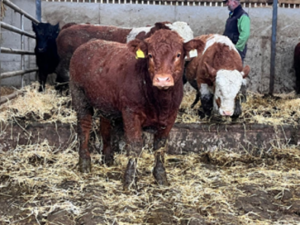
Figure 3. This bull calf weighed 369 kg on 9 November. His dam was born on 21 February 2024 and had him on 24 February 2026, just three days after she turned two. The sire was powerful Proper

Sheep

It’s a long time since I’ve had this much grass for the sheep at breeding. During the drought, I had to feed both the ewes and the lambs. The lambs had creep feeders, and I bought a snacker for the ewes. I load the hopper, set how much it drops in each heap and how many heaps I want, then drive through the field. It worked well on dry ground. Moving the ewes was easy too. They’d follow that snacker anywhere.

I gave the ewes a bolus before breeding, and they have access to a seaweed salt lick. I put two Belclare rams with a third of the 230 mature ewes and three Suffolk rams with the other two-thirds. The rams went in on 12 October and came out on 16 November. That gave any ewe that repeated a second chance to go in lamb. The ewes went to the ram in good condition and had plenty of grass. I’d like to scan at least 1.9 lambs per ewe, and I’d be delighted to get closer to two.

Lambing the ewe lambs worked well for me last year, so I’m doing it again. I put a Vendéen ram with 75 ewe lambs on 31 October and plan to take him out on 18 November. That’s 18 days in all. The ewe lambs will be lambing at the same time as the mature ewes, which gives me plenty of scope to foster any triplets. I’d be happy if 50–60% of the ewe lambs scan in lamb.

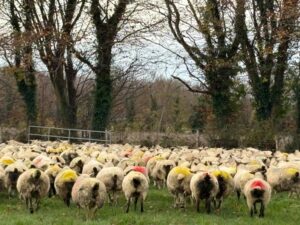
Figure 4. Ewes and rams on the move during the breeding season.

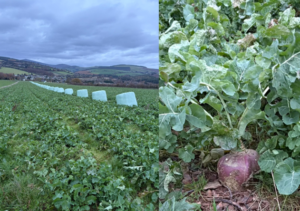
Once the sheep have grazed off the grass, I’ll move them onto stubble turnips and baled silage. That should keep them out until after Christmas.

Figure 5. Swedes and silage bales for the grazing sheep.

Fodder

There wasn’t much grass to spare during the summer, but I’ve a good pit of silage now, along with baled silage. I bought 60 bales of hay and another 50 bales of straw for feeding.

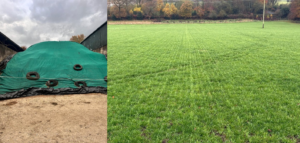
I’ve also sown four acres of forage rye with an ERTH drill. The seed cost €100 an acre. I spread slurry on the field and I’ll fertilise it in the spring. I’m hoping to get 10–12 bales an acre when I cut it in May 2027.

That’ll give me extra fodder to fall back on if we get another dry summer. If I don’t need it then, I’ll keep it for winter 2027/28 for the cows that need to lose a bit of condition after housing.

Figure 6. The silage pit going into winter on John’s farm and the four acres of forage rye.

Health

All the weanlings got two shots of Bovipast 4 weeks apart. They also got one shot of IBR vaccine when they got their second Bovipast shot. I dosed them with Levacide in September. I like to get this all completed in September so that, if I have to wean suddenly, they’re ready. This year it really paid off. I’d planned to wean and house them later, but for reasons outside the farm, I brought the date forward. I gave the ivermectin on the Monday, and the bull weanlings were weaned and housed that Saturday, 17 October.

Video 2. Bringing the bull weanlings in at housing in October

By then, the bulls were on 3 kg of meal a head per day and were creep-grazing ahead of the cows, so they were ready for weaning. As you can see from the video, they settled without a problem.

The heifers stayed out for another couple of weeks. I weaned them and brought them in late October. They got the same treatment as the bulls and settled just as well.

I have no fluke on the farm, so the only parasite treatment the cows get is a spot-on for lice.

I usually start calving in mid-February, so I’ll start giving the cows their rotavirus and coronavirus vaccine in January. Calving is spread over 10 weeks, so I split the cows into two groups by due date. The vaccination window is 12 to 4 weeks before calving. I aim for 4 to 5 weeks before each group calves, as I want to maximise the antibodies in the colostrum. I give them their IBR vaccine at the same time.

The in-calf heifers are still out. I’m waiting for a pen of finishing cattle to go before I can bring them in. I’ll dose them at housing. They’re still young and in calf, and I want to give them every chance.

Video 3. In-calf heifers at grass in November 2026