
Join the ElmAsh Research Project and help conserve Ireland’s remaining elm trees for future generations. Teagasc is seeking reports of healthy, mature elm trees across the country to support ongoing elm conservation, monitoring, and research activities.
Elm populations in Ireland have been severely affected by Dutch elm disease (DED) over the past century. While many trees have declined, some mature elms continue to survive and appear healthy, including in areas where diseased or dead elms are present. These surviving trees may possess traits associated with tolerance, resilience, or escape from disease pressure and are therefore of scientific and conservation interest.
By identifying and monitoring healthy elm trees, the ElmAsh project aims to:
- Support elm conservation and genetic resource collection
- Identify trees for further scientific evaluation
- Contribute to future breeding and restoration efforts
- Improve understanding of elm survival under Dutch elm disease pressure
Identifying Elm Trees
Elm trees can be identified by their distinctive leaves, flowers, and winged seeds (samaras). The images below show typical elm characteristics that may help with identification when reporting trees to the ElmAsh project.
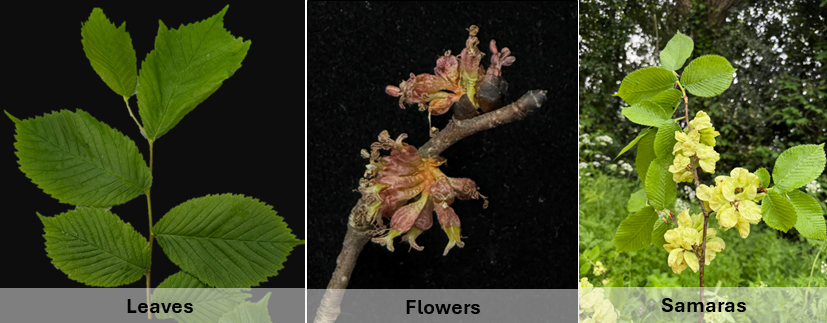
From left to right: elm leaves, elm flowers, and elm samaras (winged seeds). Photographs of leaves, bark, and seeds are particularly useful in helping the research team confirm species identity and assess trees for follow-up surveys.
What Trees Are We Looking For?
We are particularly interested in elm trees that meet some or most of the following criteria:
- Mature trees, ideally taller than 5 metres in height
- Trunk diameter (DBH) greater than 20 cm (ideally >30 cm)
- Healthy crown structure with limited dieback or wilting
- Trees showing good vigour and growth
- Trees growing near dead or declining elms, but themselves appearing healthy
- Trees producing seed or suckers (where present)
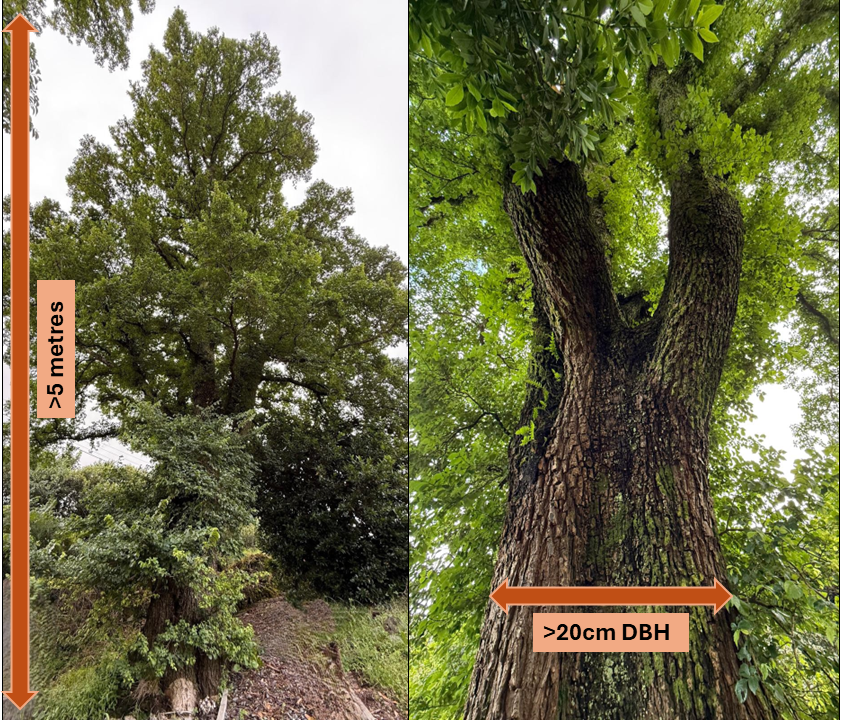
Example of a mature elm tree of conservation interest. Trees greater than 5 metres in height and with a trunk diameter (DBH) greater than 20 cm are of particular interest to the ElmAsh project.
Younger trees that appear healthy in areas affected by Dutch elm disease may also be of interest and are still worth reporting.
Please note that visually healthy trees are not automatically considered disease resistant. Further scientific assessment and long-term monitoring are required to evaluate their potential importance for conservation and breeding programmes.
How to Report a Healthy Elm Tree
If you have identified a healthy elm tree, please contact us at:
Please include:
- Your name (and/or landowner name)
- Tree location (Eircode or GPS coordinates where possible)
- Contact phone number
- Photographs of the whole tree and close-up images of leaves and bark
The information collected will contribute to a national database of healthy elm trees in Ireland. Selected trees may be visited during the growing season for further assessment and potential collection of propagation material for conservation and research purposes.
Further information
Dr Dheeraj Rathore, Tree Improvement Researcher
Teagasc, Forestry Development Department, Oak Park Research Centre, Carlow R93 XE12, Co Carlow, Ireland
Telephone: +353 (0) 59 917 0218 / +353 (0) 87 193 4169