
Commercial Beef Value: making genetics work in the dairy-beef system


Summary
- Commercial Beef Value (CBV) allows beef farmers to purchase superior calves/store cattle.
- Research at Teagasc Grange comparing High- and low-CBV Angus × Holstein-Friesian steers across three different calf-to-beef systems found that, on average, high-CBV animals had an 18 kg heavier carcass (worth €115 extra @ €6.40/kg).
- Angus sire CBV has improved by 57% since 2010, with similar gains across Hereford, Charolais and Limousin.
What is the Commercial Beef Value?
Every spring, beef farmers across Ireland purchase dairy-beef calves and face a simple question: which calves will perform best in my system? Knowing which calf is likely to exhibit good performance traits over its lifetime can be difficult when purchasing at three to four weeks of age, but the Commercial Beef Value (CBV) changes that. Just like the EBI and Euro-Star indexes, the CBV is a €-denominated genetic index developed by ICBF, where a higher Euro value means higher genetic merit. The CBV covers traits of economic importance to a drystock farmer, such as carcass weight, conformation and feed intake, and is similar to the Dairy Beef Index (DBI) but without the calving component. In practical terms: under similar levels of management, a calf with a CBV of €120 should deliver €75 more profit than one with a CBV of €45, through increased carcass weight, better feed efficiency and potentially an earlier slaughter date.
The genetic opportunity in Irish dairy-beef systems
Dairy-beef production in Ireland has grown rapidly, driven by the large increase in dairy cow numbers in recent years. In addition to this, as Figure 1 shows, sexed semen usage on dairy cows has also increased, rising from just 2% of all dairy artificial inseminations in 2019 to 30% in 2025. As sexed semen generates more dairy heifer replacements from fewer cows, dairy farmers can direct a greater share of matings toward beef bulls. Beef artificial inseminations have grown from around 250,000 in 2019 to over 600,000 in 2025, while conventional dairy artificial inseminations have almost halved. The result is that there are now more dairy-beef calves born on Irish dairy farms than dairy-dairy calves, a crossover that occurred in 2023 and continues to diverge. More dairy-beef calves are entering Irish beef finishing systems than ever before, and the genetic quality of the beef bulls producing them has never been better (Figure 2).
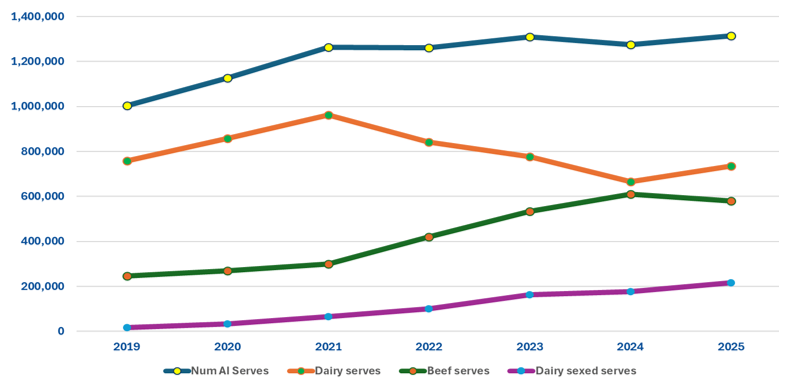
Figure 1. Artificial insemination (AI) usage in the national dairy herd, 2019–2025. Total inseminations (blue); beef (green); conventional dairy (orange); sexed semen (purple). Source: ICBF
Figure 2 shows that the genetic merit of beef sires used on dairy cows has improved across all major breeds since 2010 — Angus sires, now the most widely used breed on dairy cows, have improved by 57%, with similar gains across Hereford, Charolais and Limousin. Importantly, this has not come at the expense of calving ease. Figure 3 shows that the DBI calving sub-index of sires used on dairy cows has also improved across all breeds over the same period — the bulls selected today are both better for beef and easier calving than those used in 2010. The DBI is working as intended, and selecting beef bulls with a high DBI will generate higher CBV calves without increasing calving risk.
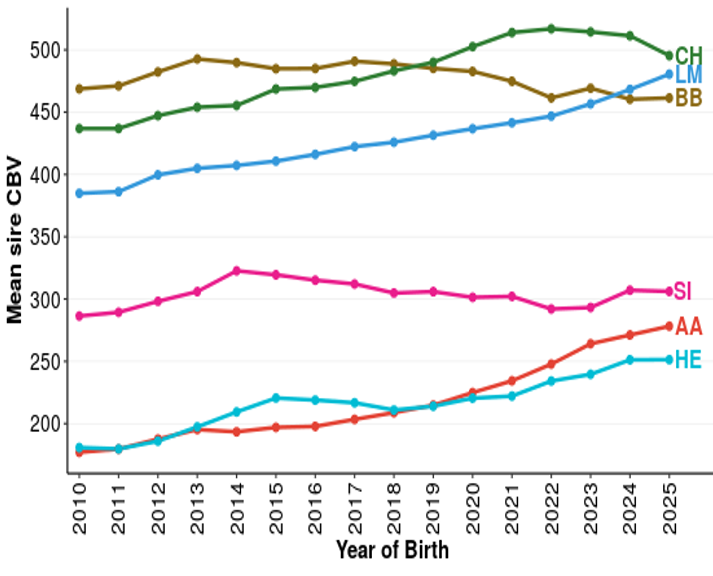
Figure 2. Mean sire CBV by breed.
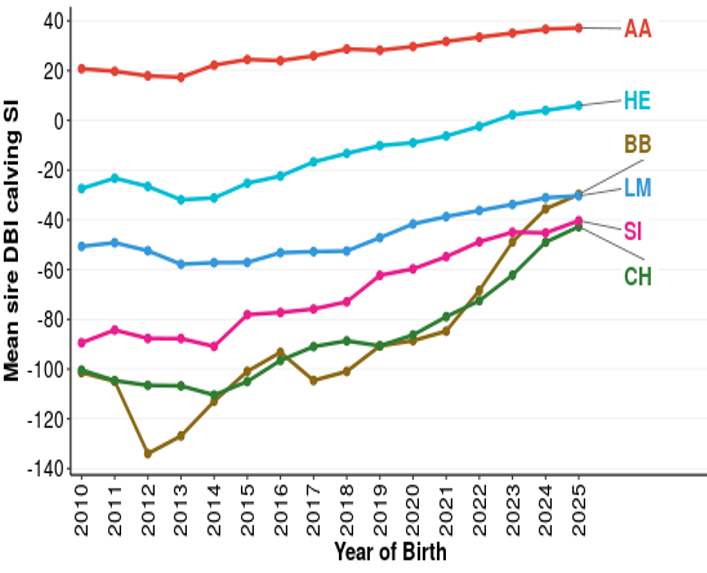
Figure 3. Mean sire DBI calving sub-index by breed.
Does it pay beef farmers to select on CBV?
The central question for any beef farmer is whether a calf’s CBV at purchase predicts how that animal will perform at slaughter. The Teagasc Grange dairy-beef research herd provides a direct test under standardised management conditions. Table 1 compares Holstein-Friesian (HF) steers and high- and low-CBV Angus × Holstein-Friesian steers reared across three contrasting calf-to-beef systems at Grange. Averaged across the three systems, high-CBV steers produced carcasses 18 kg heavier, graded better (O+/O= vs O=), and a greater proportion met carcass specifications compared to low-CBV steers. At current base carcass prices of approximately €6.40/kg, the 18 kg carcass weight advantage of high-CBV steers represents approximately €115 extra value per head, or over €5,750 for a batch of 50 calves.
Table 1. Mean daily live weight gain (ADG) and carcass performance of Holstein-Friesian (control) and Aberdeen Angus× Holstein-Friesian steers differing in Commercial Beef Value (CBV) reared on three contrasting calf-to-beef systems at Teagasc Grange
| Group | CBV (€) | ADG (kg) | Slaughter age (months) | Carcass weight (kg) | Conformation
|
Meeting
carcass spec |
| Holstein-Friesian (reference) | −5 | 0.82 | 23.5 | 316 | O− | 21% |
| High-CBV (high beef sub-index Angus) | €133 | 0.91 | 20.7 | 312 | O+/O= | 73% |
| Low-CBV (low beef sub-index Angus) | €92 | 0.87 | 20.8 | 294 | O= | 53% |
| Difference (High- vs Low-CBV) | +€41 | +0.04 | −0.1 | +18 kg | O= → O+/O= | — |
Data generated by the ICBF Beef and Dairy Research Centre, Tully has shown that cattle in the top 20% for CBV produced carcasses 12 kg heavier, with one full conformation grade improvement and a 2.3% higher kill-out percentage, while eating 0.7 kg less dry matter per day than those in the bottom 20%, further indicating the benefit of CBV for identifying feed efficient beef cattle genetics.
Does it pay dairy farmers to use high-Dairy Beef Index (DBI) beef bulls?
Every spring, the decision dairy farmers make on which beef bull to use will impact the potential income of every beef farmer who purchases their calves. From an analysis of almost 46,000 Angus × dairy steers finished in Ireland in 2025 (Table 2), the top 20% CBV calves sold at the mart for €200, which was €55 more than the bottom 20% animals sold at the same point of purchase. Those same top 20% calves returned €170 more at the factory, were finished 27 days earlier and had a lower carbon footprint.
Table 2. Performance of Angus × Dairy steers finished in Ireland in 2025 by Commercial Beef Value (CBV) rank group at €7.78/kg carcass weight.
| CBV rank | CBV (€) | Calf price (€) | Finish price (€) | Finish weight (kg) | Conf.
Score (1-15) |
Fat score
(1-15) |
Finish age (days) | GHG emissions (CO₂e/kg carcass) |
| Bottom 20% | €73 | €145 | €2,471 | 318 | 5.3 | 8.2 | 885 | 16.0 |
| 20–40% | €113 | €170 | €2,528 | 326 | 5.4 | 8.3 | 876 | 15.9 |
| 40–60% | €136 | €185 | €2,555 | 329 | 5.4 | 8.3 | 867 | 15.7 |
| 60–80% | €157 | €190 | €2,592 | 333 | 5.5 | 8.4 | 858 | 15.6 |
| Top 20% | €188 | €200 | €2,640 | 339 | 5.7 | 8.4 | 858 | 15.6 |
| Diff. Top vs Bottom | +€116 | +€55 | +€170 | +21 kg | +0.4 | +0.2 | −27 days | −0.4 |
Conf. = conformation score (1–15 numeric EUROP scale). CO₂e / kg carcass weight = carbon footprint. Source: ICBF (2026)
The beef sub-index of the DBI directly determines the carcass weight and conformation genetics transmitted to progeny and it is these traits that drive CBV. Selecting a high-DBI beef bull on the dairy farm is therefore the most direct lever a dairy farmer has to raise the CBV of the calves they sell. For the dairy farmer, using a high-DBI over a low-DBI beef bull is generally cost-neutral at AI service but generates calves the market is already paying a premium for. The €55 extra paid at purchase for a top 20% CBV calf returns €170 more at slaughter, a ratio of more than 3:1 on that investment, plus a further estimated €46 per head from the 27-day earlier finish, based on Teagasc finishing cost estimates.
Does selecting for higher CBV mean harder calvings?
The beef sub-index of the DBI is the primary driver of a calf’s CBV — so a bull with a higher beef sub-index will sire higher-CBV calves. Table 3 shows a national comparison of two Angus bulls widely used on dairy cows. Bull A had a DBI of €170, beef sub-index of €92 (+2 kg carcass, +0.98 conformation, −18 days to slaughter) and calving sub-index of €66 (2.2% difficult calvings, −3.5 days gestation). Bull B had a DBI of €179, beef sub-index of €112 (+13.8 kg carcass, +0.95 conformation, −19 days) and calving sub-index of €58 (2.8% difficult calvings, −3.4 days gestation). The two bulls are similar in overall DBI but differ meaningfully in beef merit, and this is reflected in their progeny. Compared to Bull A, Bull B’s calves had +€20 CBV, returned €99–€116 more in carcass value per head, sold for €12 more as calves, and saved €63 per head on estimated finishing costs from 18 fewer days to slaughter, which is worth over €15,000 across 100 cattle. Yet, there was no meaningful difference in unassisted calving rates (95% vs 96%). Therefore, when selecting beef bulls for use on dairy cows, first identify all bulls within your acceptable calving difficulty threshold, and from those, select the ones with the highest beef sub-index to maximise profitability.
Table 3. Progeny performance of Bull A (lower Commercial Beef Value (CBV); progeny CBV, €150) compared to Bull B (higher CBV; progeny CBV, €170) used on dairy cows nationally.
| Gender | Carcass wt. (kg) | Conformation score | Finishing age (months) | Value/head (€) | Unassisted calving | |
| Lower CBV bull
Progeny CBV: €150 |
Heifer | 257 kg | O=/O+ | 22.7 | €1,992 | 95.9% |
| Steer | 314 kg | O+ | 24.5 | €2,412 | 95.9% | |
| High CBV bull Progeny CBV: €170 | Heifer | 272 kg | O=/O+ | 22.2 | €2,108 | 95.5% |
| Steer | 327 kg | O+ | 23.8 | €2,511 | 95.5% | |
| Difference (High − Lower CBV bull progeny) | — | +13–15 kg | Similar | -0.5 months | +€99–€116 | No difference |
Conclusions
The CBV reliably predicts carcass performance from birth to slaughter. High-CBV calves produce heavier, better-conformed carcasses, meet factory specifications at a higher rate, and return more profit per head. Checking CBV at calf purchase is one of the simplest and highest-return decisions available to beef farmers.
Compiled and edited by Mark McGee and Paul Crosson, Teagasc, Grange Animal & Grassland Research and Innovation Centre, and first published in BEEF2026 – Driving Sustainable Performance, additional reading from BEEF2026 is available here.