
Developing premium Irish beef through dry aging and novel processing technologies

Summary
- Dry aging enhances beef quality by improving flavour, tenderness, and overall eating quality through a combination of moisture loss, proteolysis and generation of flavour and aroma precursors.
- Advanced analytical approaches, including proteomics and metabolomics, reveal how dry-aged beef undergoes distinct biochemical and structural changes over time, depending on processing, influencing dehydration, protein degradation and flavour development.
- Emerging pre-dry-aging technologies such as high-pressure processing (HPP) and ultraviolet (UV) light show potential to accelerate and manipulate dry aging outcomes by promoting biochemical changes associated with flavour formation.
Irish beef is well-known around the world and is synonymous with being high quality, flavoursome and nutritious, thanks to our pasture-based farming systems. Considering this high-value raw material, industry is increasingly seeking opportunities to further enhance the eating quality and consumer acceptance of Irish beef. Extensive research has been carried out on this area at the Teagasc Food Research Centre in Ashtown, Dublin, where a particular area of interest in recent years has been on dry aging. In this regard, Teagasc led an international joint effort (INIA-Uruguay, IRTA-Spain, AgResearch-New Zealand and Teagasc-Ireland) to develop smart dry-aging processes focused on pasture-based production systems. This recently completed project brought together international expertise in animal production, customisation of dry-aging process, advanced -omics approaches and application of innovating processing technologies. This project demonstrated that, i) -omics tools, such as proteomics and metabolomics, are essential to understand the biochemical changes taking place during aging and its impact on aroma and flavour precursors, ii) showed how grass-fed beef is an excellent raw material for high-quality dry aged meat and iii) established the basis of future research on advanced processing technologies aiming to make this process more sustainable and economically feasible.
What is dry aging?
Dry aging involves storing beef (carcasses, primal or subprimal cuts) without packaging (or using water permeable packaging materials) under controlled conditions (typically 0 – 4 °C and 75 – 85% relative humidity) for between 14 to 35 days. This is opposed to the conventional method of aging (i.e. wet aging), whereby primals are vacuum packed prior to maturation. Dry aged beef is sold at a premium price as it produces a first-class flavoured product; however, dry aging reduces saleable yield (compared to wet aging) and promotes crust formation, which needs to be trimmed prior to sale. The time required for dry aging and related reduction in yield makes dry aged beef a more expensive product when compared to wet aged beef.
What happens in the meat throughout dry aging?
1. Water migration and evaporation
Water loss is the key macroscopic event that occurs during dry aging, due to water migration from the core to the surface, and subsequent loss from the surface of the muscle via evaporation. This water loss favours the concentration of flavour and aroma related molecules, developed during the maturation process. Research carried out at Ashtown has found that the rate of moisture loss is influenced by the shape and size of muscle (geometry) being aged. It was found that thinner cuts, such as slices (0.5 cm thick) and steaks (2.54 cm thick) lost moisture faster than sections (24 cm thick). In all cases, moisture content decreased exponentially over time until an equilibrium was reached (final weight). The final weight loss at equilibrium for each muscle geometry studied, differed. For example, slices were ~68% of initial weight after 22 days, steaks were ~58% of initial weight after 48 days, and sections were ~33% of initial weight after 48 days of dry aging. Prediction models developed based on this work, means that processors can now better estimate how long it will take to reach a target moisture content and thus control the dry aging process, helping to balance meat quality and yield reductions.
Subsequent research at Teagasc explored water loss at a deeper level by examining the moisture content and water activity of internal and external locations within section of muscle before and after dry aging. To establish a baseline prior to dry aging, a 5 cm thick section was examined across internal and external locations. Water activity across the section was uniform, and moisture content varied minimally within the section (<2%; ~ 72-74%) indicating no strong internal gradients were present. However, following 48 days of dry aging, a pronounced gradient had developed across the diameter of the dry-aged piece. Internal regions retained high moisture (~69%), in-between regions contained ~59%, whereas external regions were much drier (~36%), confirming that water had migrated outward. This migration, however, was limited by matrix properties and the formation of crust on the surface, restricting the evaporation rate. Water populations (i.e. how the water molecules interact with the meat matrix: free water, trapped water or bond water) were also investigated. The most mobile fractions—free and entrapped water—decreased significantly in the internal regions of the meat over time, while the proportion of more tightly bound water increased. This indicates that the more mobile water moved outward first and was removed during evaporation at the surface, leaving behind water that is more strongly associated with muscle structures. This phenomenon was more evident in thinner geometries, such as slices and steaks.
2. Proteolysis and oxidation
Lipid and protein oxidation are the key biochemical drivers for the development of the characteristic flavour of dry aged beef. During dry aging, proteolysis also occurs as enzymes such as calpains and cathepsins break down muscle proteins over time, contributing to the tenderisation of beef, while also releasing free amino acids and peptides that act as flavour and aroma precursors. The combination of these two processes produces a premium, tender beef product with enhanced flavour and aroma. Studies carried out in Teagasc, Ashtown have also shown that at a molecular level (using a proteomics approach), the inner and outer regions of dry aged meat evolve differently over time due to differences in oxygen exposure, microbial activity and dehydration. The outer surface showed greater antibacterial activity, protein folding and metabolic pathways associated with dehydration and oxygen exposure, while the inner region had more abundant proteins linked to muscle structure and tissue organisation. Proteomic analysis also showed that beef aged using dry- or wet-aging, and animals finished on either grass-based or concentrates-based diets had differential proteomics profiles (Figure 1), and thus, potential differences in organoleptic features.
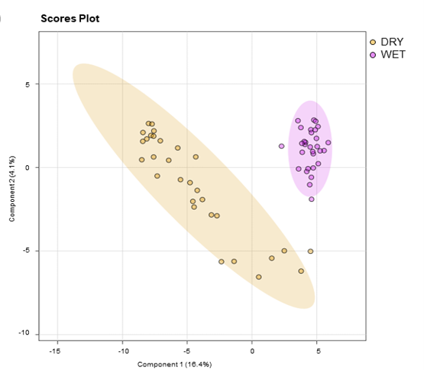
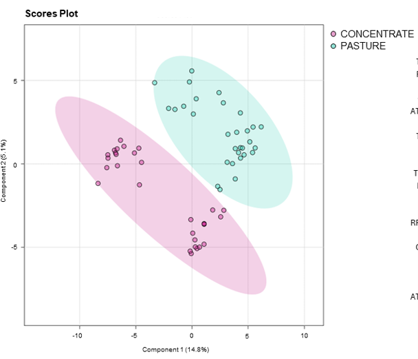
Figure 1. Partial least squares-discriminant analysis (PLS-DA) score plot according to aging method – dry vs wet (left) and feeding system concentrate-based vs pasture-based (right).
Metabolomic studies, in which dry-aged samples were evaluated at different time points over 28 days, further identified increases in flavour-related compounds such as peptides and lipid-derived metabolites during aging. It was demonstrated that although most of the metabolites were generated in the first 14 days of aging, their concentrations still change gradually during the entire period of maturation.
3. Tenderisation
Tenderisation is another key process that occurs during dry aging and is a major contributor to the enhanced eating quality associated with dry aged beef. Proteolysis is principal mechanism responsible for this tenderisation and involves the progressive degradation of key myofibrillar proteins by endogenous proteolytic enzymes, including calpains, cathepsins, and caspases. As aging time increase, Warner-Bratzler shear force (WBSF) values decrease significantly, indicating a progressive improvement in meat tenderness. Further evidence of proteolysis during aging is provided by increases in myofibrillar fragmentation index (MFI) values over time. MFI is used as an indicator of myofibril protein degradation, with higher values indicating greater disruption of the myofibrillar structure. The increase in MFI observed during dry aging suggests that proteolysis continues throughout the aging period, resulting in the weakening of muscle fibre integrity and contributing to the development of a more tender product.
Can we improve or accelerate the dry aging process?
While we can control the shape and size of the beef being dry aged, innovative technologies such as high-pressure processing (HPP) and ultraviolet (UV) light have been investigated at Teagasc, Ashtown as potential methods to manipulate dry aging.
High-pressure processing has the potential to accelerate the dry aging process, but this must be carefully controlled as it can negatively affect quality parameters of dry aged beef, such as tenderness. This has been demonstrated when investigating the effect of HPP on the metabolomic profile of beef over time, where it was found that while the metabolomic profile of bovine muscle did not change immediately post-treatment, changes between control and HPP treated muscle evolved differently over time, as indicated by the three groupings in Figure 2, potentially impacting on the final flavour of dry aged beef. The metabolites most impacted by HPP were peptides and phospholipids. When investigated over dry aging time, the metabolites most impacted were peptides and nucleotides. If pressure levels or treatment durations are too high, HPP can negatively affect key quality traits of beef such as tenderness, colour and lipid oxidation. However, under the right processing conditions, HPP could accelerate the generation of aroma-related molecules.
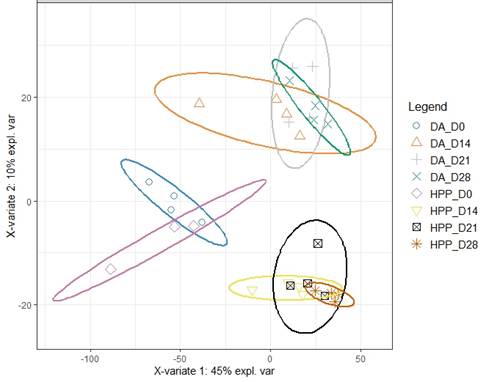
Figure 2. Partial least squares-discriminant analysis (PLS-DA) score plot differentiating the metabolomic profile of bovine Longissimus thoracis et lumborum according to aging time (D0, D14, D21 and D28) and process method (with HPP (HPP) or without HPP (DA))
Intense UV light exposure before dry aging can promote the accumulation of flavour and aroma-related compounds, potentially shortening the aging time required to achieve a complex and rich flavour profile. This accelerated formation was not linked to an increase in lipid oxidation, thus increasing the likelihood for this technology to potentially reduce aging time to achieve desired aroma profiles.
Conclusions
Dry aging enhances Irish beef by improving flavour, tenderness and overall quality through moisture loss, proteolysis and oxidation. Meat geometry plays a key role in controlling water loss, enabling processors to better predict and manage yield and process efficiency. Advanced -omics approaches reveal that biochemical changes during aging are both time- and location (i.e. internal vs external)-dependent, providing deeper insight into flavour development and structural transformations. Emerging technologies such as HPP and UV light offer promising opportunities to accelerate and control these changes, potentially reducing aging time, while maintaining quality.
Compiled and edited by Mark McGee and Paul Crosson, Teagasc, Grange Animal & Grassland Research and Innovation Centre, and first published in BEEF2026 – Driving Sustainable Performance, additional reading from BEEF2026 is available here.