
Farming for the next generation


Summary
- European and Irish farming face a pronounced ageing problem.
- The share of Irish farmers aged over 65 rose to 38% in 2023 while those aged under 35 fell to 4%.
- Generational renewal strengthens farm sustainability: younger farmers tend to adopt new technologies and invest in infrastructure.
- Combined with the older generations’ knowledge and experience, an intergenerational mix can bring both innovation and continuity, improving resilience and farm performance.
- Data from the National Farm Survey shows that hours worked per farm on cattle farms have declined since 2010.
- 60% of cattle farmers aged over 60 have identified a successor, with 38% expecting farm transfer to occur within 5 years.
Generational renewal in farming is generally understood to mean younger farmers taking over from the older generation in running and owning farms (Department of Agriculture, Food and the Marine – DAFM, 2025).2
It should be seen as a process rather than a single event and it has been described in the literature as a “ladder of transition”. Generational renewal has emerged as a critical challenge for European agriculture, reflecting a rapidly ageing farm population and persistent barriers to entry for younger and new farmers. Across the EU, the average farm holder is now aged 57 years. Data from the most recent Census of Agriculture in 2020 indicates that 33 percent of EU farmers are aged over 65 with only 12 percent aged under 40 (Figure 1).
The age profile of Irish farm holders is generally in line with the EU average. Although the picture differs across countries, this can in part be explained by differences in farm types and structures (e.g. younger farmers may be more active in countries where there is a strong culture of farm-related businesses in food and tourism such as Austria, or where farms tend to be run on a more part-time basis). The ageing profile of farm holders raises concerns for the long‑term sustainability and competitiveness of the agricultural sector, and the EU has now set a target of doubling the share of young and new farmers by 2040.3
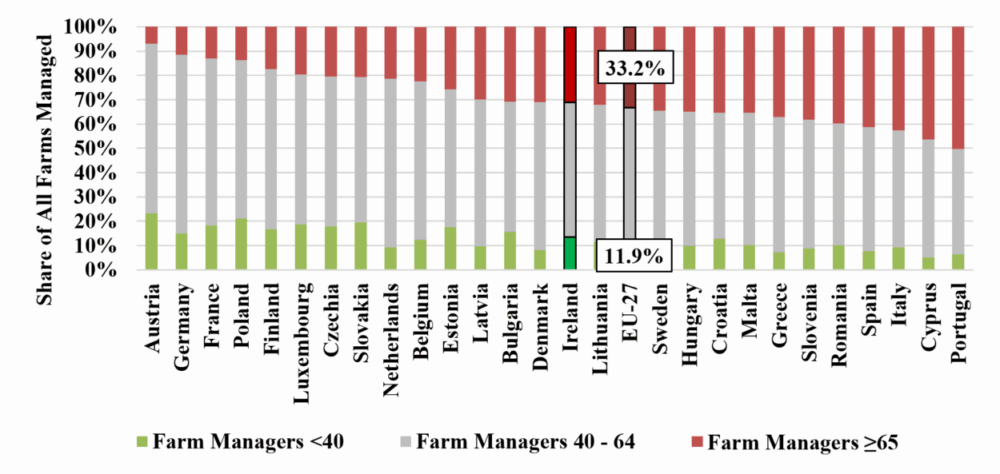
Figure 1. Share of farmers by age – EU Member States 2020. Source: Eurostat
The decline in the demographic profile of Irish farm holders is reflected in data from the Central Statistics Office (CSO) over the last three decades (Figure 2) which illustrates an increasing trend in the proportion of farmers aged over 65 and a declining trend in the younger age categories.
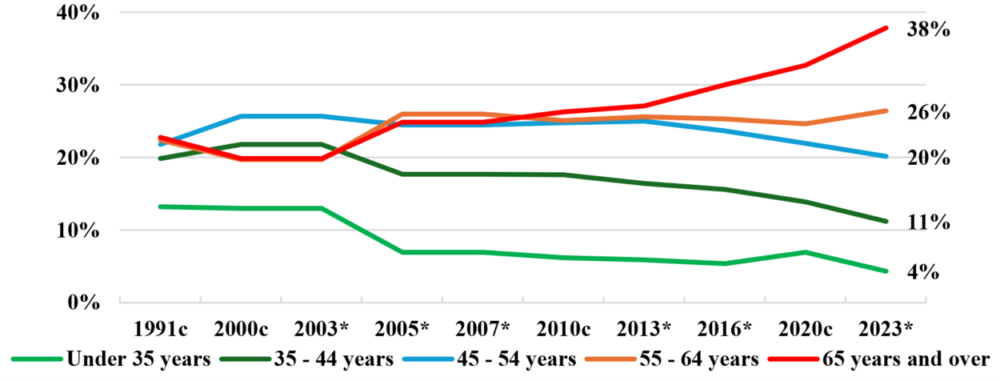
Figure 2. Share of farmers by age – Ireland 1991-2023. Source: CSO (Years C=Census, *=Farm Structures Survey)
This demographic imbalance threatens the future of Irish farming and the sector’s capacity to maintain productivity and competitiveness, ensure innovation uptake, support rural vitality and meet binding climate targets. The problem persists despite the inclusion of targeted schemes for young farmers in the latest CAP. The recent Commission on Generational Renewal in Farming has advanced recommendations spanning CAP supports, taxation, pensions, collaborative farming models and gender balance.
Much research supports the broad idea that generational renewal can improve the sustainability of farming. Younger farmers are more likely to adopt new technologies, invest in infrastructure, and pursue growth-oriented strategies. The presence of a successor has been shown to influence farm investment decisions well before formal succession occurs. Older generations contribute valuable knowledge and experience, while younger members bring fresh perspectives, technical expertise, and a greater willingness to take risks. However, succession on farms is rarely clear cut and a broad range of supports are needed to facilitate it, taking account of individual farm and family circumstances. A recent study by Mullan (2026) engaged with potential successors on beef and sheep farms on the island of Ireland and found that succession can be driven by family values and relationships.4 Most participants felt a strong attachment to the land and a duty to keep the farm in the family, but many also had off‑farm commitments which made taking full control difficult in practice. Partnership arrangements between farmers and new entrants (both family and non-family) can be mutually beneficial in supporting the involvement of both generations in managing the farm where that is desired.
Insights from the National Farm Survey
The National Farm Survey (NFS) has been conducted by Teagasc on an annual basis since 1972. The survey is operated as part of the EU Farm Sustainability Data Network and fulfils Ireland’s statutory obligation to provide data on farm output, costs and income to the European Commission. A random, nationally representative sample, of about 900 farms across systems (Cattle, Sheep, Dairy and Tillage) is selected annually in conjunction with the CSO. Each farm is assigned a weighting factor so that the results of the survey are representative of the national population of farms. In assessing the economic performance of farms, their economic viability is considered. A farm business is defined as viable if its Family Farm Income is sufficient to remunerate family labour at the minimum wage and provide a five percent return on the capital invested in non-land assets, i.e. machinery and livestock. Figure 3 summarises the viability performance of cattle farms from 2010 to 2023, comparing farm performance according to the age of the main farm operator (both above and below 50 years). The data indicates that those farms operated by younger farmers are consistently more viable over the period.
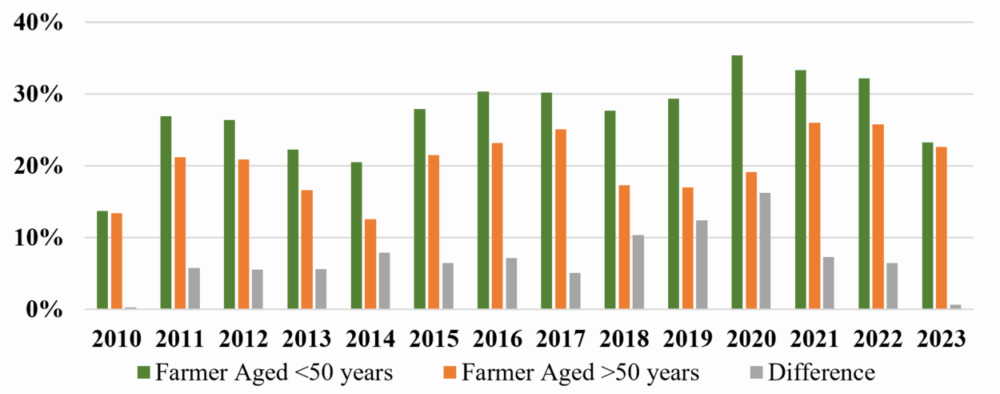
Figure 3. Viability of cattle farms by farmer age. Source: NFS
In addition, the data indicates that those households with younger members who are involved in farm work generally reported an improvement in viability over time. In exploring the role of younger people on farms, the NFS collects information on the age profile and hours worked by the farmer and other household members. A summary from cattle farms is contained in Table 1. In line with an ageing farm holder profile, a declining trend in demographic viability is evident (i.e. a lower proportion of farm households had a member aged below 44 years in 2023 compared to 2010). A dramatic increase in the proportion of farmers working off-farm and those in receipt of a pension is also evident.
Table 1. Farm household demographic data 2010 and 2024.
| Cattle rearing | Cattle other | |||
| 2010 | 2024 | 2010 | 2024 | |
| Farm Holder Age | 53 | 61 | 56 | 60 |
| % HH with members aged <24 years | 39 | 20 | 41 | 33 |
| % HH with members aged 22-44 years | 42 | 35 | 31 | 34 |
| % Demographically viable | 71 | 47 | 67 | 55 |
| % Farmers with off-farm job | 34 | 47 | 38 | 55 |
| % Farmers and/spouse off-farm job | 53 | 61 | 53 | 64 |
| % Farms HH in receipt of a pensiom | 25 | 46 | 21 | 38 |
| Source: NFS | ||||
To date, much discussion on the generational renewal challenge has focused on the main farm operator, with less official information available on the involvement of other household members. Data from the NFS indicates that, on average, hours worked by cattle farmers has declined over the past two decades (with an annual figure of approx. 1,700 hours per farm reported in 2010 compared to 1,400 per farm in 2023). In further exploring family labour contribution by household member age category, Figure 4 indicates that the labour contribution of family members (excluding the main farm operator) was lower in 2023 compared to 2010 across age categories apart from a marginal increase in the 25-44 year group (slightly up to 590 hours in 2023).
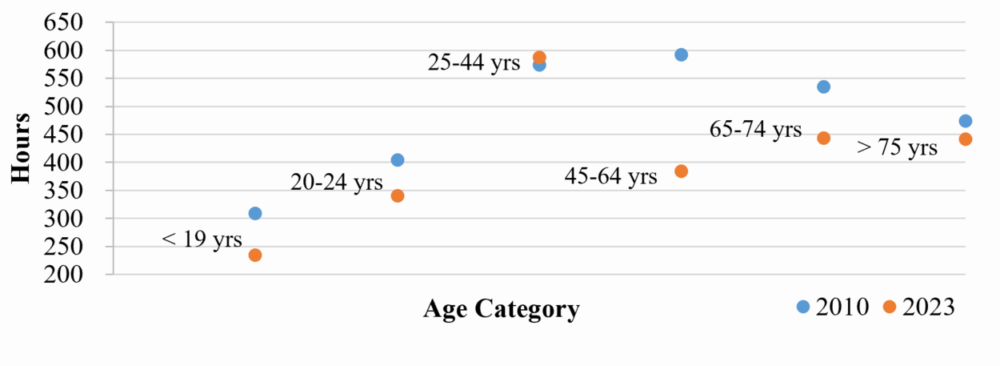
Figure 4. Self-reported family labour hours (excl. farmer) by age – 2010 vs 2023 (NFS)
Planning for the future
In 2023, the NFS reported that 77% of cattle farmers have been the main operator of their farm for more than 20 years, with a further 15% in managerial control for 10-20 years and the remaining 8% for less than 10 years. In terms of succession planning, 60% of cattle farmers aged over 60 years had identified a successor, although a formal plan may not be in place. Of the identified successors, 86% were male. When asked when farmers expected the transfer to take place, 38% expected this to occur within the next five years, a further 45% within 5-10 years, 11% within 10-15 years and 6% beyond 15 years. Of those farms where a successor had not yet been identified, 84% of farmers intended to continue farming, with 11% more uncertain as to the future of the farm. Only 1% of farmers expected the farm to be sold with the remaining 3% open to long-term leasing.
Acknowledgements and references
1The authors would like to acknowledge the kind participation of NFS farmers and their data collectors, research collaborators, and funding received from the Department of Agriculture Food and the Marine Policy and Strategic Studies Research Call (GENFARMS 2023PSSRC917) and the Teagasc Walsh Scholarship Scheme.
2Commission on Generational Renewal in Farming.
3European Commission Strategy for Generational Renewal.
4Farm succession on the island of Ireland: exploring succession intentions among older potential successors through a multidimensional person environment fit lens. PhD thesis, Ulster University.
Compiled and edited by Mark McGee and Paul Crosson, Teagasc, Grange Animal & Grassland Research and Innovation Centre, and first published in BEEF2026 – Driving Sustainable Performance, additional reading from BEEF2026 is available here.