
Health management of purchased weanlings and store cattle


Summary
- Repeated animal movements are an inherent feature of Irish beef production systems; good management practices can help minimise impacts on cattle health and growth performance.
- Research shows that each additional change of location (movement) is associated with an increase in finishing age of ~20 days, highlighting the value of integrated health and management strategies.
- Many purchased cattle may appear healthy on arrival but can carry subclinical disease; early detection and preventative health planning help maintain growth and finishing efficiency.
- Proactive management of purchased cattle, including reducing stress at arrival, maintaining strong biosecurity, strategic vaccination and parasite control, as well as ongoing monitoring, can significantly improve lifetime growth performance and reduce disease risk.
Beef farming in Ireland is characterised by many different production systems and repeated animal movements are an inherent feature. The structure of the sector typically involves cattle moving through several holdings before slaughter, often transferring from dairy or suckler herds to specialist rearers and subsequently to finishing farms. While this system supports efficient use of land, labour and other resources, it also exposes animals to repeated physiological and environmental stressors. These include transport, co-mingling with unfamiliar cattle, dietary changes, and adaptation to new housing or grazing conditions. Additionally, there is increased exposure to different infectious agents. Each additional movement has potential consequences for animal health, welfare, and lifetime performance. Purchased cattle represent a particularly high‑risk group within beef systems. In contrast to closed herds, purchased animals frequently arrive with unknown health histories, variable immune status, and differing prior exposure to infectious agents. These factors contribute to the prevalence of production‑limiting conditions observed in purchased cattle, particularly bovine respiratory disease (BRD), which remains a significant health challenge affecting cattle post-arrival on the farm.
Overview of cattle movements in Ireland
In 2025, only 13% of steers and heifers were sold directly to a meat processor from their farm of origin, indicating that most cattle experienced at least one movement to another farm during their lifetime. When compared by genotype, approximately 10% of beef × dairy and 15% of both dairy × dairy and suckler steers plus heifers were finished on their farm of origin. On average, steers and heifers moved across 2.6 different locations during their lifetime. Except for dairy‑bred heifers, the number of locations an animal was registered was similar across genders and genotypes. Data from the most recent DAFM Animal Identification and Movement (AIM) report (2024) estimate that in 2023 approximately 1.50 million beef‑sired cattle were traded between the ages of 6–30 months, with 74 % and 26 % of sales via the mart or direct to farms, respectively. Animals aged 6–12 months represented the largest proportion of farm‑to‑farm movements (38%), followed by those aged 12–18 months (32%). In mart transactions, cattle aged 6–12, 12–18 and 18–24 months each accounted for 27–29% of movements, while animals aged 24–30 months represented 16% of mart sales.
Recent provisional analysis from the DAFM-funded research project Beef‑Quest examined the relationship between the number of movements and finishing age of steers. Each additional change of location (movement) was associated with an increase in finishing age of 15.6, 21.1 and 19.5 days for suckler, beef × dairy and dairy × dairy cattle, respectively. At a national population level, if the average animal (2.6 location changes) maintained the same level of performance as cattle finished within an integrated calf‑to‑beef system, finishing age could be reduced by approximately 50 days.
Stress, immune suppression, and disease following movement
Research from Teagasc, Grange has demonstrated that management stressors commonly associated with cattle movements, including weaning, transport, mixing with unfamiliar animals and housing, can induce short‑term immune suppression. Activation of stress pathways during these events compromises immune responsiveness, creating a window of heightened susceptibility to infectious disease. This period of increased vulnerability is most pronounced in the immediate post‑arrival phase, when animals are adapting to new social, nutritional, and environmental conditions. Weanlings are especially vulnerable, as weaning, transport, diet change, and co-mingling with other cattle frequently occur simultaneously. Similarly, older store cattle are also exposed to movement‑related stresses. Furthermore, these animals may also carry infectious agents, reinforcing the importance of managing all purchased cattle as potential disease risks. In addition to endemic pathogens, emerging infectious diseases must also be considered in the context of animal movement. Bluetongue virus (BTV), a vector‑borne viral disease transmitted by Culicoides midges, has re‑emerged as a significant threat to northern Europe, including Ireland. Movement of BTV-infected cattle between holdings can facilitate the geographic spread of infection. Furthermore, stress and transient immune suppression following transport may increase susceptibility to viraemia and prolong recovery, reinforcing the importance of robust biosecurity and health planning for all purchased cattle.
Respiratory health status of purchased weanlings
To quantify the extent of respiratory disease following purchase and movement, 153 suckler weanlings, purchased through 10 auction marts, were assessed during the first month post‑arrival at Teagasc Grange using both a clinical respiratory scoring system (CRS) and thoracic ultrasonography (TUS). The CRS included five clinical parameters, rectal temperature, ear position, cough, nasal secretion, and ocular secretion, each scored from normal (0) to abnormal (3). The TUS scores ranged from normal lung appearance (0) to lung lesions ≥ 1 cm² (2) (Figure 1). Based on CRS, one-third of calves (54/153) were classified as CRS‑positive, while two-thirds (99/153) were CRS‑negative over the first 28-days post-arrival. Although no lung lesions were detected at arrival, 34% of calves (52/153) developed lung lesions (TUS-positive) during the first 28-days post‑arrival. When comparing CRS and TUS in the current study, 28% of calves classified as CRS-negative had lung lesions, whereas 56% of calves classified as CRS-positive had no lung lesions detected by TUS.
From day 0 to 65, daily live weight gain did not differ between CRS‑positive and CRS‑negative calves, however, live weight gain was 0.09 kg/day lower in TUS‑positive calves with lesions compared with TUS‑negative calves. Calves classified as having BRD with lung lesions (CRS-positive and TUS ≥ 5) had lower live weight gain from arrival to day 28 than both healthy calves and BRD calves without lung lesions (0.11 vs 0.53 vs 0.57 kg/day, respectively); however, no differences in live weight gain were observed from day 0 to 65.
Overall, this study has shown that it is necessary to use both CRS and TUS to provide a better classification of BRD cases (i.e. calves that show clinical signs without evidence of lung lesions detectable by TUS, calves with lung lesions detected by TUS without evidence of clinical signs, and calves with both clinical signs and lung lesions). Interestingly, 60% (22/38) of lung lesions identified in calves with BRD, that received antibiotic and non-steroidal anti-inflammatory drugs at the time of diagnosis, were no longer detectable by ultrasound at day 28.
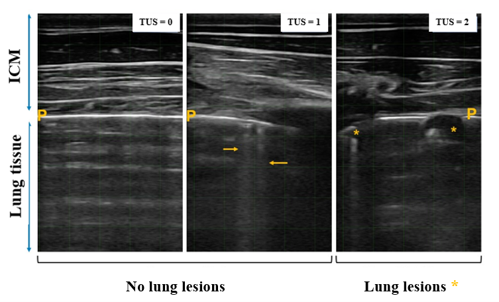
Figure 1. Ultrasonograms of the three thoracic ultrasound (TUS) score classifications. Echo of the lung tissue is observed in the bottom part, separated from the intercostal muscles (ICM) by the pleura (P). Normal healthy lung TUS=0. Two comet tails in TUS=1 are indicated with arrows. Lung lesions (1 cm2) in TUS=2 are marked with stars.
The long‑term consequences of disease challenges
Data from the Animal Health Ireland (AHI) Beef HealthCheck programme showed that steers and heifers with pneumonia lesions at the abattoir were approximately 12–15 days older at slaughter compared to unaffected animals, indicating the impact of disease on finishing age. Similarly, steers and heifers with liver fluke and liver abscesses present were 40-46 and eight days older at slaughter, respectively, compared to those without infection/abscesses. A large Irish meta‑analysis involving over 32,000 steers reported that animals with liver fluke infection had a 36–46 kg reduction in lifetime live weight gain compared with uninfected animals. These findings support a management approach in which biosecurity and proactive health planning are essential for purchased weanlings and store cattle.
Management of purchased cattle
While repeated animal movements are unavoidable in Irish beef production, their negative consequences can be reduced through proactive management of purchased livestock. Effective herd health programmes for purchased cattle focus on minimising stress at arrival, implementing appropriate biosecurity measures, and supporting immune function during high‑risk periods, thus reducing the risk of disease introduction and spread within the herd. The health and management protocol for purchased cattle at Teagasc Grange is summarised in Table 1. This is provided only as a guide, and it should be adapted to suit the specific circumstances (e.g. animal type, risk profile and veterinary advice) on individual farms purchasing cattle.
Table 1. Health and management protocol for purchased cattle at Teagasc Grange
| Stage | Intervention | Timing | Purpose |
| Arrival / Quarantine | Quarantine in housing | On arrival (minimum 24 h) | Isolate from main herd; minimise disease introduction |
| Low stocking density, straw bedding | On arrival | Reduce stress and disease expression, allow rest | |
| Hay and clean water ad libitum | On arrival | Support recovery post-transport | |
| Vaccinations | Intranasal RSV / PI‑3 (live) | After 24 h rest | Improved efficacy post‑stress period |
| IBR live vaccine | After 24 h rest | BRD prevention | |
| Broad‑spectrum wormer + flukicide* | After 24 h rest | Address prior gastrointestinal, lungworm, and fluke burdens | |
| Hoof care | Footbath (digital dermatitis control) | On arrival | Reduce lameness risk |
| Turnout
(if applicable) |
Turnout to clean pasture | After quarantine treatments | Supports immune response development |
| Vaccination | Clostridial vaccine | ~1 week after arrival | Clostridial disease protection |
| Housing | Clip backs and tails | Day of housing | Ectoparasite administration and body cleanliness |
| Lice treatment | Day of housing | Treat entire shed simultaneously | |
| Vaccinations | Clostridial booster + RSV/PI‑3 booster | 4–6 weeks after first dose | Complete primary vaccination course |
| Repeat lice treatment (if required) | During housing | Treat all animals together if signs evident | |
| Faecal egg count (FEC) | ~8 weeks after housing | Assess worm/fluke burden and dosing efficacy |
*Administration of wormers and flukicides should be based around faecal egg count (FEC) test results
Acknowledgements
The information summarised here has been generated within projects supported by Teagasc (Beef-Growth; RMIS2339) and the Department of Agriculture, Food and the Marine Competitive Research Programmes (Beef-Quest; 2023RP892) and US-Ireland (2018US-IRL200).
Compiled and edited by Mark McGee and Paul Crosson, Teagasc, Grange Animal & Grassland Research and Innovation Centre, and first published in BEEF2026 – Driving Sustainable Performance, additional reading from BEEF2026 is available here.