
Information on Bluetongue Virus (BTV) for Irish beef herd owners


Summary
- Bluetongue Virus (BTV) is a notifiable viral disease of domestic and wild ruminants, spread by biting midges.
- Spread is seasonal, peaking during warm summer months when midges are most active.
- The virus has moved north from southern Europe since the late 1990s, with BTV‑3 reaching the UK and northern Europe from 2023.
- BTV‑3 was first confirmed in Ireland in January 2026 and has since been detected in several counties.
- Clinical signs include fever, mouth lesions and lameness; infections in cattle are often subclinical.
- In beef cattle, BTV can reduce fertility and cause congenital defects in calves.
- Vaccination is the only evidence‑based control measure for herds at risk.
Bluetongue is a viral disease caused by bluetongue virus (BTV). This virus is a double stranded RNA virus of the genus Oribvirus due to the ‘ring’ (‘orib’) appearance of its outer capsid. There are at least 29 different serotypes or strains of the virus, and each strain differs in the severity of disease that is seen in infected hosts. It is a non-contagious (i.e., not spread directly from animal to animal) virus that is seen in both domestic (cattle, sheep and goats) and wild (buffalo, deer and elk) ruminants as well as camelids (alpacas and llamas). All ruminants become infected with BTV from the saliva of an infected biting midge (from the Culicoides species); therefore, infection risk is directly related to the activity of the midge population. In Ireland, this period of increased midge activity would coincide with warmer months from May to October.
Transmission
As stated, BTV is spread primarily by biting midges. In utero transmission from a cow to her calf or transmission via infected semen or embryos can also occur, but these methods are not deemed to be major transmission pathways within an animal population. The cycle of transmission is highlighted in Figure 1. Essentially, the midge vector becomes infected after feeding on an infected host (e.g., viraemic cattle) and the virus takes anywhere between 4-20 days to replicate within the midge. This replication stage is highly dependent on environmental temperature, with the rate of replication increasing as temperature increases thus shortening the incubation in the midge. It is understood that the minimum daily average temperature must exceed 11-13°C to allow for replication of the virus within the Culicoides species. A recent study by Queen’s University Belfast and the Pirbright Institute (UK), examined how cold temperatures (−1°C to −18°C) affect different life stages (eggs, larvae, pupae, and adults) of the Culicoides midge over short (1 hour) and longer (6–24 hour) exposure. Results showed that cold tolerance varied by life stage. Eggs were the most resilient (surviving ≤ −18°C), followed by pupae (−14°C), early instar larvae and adults (−10°C), and late instar larvae were the least tolerant (−7°C). This data indicates that these populations can withstand brief cold spells and rebound once conditions become more favourable.
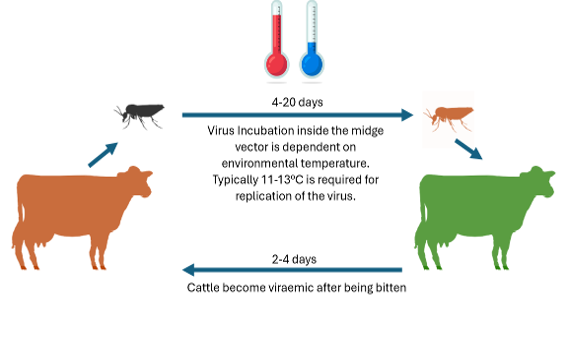
Figure 1. Transmission of Bluetongue virus (BTV) by the midge (Culicoides) vector.
It only takes a single BTV infected midge to infect a host and even though the lifetime of an adult midge is less than 20 days, a single infected midge can feed on multiple hosts potentially infecting them with BTV. At low wind speeds and low altitudes, midges can fly relatively quickly and at reasonable distances (e.g., 5 km in a few days), so this is why initial restriction zones are often put in place once there is an incursion into a new area. If there are large host populations (i.e., cattle and sheep) in an area then the rate of spread of BTV, if temperatures are suitable (i.e., summertime), can be quite rapid. Midges can also be dispersed long distance when carried at high altitude with prevailing winds. Wind carriage is how the BTV-8 incursion into United Kingdom from Belgium occurred and possibly how BTV-3 may have come to Ireland last autumn. Transport of infected midges during livestock movement is also a possibility.
European and Irish Situation with BTV
Prior to the 1990s, parts of Portugal, southwest Spain, certain Greek Islands, Cyprus and Turkey were the only areas to experience BTV incursions within Europe. Between 1998 and 2010, BTV occurred in many countries around the Mediterranean Basin that had never previously recorded issue with the virus. This change of the disease distribution caused 28 European countries to report over 58,000 unexpected outbreaks of the disease between 2007 and 2010 (WAHIS). These initial incursions were largely with BTV-8. More recently incursions of BTV-1, 3 and 4 have been reported. Climate change has been implicated in much of this spread.
In September 2023, BTV-3 serotype emerged in the Netherlands. This BTV-3 outbreak caused severe clinical disease (particularly in sheep) that spread rapidly and by November 2023, evidence of an incursion into England was detected. During 2024 and 2025, BTV-3 spread considerably throughout mainland Europe. In England, cases steadily moved westward during 2025 with confirmations in Wales in September of that year. The first evidence of infection in Northern Ireland was discovered in November 2025. Evidence of BTV-3 infection was detected in Irish cattle for the first time in January 2026 in County Wexford. Since then, BTV has been detected counties Wicklow, Laois, Louth, Monaghan, Kildare and Cork. Blood samples taken in September 2025 have also tested positive for BTV suggesting that it may been late last year when the first cases of BTV occurred in Ireland. Clinical disease for the upcoming summer may be seen in Irish cattle and sheep from either “overwintering” of the current incursion and re-emergence of infection, and/or transmission following a second introduction via windborne spread (or animal introduction) from the UK or mainland Europe.
In January 2026, the European Commission implemented a regulation re-categorising Bluetongue virus (serotypes 1-24), from a “Category C” to a “Category D+E” disease. This change is scheduled to take full effect in July 2026. As a result, BTV will be treated as a disease under surveillance rather than a disease to be eradicated. Consequently, no Member State will be able to achieve official freedom from the disease, and at a national level, emphasis will be placed on movement controls and surveillance rather than national disease eradication. Since March 2026, movement of cattle and sheep for production and breeding between Ireland and Northern Ireland re-commenced. As BTV does not affect human health or food safety, trade of animal products between Ireland and most international markets is unaffected. BTV remains a notifiable disease in Ireland and any suspect cases should be reported to the Department of Agriculture, Food and the Marine (DAFM).
Clinical signs and impact of BTV-3
Once a host (e.g., sheep and cattle) becomes infected by a midge bite, BTV moves to local lymph nodes and replicates. This then leads to virus spreading to the bloodstream where it replicates further causing damage to the blood vessels walls. This viraemia, damage and inflammation to the blood vessel walls, causes many of the clinicals signs that are noted such as; fever, depression, haemorrhages, ulcers and swelling of the head, nose or mouth, salivation or lameness due to swelling of the limbs at the coronary band (i.e., line where the hoof wall meets the skin). Pregnant cattle (or sheep) that are infected with BTV may abort or deliver calves (or lambs) with malformations affecting the nervous system. These malformations may be seen as blindness or imbalance in calves (or lambs) at birth.
The severity of these clinical signs and thus impact of the disease depend on the species and the serotype. Sheep show much more severe clinical signs than cattle. For example, mortality in sheep can reach up to 30% (e.g. 2023 Dutch BTV-3 outbreak), while in cattle mortality rates tend to be much lower. Indeed, many cattle that are infected with BTV will go unnoticed by farmers. However, for Irish beef farmers (suckler farmers especially), the most likely adverse effects of BTV in the herd would be on fertility (i.e., the potential to cause embryonic death, bull infertility and/or abortion), birth defects in calves infected in utero, and a possible increase in the mortality rate across all age groups.
In the Netherlands, Belgium and France, mortality and fertility impacts have been dramatic in both cattle and sheep. In the UK however, although there have been fewer formal reports of disease impact, indications are that the observed clinical and production impacts are substantially less than those documented in other European countries. How this apparent reduced impact in UK livestock might have occurred is not yet clear. That stated, due to the substantial consequences of even minor reductions in reproductive performance to short- and long-term profitability of spring-calving beef systems, losses for individual herds could be substantial should the infection enter the herd during the breeding and post-breeding period.
Vaccination
As it is practically impossible to control the midge vector and the fact that it only requires one infected midge to infect an animal, vaccination against BTV remains the only evidence-based control option that is available for herds at risk of exposure to this virus. As potential negative impacts of BTV-3 in Irish beef herds (and sheep flocks) is a real possibility, the Minister of Agriculture, Food and the Marine (Minister Martin Heydon) announced in March that BTV vaccination will be included as an option in the 2026 beef and sheep welfare schemes. Beef farmers that want to pursue vaccination of their beef herds need to contact their local veterinary practitioner.
The current BTV-3 vaccine/s available are inactivated and in cattle they require a primary course of two injections separated by a period of three weeks. Protective immunity tends to begin at three weeks after a primary course, so it is recommended that the vaccine is given in advance of the greatest risk period (in Ireland this will be from May onwards). These vaccines can be used safely during pregnancy and have no impacts on fertility or pregnancy in cows or ewes. Most labels on the available vaccines state that safety in breeding males has not been established, so the decision to vaccinate these animals should be made on a risk-benefit basis by the prescribing veterinarian. That stated, the negative impact of natural BTV infection on breeding males is significant, and there has not been widespread reports of vaccine-related fertility problems, so this should be strongly considered if not vaccinating. The duration of immunity is not stated on many of the vaccine labels, but most manufacturers anticipate it is 12 months, although in Ireland the risk period (i.e. May to October) will be considerably shorter than this.
Conclusion
Bluetongue is an emerging and considerable threat to Irish cattle and sheep for the upcoming summer and autumn. The disease is notifiable so any suspected cases should be reported to DAFM. Vaccination remains the only viable control strategy in Irish beef herds and should be strongly considered due to the potential negative impacts on fertility and health.
Compiled and edited by Mark McGee and Paul Crosson, Teagasc, Grange Animal & Grassland Research and Innovation Centre, and first published in BEEF2026 – Driving Sustainable Performance, additional reading from BEEF2026 is available here.