
Lime – increases farm productivity while reducing fertiliser costs

Summary
- Correcting soil pH through lime application improves fertiliser efficiency and reduces costs.
- Correcting soil pH from 5.8 to 6.3 can increase annual grass production by up to 2.5 tonnes dry matter/hectare, valued at €105/tonne dry matter.
- Improving soil pH supports climate and environmental goals.
Correcting soil pH is an old but vital farm practice that delivers both productivity and environmental benefits. Maintaining optimum soil pH of 6.3 to 6.5 on mineral soils increases the biological soil activity and availability of major nutrients such as nitrogen (N) thus reducing the need for imported chemical fertiliser. Soil test results show that approximately 60% of drystock farms are sub-optimal for soil pH and would benefit from an application of ground limestone. Fertiliser prices have increased substantially over the last number of months due to conflict in the Middle East plus trade tariffs and carbon taxes. Increased lime application increases N use efficiency of both soil and applied N sources, while reducing our dependence on imported fertilisers.
Lime is a low-cost technology and its application to low pH soils improves profit, while increasing the sustainability and resilience of farming systems. In 2025 soil pH levels improved (+2%) on beef farms which reflects increased lime usage in 2022 and 2023. Currently ~60% of soils have a sub-optimal soil pH, and these soils will benefit from an application of ground limestone based on recent soil analysis. These soil results would indicate that there is an estimated annual lime requirement of ~0.95 million tonnes of lime on beef farms.
Lime is the foundation to help Ireland meet its climate emission reduction targets by 2030 through improved nitrogen use efficiency. The Teagasc Marginal Abatement Cost Curve (MACC), which identifies the most cost-effective pathway to reduce greenhouse gas emissions and enhance carbon sequestration, targets lime applications to correct soil pH in order to reduce our dependence on imported chemical fertilisers. In 2026, the target is to apply 1.85 million tonnes of lime to correct soil pH nationally, increasing to 2.5 million tonnes by 2030. Soil test results over the last two decades clearly show that drystock farms need more lime, which will pay dividends in terms of farm productivity and profitability, while reducing farm carbon emissions through more efficient use of farm N sources.
The following are key benefits from correcting soil pH on productive mineral soils with the aim to maintain soils in the optimum range of pH 6.3 to 6.5.
Soil nitrogen supply
Liming acidic mineral soils to the optimum pH 6.3 for ryegrass swards will result in the soil N supply increasing by up to 70 kg N/hectare (ha) per year. For grass-clover swards maintain soils at pH 6.5 for clover establishment and clover long-term productivity. This will increase farm N supply and support grass growth during the growing season, while reducing fertiliser N costs by approximately €140/ha (€57/ac) per year. This benefit alone will cover the annual cost of maintaining soil pH levels. Increasing soil N supply will reduce the need for expensive chemical fertilisers and reduce emissions associated with fertiliser production and in-field losses after application.
Nitrogen Use Efficiency (NUE)
Maintaining optimum soil fertility increases the efficiency/ utilisation of applied N (NUE) from 35% on low fertility fields to 63% on fields with optimum pH, phosphorus (P) and potassium (K) (See Figure 1). Correcting soil pH will result in an improvement in NUE from 35% to 53% where soil P and K is sub-optimal. In other words, for every 100 kg N/ha applied, the available N increases from 35 to 53 kg N/ha from correcting soil pH alone. With forecasted higher chemical N fertiliser costs, spending money on lime to correct soil pH will ensure a better return from every kilogram of N applied.
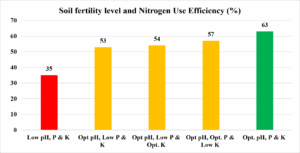
Figure 1. Percentage nitrogen use efficiency (NUE) to nitrogen (N) fertiliser across grassland fields according to the status of soil pH, phosphorus (P) and potassium (K) fertility.
Source: Murphy et al. (2015).
Soil phosphorus availability
Correcting the soil pH increases the availability of soil P and the utilisation of P as either cattle slurry or chemical P fertiliser by the growing crop. A study completed at Teagasc Johnstown Castle demonstrates the impact of lime application on soil P availability (See Figure 2). For example, liming an acidic soil (pH <5.5) alone increased the soil P by ~6 mg/litre (equivalent to 2 Soil P Indexes). On many farms this would remove the need for building soil P levels in a grass sward at minimal cost and increases the productivity (+ 1 tonne grass dry matter/ha). With P being the most expensive nutrient in a more regulated environment, maintaining optimum soil pH pays many dividends for farm productivity and profitability.
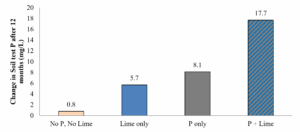
Figure 2. Average change in soil test P (Morgan’s P test) across 16 mineral soils treated with phosphorus (P) (100 kg/ha of P), Lime (5 t/ha of lime), or P + Lime and re-tested after 12 months
Source: Sheils et al. (2013).
Increasing soil pH reduces nitrous oxide (N₂O) emissions
Increasing soil pH by liming resulted in a significant reduction of N₂O emissions and increased grassland productivity compared to un-limed plots under the same management and fertiliser regime. The degree of reduction in N₂O emissions depended on the amount of lime applied across the experimental period. When soil pH was increased to 6.9, total N₂O emissions were reduced by 39% compared to control soil pH of 5.0 (Figure 3).
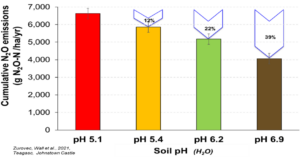
Figure 3. The effect of soil pH on nitrous oxide (N₂O) emissions.
Lime increases grass production
Research shows that correcting soil pH on acidic soils (pH 5.8) can increase grass production by up to 2.5 tonnes dry matter/ha (Figure 4). In addition, maintaining soil pH is critical to maintaining the productivity of ryegrass and clover. On drystock farms producing extra grazed grass or conserved feed as silage reduces the need for expensive imported feeds. For example, the value of a tonne of grass dry matter is €105. Growing an extra 2.5 tonnes dry matter/ha represents a return on investment of €7.50 in extra grass production for every €1 invested in lime. On a 40 ha drystock farm this is worth €10,500 in extra grass production annually, reducing the need for imported supplementary feeds during the year.
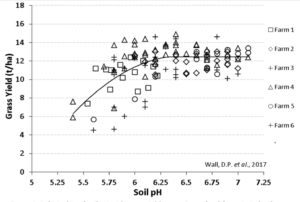
Figure 4. The relationship between soil pH and grass yield across a range of farms in Ireland.
Clover requires higher soil pH levels
Compared to ryegrass swards, clovers require a higher soil pH 6.5 to 6.8 for good establishment, persistency and productivity. It is important to correct soil pH with recommended rates of lime before establishment of clover. In general, grassland soil test results show that for clover, an additional 2.5 tonnes of lime/ha is required compared to recommended application rates for ryegrass swards. White clover has an enormous capacity to fix N and reduce our dependence on chemical N fertilisers.
Compiled and edited by Mark McGee and Paul Crosson, Teagasc, Grange Animal & Grassland Research and Innovation Centre, and first published in BEEF2026 – Driving Sustainable Performance, additional reading from BEEF2026 is available here.