
The principles of successful calf rearing


Summary
- Calf rearing is typically the most costly and labour-intensive stage of grass-based dairy-beef production systems.
- The target growth rate during the calf rearing period up to weaning is 0.7 kg/day.
- Poor growth rate during early-life negatively impacts finishing age and carcass weight.
- The promotion of solid feed intake is critical to aid rumen development and calf growth performance.
- Feed 1–1.5 kg of concentrate per day for three weeks after turnout to pasture to help calves transition smoothly onto a grass-based diet.
Calf health and nutrition strongly influence an animal’s lifetime growth potential. The calf-rearing phase provides an important opportunity for efficient live weight gain due to calves’ high feed conversion efficiency in early life, which has been shown to be 2–3 times greater than that of comparable finishing cattle. Efficient calf-rearing protocols aim to maximise health, welfare, and growth, while minimising input costs within a labour-efficient production system.
Unlike older cattle, calves have limited capacity for compensatory growth. Consequently, failing to achieve target weights at key milestones, such as weaning (8–12 weeks of age) and housing (7–8 months of age), can have lasting effects on performance, resulting in longer finishing periods and older finishing ages. Poor early-life growth also reduces carcass weight, increases feed costs and greenhouse gas emissions, and lowers profitability in dairy-beef systems. As a result, failure to achieve high growth rates during the first six months of life is a major source of inefficiency in grass-based dairy-beef production systems.
Sourcing healthy calves
The purchase of calves should be based on their health status, live weight, beef genetic merit (Commercial Beef Value, CBV) and the health status of the herd of origin. Many dairy-beef farmers aim to purchase calves directly off their birth farm, from as few farms as possible, thus minimising the disease risk. Farm sources who have a good colostrum management policy, scour vaccination programmes and who also vaccinate calves against bovine respiratory disease are a valuable resource to rearers.
Calves must receive a sufficient volume (three litres, (L)) of high-quality colostrum (> 50 mg/ml IgG), within the first two hours of life to ensure adequate passive transfer of immunity is achieved. Colostrum contains essential immunoglobins, maternal leukocytes, growth factors, hormones, cytokines, and microbial factors that are vital for a calf’s defence against disease. Following the initial colostrum feed, at least four feeds of transition milk should be fed prior to the calf being moved onto high-quality whole milk or milk replacer.
Before purchase, calves should be carefully examined to ensure they are alert, with bright eyes and a clean, moist nose, have supple skin and a shiny coat, and free from visible signs of scour, discharge from the mouth, nose or eyes, injury, or lameness. Calves considered healthy are suitable for transport from the dairy farm to the calf-rearing farm once they are at least 10 days old, but transport typically occurs when calves are aged between 3-4 weeks of age and weighing >50 kg live weight.
Milk feeding
During the calf rearing (up to weaning) period, the target growth rate for calves is 0.7 kg/day. To achieve this, calves are typically fed 6 L of milk replacer per day at a 12.5% concentration (equivalent to 0.75 kg of milk solids daily), divided across two feeds, up to four weeks of age. After this point, milk allowance is reduced to encourage greater concentrate intake and support rumen development ahead of weaning.
This feeding strategy is supported by research conducted at Teagasc Grange, which examined the effect of early-life calf nutrition on lifetime animal performance. Over a two-year period, calves were assigned to one of two milk replacer feeding strategies from four weeks of age until weaning, receiving either 4 L or 8 L of milk replacer per day, split into a morning and evening feed. The study found no differences in lifetime growth performance or carcass characteristics between the two groups. Although calves on the 4 L treatment consumed 25 kg more concentrate during the rearing phase, they consumed 20 kg less milk replacer. Consequently, this approach reduced calf-rearing costs by €33 per head.
Based on these findings, calf rearing systems at Teagasc Grange and Teagasc Johnstown Castle research farms and the Tipperary Dairy Calf-to-Beef Demonstration farm have adopted this reduced milk feeding strategy. Calves typically arrive on the farms at around three weeks of age, weighing between 50 and 55 kg. Initially after arrival, calves receive 6 L of milk replacer per day alongside ad-libitum access to concentrates, roughage (straw) and water. From four weeks of age until weaning, milk allowance is reduced to 4 L/day (0.5 kg milk solids daily) to promote concentrate intake and facilitate a smooth transition through weaning.
When choosing a milk replacer, priority should be given to its nutritional composition to ensure it meets the calf’s developmental requirements. Milk replacer should contain 20-23% crude protein and 18-20% fat to support adequate growth in pre-weaned calves. Consistency is vital when milk feeding calves. The milk replacer should be mixed each day at a consistent temperature (37-39°), mixed fully prior to feeding and a high standard of hygiene should be maintained throughout. A good quality milk replacer is essential to support optimum growth, and farmers should stick with one brand and formulation to avoid digestive upsets. Under EU law, calves must be fed twice a day up to four weeks of age. Once-a-day feeding from four weeks of age until weaning is a strategy employed on a lot of Irish dairy-beef farms, including the Tipperary Dairy Calf-to-Beef Demonstration farm, to reduce the labour associated with the calf rearing period. On the Tipperary Dairy Calf-to-Beef Demonstration farm, when calves are transitioned to the 4 L/day milk feeding rate this is fed in a single morning feed.
In a once-a-day feeding scenario, where milk feeding is occurring in the morning, concentrates should be offered later in the day to be compliant with EU feeding regulations. Automated calf feeding systems are also commonly used on Irish farms to deliver targeted milk feeding programmes to individual calves in a labour efficient manner.
Solid feed and water
During the pre-weaning period, the nutritional management strategy, especially concentrate availability and quality, are critical in determining the weaning age and post-weaning performance of dairy-beef calves. At birth, a calf’s rumen is not fully developed. From four weeks of age, calves begin transitioning from a pre-ruminant to a ruminant stage. At this stage nutritional management is focused on developing a functional rumen capable of efficiently digesting solid feed. A high-quality calf starter ration (17-18% crude protein; minimum energy content 12 MJ/kg or >0.95 UFV/kg dry matter) should be offered to calves from the beginning of the rearing period. The calf ration should be kept fresh, dust free, and offered daily to maximise intake. A restricted milk diet with access to solid feed (concentrate and straw) aids in the development of structures that line the rumen wall called papillae, which facilitate nutrient absorption (Figure 1). A roughage source (e.g. straw) should be offered to calves to further promote rumen development. Providing fresh drinking water from birth is equally important in encouraging increased intake of concentrate and roughage for dairy-beef calves.
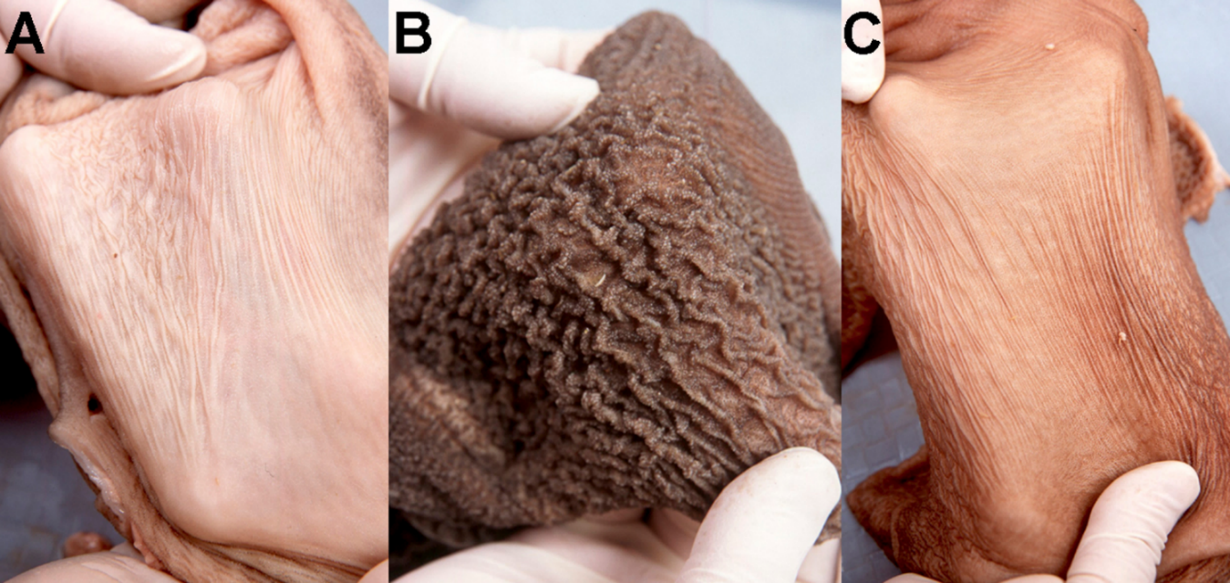
Figure 1. Rumen development of calves by 6 weeks of age, offered three contrasting diets: A) milk only; B) milk, hay and concentrate; and C) milk and hay. Source: Heinrichs and Jones (2022)
Housing
The calf’s environment plays a major role in its health, growth and welfare. Calf housing should provide optimal conditions that support performance while minimising disease risk. Ideally, facilities should be designed to meet the specific needs of young calves and allow efficient feeding and management. Group housing compared with individual penned housing offers a good balance between labour efficiency, calf performance and welfare. In a group housing scenario, calves (up to 150 kg) require a minimum space allowance of 1.5 m2/calf.
As calves spend much of their time lying down, warm and dry bedding is essential to reduce heat loss. Deep straw bedding is particularly effective due to its high insulation value and has been shown to help reduce the risk of respiratory disease.
Calf houses should be draught-free but well-ventilated to prevent the build-up of humidity, dust, harmful gases, and bacteria. Effective natural ventilation requires adequate ridge and eave openings and sufficient height difference between air inlets and outlets to ensure regular air exchange. Recommended air space allowances are at least 6 m³ per calf up to six weeks of age and 10 m³ up to 12 weeks.
Weaning
Weaning generally occurs between 8-12 weeks on Irish commercial dairy-beef farms, depending on the feeding strategy employed on the farm. Gradual weaning (~7 days) is more favourable to minimise stress, and to prevent reductions in dry matter intake and growth. Weaning decisions should be based on calves consuming at least 1.5% of their body weight in concentrates to support maintenance and growth. At the Teagasc Grange and Johnstown Castle research farms, weaning occurs when calves reach a target weight of 85-90 kg, are at least 70 days of age and are consuming at least 1-1.5 kg of concentrate daily. Calves are weighed every Monday morning, and animals that meet the weaning criteria are stepped down by 0.25 L per feed until off milk completely. Fresh concentrate, straw and water are offered ad libitum to the calves throughout the weaning process. Post-weaning, calves are kept indoors and given unlimited access to a calf ration and straw and clean, fresh water for three weeks prior to transition to grass.
Transition to grass
Post-weaning, calves should be turned out to pasture, where, for the first three weeks, they are offered 1-1.5 kg of concentrate/day, along with free access to straw, to ease the transition to a grass-based diet. Calves should be offered high quality pasture, with a target pre-grazing herbage mass of 1,200 kg dry matter/hectare initially, which can be increased up to 1,400-1,600 kg dry matter/hectare, and a target post-grazing sward height of 4.5-5.0 cm, when they acclimatise to grazing.
Conclusion
Successful calf rearing in dairy-beef systems depends on sourcing healthy, high-quality calves and providing optimal nutrition, housing, and management throughout the early stages of life. Achieving high growth rates during the calf-rearing period is essential improve lifetime performance and enhance the overall profitability and sustainability pasture-based dairy-beef systems.
Reference
Heinrichs, J. and Jones, C. (2022). Photos of rumen development [Online]. Pennsylvania State University. [Accessed 15/05/2026 2026].
Compiled and edited by Mark McGee and Paul Crosson, Teagasc, Grange Animal & Grassland Research and Innovation Centre, and first published in BEEF2026 – Driving Sustainable Performance, additional reading from BEEF2026 is available here.