
70% of farmers complete most sheep tasks on a Saturday – survey
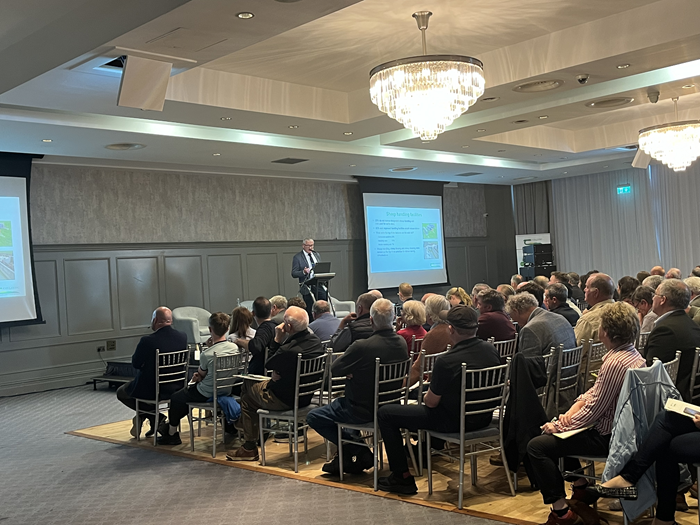
Interim findings from a Labour on Sheep Farms Survey were presented by Damian Costello, Teagasc Sheep Specialist, at the Teagasc National Sheep conference in Ballinasloe, County Galway on Thursday, 18 June.
Based on 466 responses, with all counties represented, the survey presented interesting insights into the numbers of farmers working off farm. Forty five percent of the sheep farmers that responded to the survey work full time off farm, five days per week with a further 16% working part time off farm for between one and four days per week. Just 39% farm full time.
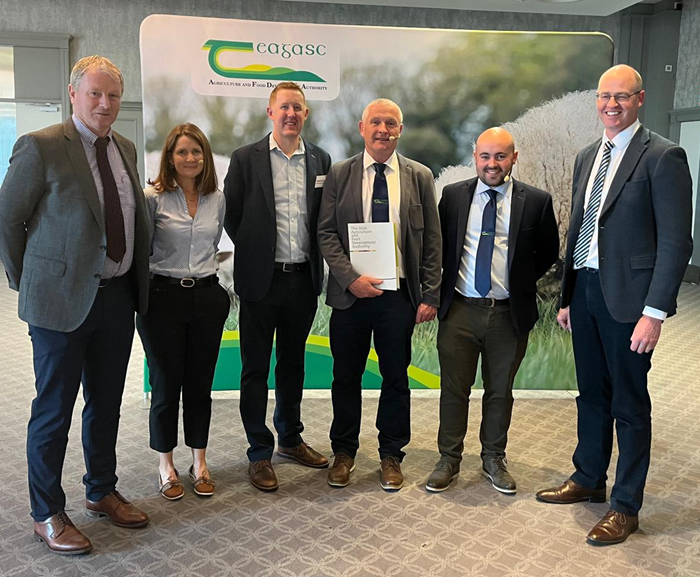
Pictured at the Teagasc National Sheep conference in Ballinasloe were from (L to R): Pat Clarke, Teagasc Regional Manager Galway/Clare Advisory Region;
Dr. Ruth Sanders, Superintending Veterinary Inspector with the Department of Agriculture Food and the Marine (DAFM); Darren Carty, Irish Farmers Journal; Damian Costello, Teagasc sheep specialist; Jake Delaney, Teagasc Walsh Scholar and Stan Lalor, Teagasc Director of Knowledge Transfer.
Given this, achieving a work-life balance on sheep farms is a challenge. Seven out of 10 farmers complete most sheep tasks on a Saturday and use 17 days per year annual leave for farm work.
The survey also indicated that a higher percentage of younger farmers have off-farm employment with 84% of the under 35 category working off farm. The authors, Damian Costello and Dr Noirin McHugh of Teagasc said that the trend indicates sheep farmers of the future will be predominantly part time.
Participants in the survey were also asked what handling facilities they had on their farms? Just one-third of respondents had the five handling facilities deemed to be essential, namely: weighing scales, collecting pen, footbath, handling race and sorting gate. The most surprising result was that half of the sheep farmers that responded didn’t have a sorting gate.
Despite handling, fencing and housing being identified as labour saving infrastructure, just forty percent or of sheep farmers had applied for supports through TAMS funding.
View the presentation: Results from the Teagasc Labour Survey on Irish Sheep Farms (PDF)
View the other presentations from the Teagasc National Sheep Conference here.
More from Teagasc Daily: CODD present on 49% of Irish sheep farms – national survey