
Associating climate change mitigation with protein security
A new study from Teagasc, published in the journal ‘Environmental Science and Policy’, has investigated the impact of climate policies on protein security in the Republic of Ireland.
The main land-based systems of agricultural production in Ireland can currently meet the annual protein requirements of 20 million people, 35 million if protein digestibility (how much of the amino acids present in the protein is left for the body to use after digestion) is accounted for.
Implementing policies aimed at mitigating climate change in the Irish agricultural sector could increase net protein output, but net digestible protein output would increase or decrease depending on the policy pursued.
Current contribution of Irish land-based agricultural production systems to protein security
The study estimated the net protein output across the dairy, cattle, sheep and tillage production systems in the Republic of Ireland, and protein security defined by the amount of people who could have their protein requirements met by these production systems.
All the results are presented in net terms, i.e., considering protein input (human edible protein fed to livestock) and protein output (e.g. milk, meat, grains). Results are also presented with and without correcting protein for digestibility.
Results indicate that, before accounting for protein digestibility, one hectare dedicated to cereal or legume production generates more protein, in net terms, than one hectare dedicated to milk, beef or sheep meat production. Moreover, the value is negative for sheep meat, indicating that producing sheep meat consumes more protein input than it generates output.
If digestibility of the relative protein inputs and outputs is considered, one hectare dedicated to milk production produces less protein than one hectare dedicated to legume production, but more protein than one hectare dedicated to cereal production.
Notably, the contribution of sheep production becomes positive when digestibility is accounted for.
At the national level, these land-based agricultural production systems can meet the annual protein requirements of 20 million people if digestibility is not accounted for, and of 35 million if digestibility is considered. The difference is due to cereal protein having lower digestibility than animal-based protein, which impacts the volume of human digestible protein available in animal feeds. The contribution of sheep systems also becomes positive when digestibility is included.
Modelling changes in protein security under different activity and policy scenarios
Two scenarios were subsequently modelled in this analysis, investigating the impact on protein output and security out to 2030.
In a ‘Business-as-Usual Scenario’, based on FAPRI Ireland projections included in the Teagasc MACC analysis, agricultural production levels remain relatively stable, and no major climate-related or trade policy changes are assumed. This results in a moderate decrease in beef and sheep livestock numbers, and in an increase in dairy cow numbers.
In the second scenario called ‘Climate Policy Scenario’, agricultural production levels decrease, and climate change mitigation policies are implemented for the agricultural sector. This leads to a large decrease in beef and sheep livestock numbers, a small increase in dairy cow numbers, and an increase in tillage area.
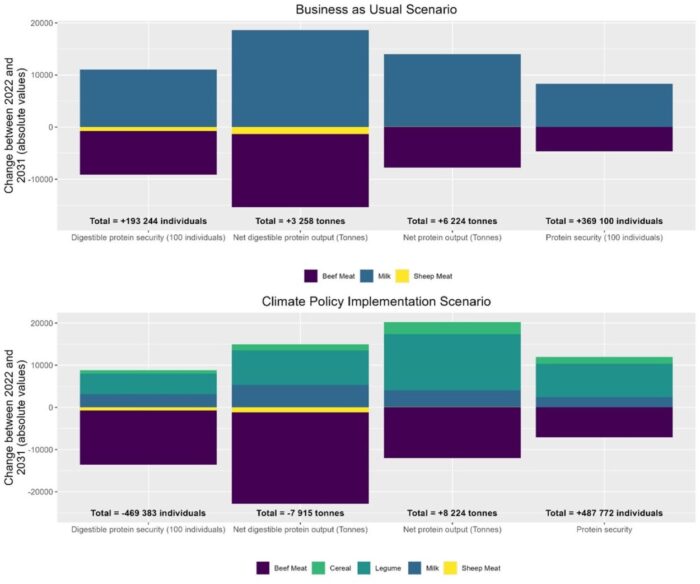
The Business-as-Usual Scenario would lead to an increase in net protein output and protein security, both with and without accounting for protein digestibility. Around 369,000 additional individuals could have their protein requirements met, not accounting for digestibility, with the increase in dairy livestock units compensating for the decrease in beef livestock units.
As shown in the figure below, this figure drops to 193,000 additional individuals if digestibility is accounted for, with the impact of a decrease in beef livestock units being exacerbated if digestibility is included.
Under the Climate Policy Scenario, an additional 488,000 individuals could have their protein requirements met, if digestibility is not considered. However, when digestibility is considered net protein output would decrease, with 469,000 fewer individuals having their protein requirements met, leading to a decrease in protein security. In the Climate Policy Scenario, animal-based protein is substituted towards plant-based protein. Without accounting for digestibility, the increase in tillage area is enough to compensate the loss in livestock-based protein production. However, the digestibility of plant-based protein is around half that of animal-based protein, hence, if digestibility is considered, the increase in tillage area is not enough to compensate this loss. In this analysis, GHG emissions would decrease by 1.5 Mt under the Business-as-Usual Scenario, and by 2.7 Mt under the Climate Policy Scenario when emissions associated with the LULUCF sector are excluded.
Trade offs
Marie Merlo, who conducted this research as part of her PhD, said: “This analysis shows the trade-offs involved in implementing climate policies to diversify from animal to plant based protein production in Ireland.
“While the main goal is to reduce farm-level greenhouse gas emissions and reach the target of a 25% reduction by 2030, the impact on protein security needs to be considered. Protein generated by the main land-based agricultural systems is of strategic importance nationally and globally.
“The Republic of Ireland has the ability to meet the protein requirements of 4 to 7 times its own population (depending on whether digestibility is considered). Hence, this research also shows the importance of considering protein digestibility. Ireland is specialised in milk and meat production, which are protein sources with a significantly higher digestibility level than plant-based protein,” Marie Merlo added.
Authored by Marie Merlo, Teagasc; Cathal Buckley, Teagasc; Thia Hennessy, University College Cork; and Seamus O’Mahony, University College Cork, the full article: Associating climate change mitigation with protein security: The case of Ireland can be accessed here.
A related Signpost Series webinar is available to view below:
This work was conducted under the U-Protein (Unlocking Protein Resource Opportunities to Evolve Ireland’s Nutrition) project. The U-Protein project is funded by the Irish Department of Agriculture, Food and the Marine (grant number 2019PROG702).
This research was conducted as part of the Teagasc Climate Centre.