
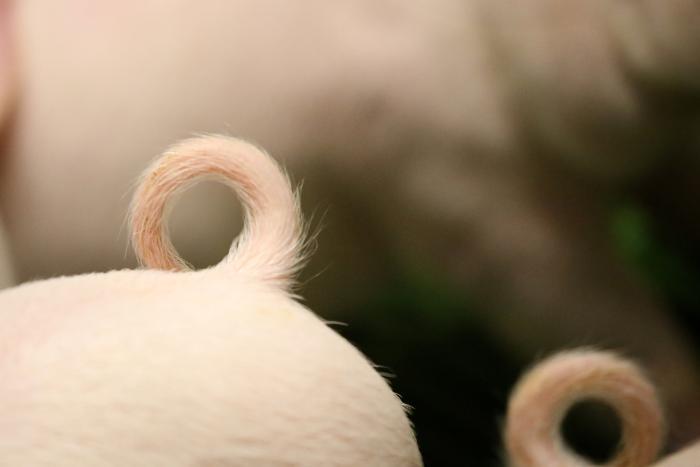
Peadar Lawlor, Pig Development Department, discusses the challenge of tail biting in pigs and how emerging breeding strategies may offer part of the solution.
Tail biting in pigs has been reported as far back as the 1950s, and probably occurred before then. It occurs in free-range and intensively reared pigs, although its prevalence and severity seem to increase as the level of intensification increases.
We know that outbreaks are difficult to predict and to stop once they occur. We know that it can affect pig growth and carcass value and therefore reduce profitability. We also know that tail-biting has major welfare implications and that outbreaks are stressful for both pig and human alike. We are rightly told that the solution is multifaceted. But all of this wisdom has remained virtually unchanged during my working life. What the industry needs are solutions to this problem.
Based on a recent study, it appears that part of the solution may come through advances in pig breeding. The research, carried out in Belgium by Gorssen and colleagues, suggests that selecting pigs for resilience traits could help reduce tail biting in the future. Although this won’t solve a current tailbiting outbreak on your unit, it points to how animal breeders can help in reducing tail biting on units in the future through selection for resilience traits in pigs.
Resilience in livestock is defined as “the capacity of the animal to be minimally affected by disturbances or to rapidly return to the state pertained before exposure to a disturbance.” The assumption is that disturbances, feed outage events or disease challenge for example, can affect a group of animals so that, the growth of some animals are more negatively impacted by the disturbance than is the case for other individual animals within the group. Deviations in, for example, weight for age over time can be used as proxies for overall resilience, as more resilient animals will more closely track their predicted optimal production level and will more quickly recover after a challenge.
The paper showed that deviations in body weight over time compared to the predicted growth curve for the pigs are promising proxies for a pig’s general health, welfare and resilience. The resilience traits used in the study were found to be moderately heritable and were also genetically correlated with tail biting wounds, lameness and mortality. These results can now be used by pig breeders to select for more resilient pigs. The results indicate that doing so will not only reduce tail-biting and improve pig health but will also have the added benefit of increasing uniformity in pig weight in pen groups.
Genetic companies now have the equipment to automatically record intake and pig weight of individual pigs within groups as frequently as desired. Therefore, they now have the tools at their disposal to select for increased resilience and therefore to reduce tail-biting, lameness and mortality. Doing so should help start to solve one of our greatest production problems. This may well be part of the long-term solution to dealing with the issue of tail biting in pigs.