
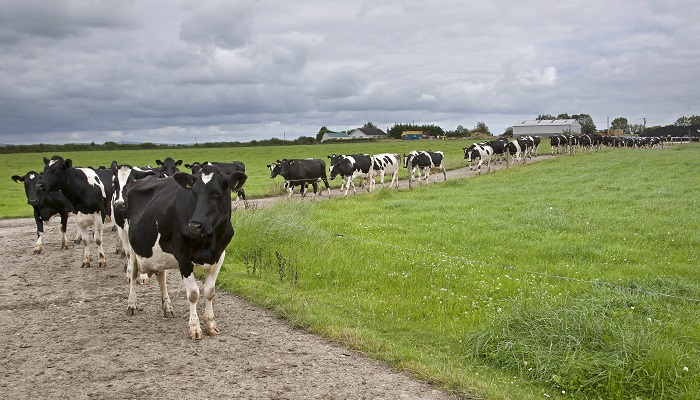
Although dairy cull cow sales are a relatively small contributor to overall farm net margin, Teagasc Specialists, James Dunne and David Argue write opportunities exist to add value to cull cows.
Such opportunities with cull cows include through higher late lactation milk sales and increasing the percentage of animals that meet market carcass specifications thereby maximising beef price per kg carcass sold.
Nonetheless, these opportunities are very much farm-specific and decisions around the timing of dairy cull cow sale should take cognisance of direct and overhead costs, farm facilities, labour and the implications for annual nitrates and banding calculations.
Target market specification
Research carried out outlined the percentage of dairy cull cows that met target market specification as BCS increases across various cow liveweight categories (Table 1). For example, an extra 30% of cows in the 550-620 kg liveweight category achieved target specification (>270 kg carcass, fat score ≥ 3-, carcass conformation ≥ P+) at BCS of ≥ 3.5 vs ≤ 3.0.
The price paid for in-spec cows in January 2025 was €5.10 per kg carcass weight. At the same time, cows that failed to meet market spec ranged from €2.60 – €4.60 per kg of carcass, dependent on weight, fat score and conformation. Therefore, the difference in meeting target specification was on average worth an extra €1.50 per kg of carcass weight and an additional €405 in carcass value.
Table 1. Percentage of Friesian cows which achieved target spec at various combinations of live weight and BCS
| BCS (5-point scale) | Live weight (kg) | ||
| <550 | 550-620 | >620 | |
| ≤ 3.0 | 2% | 11% | 35% |
| 3.25 | 20% | 32% | 44% |
| ≥ 3.5 | 29% | 41% | 40% |
What should farmers consider when deciding a cull cow strategy?
Common sale options for spring calving cull cows are to: 1) sell in October during the last rotation and prior to housing; 2) sell in December at the point of dry off; and 3) dry off in December and finish to target market specifications. The optimal decision on the timing of sale will depend on a number of farm-specific factors:
Projected financial returns
Dairy cull cow sales are a relatively small contributor to overall farm output standing at 8.3% and 7.6% of total dairy gross output for 2023 and 2024, respectively, and with average cull cow values at €1,003 and €1,106 for 2023 and 2024, respectively (NFS). Nonetheless, opportunities exist to increase net margin through the correct timing of cull cow sales. For highly stocked farms, the most profitable outcome will be to sell the cull cows in October to improve the feed budget situation, whereas it may be better to milk these cows through to dry off and sell in mid-December on lower stocked farms. Projected gains in additional milk revenue and cull cow sale value should be weighed against additional feed costs, overheads and labour requirements.
Feed quantity and quality
Consider the total winter feed budget and the quality of silage in the yard, which should include a 20% reserve. Farms facing feed shortages must evaluate the cost-effectiveness of keeping cows versus purchasing additional feed, with a focus on securing reliable feed supplies. If additional silage is needed, careful consideration should be given to its quality, as poor-quality silage will require increased supplementation.
Current animal performance
Early culling decisions should prioritize removal of high somatic cell count (SCC) cows, older/infirm cows marked for culling, or low milk production animals (i.e. where daily feed plus overhead cost exceeds daily milk solids value). Cull cows with low SCC and good milk production can be retained for longer to maximize milk revenue; these animals will efficiently gain BCS on a good quality diet, which will enhance their marketability at point of culling.
Housing facilities
Retaining cull cows over winter increases the slurry storage capacity required, e.g. 10 cull cows retained over a 4-month period will produce an estimated 64 cubic metres of slurry. It is essential to assess whether the existing slurry storage infrastructure is sufficient. Additionally, ensure there is adequate cubicle and feed space to accommodate the cull animals, factoring in the cubicle space requirements of the in-calf heifer group.
Labour availability
Retaining cull cows will increase labour demands, reducing the number of days at grass and increasing the workload related to feeding silage, cleaning cubicles, and maintaining the herd.
Cull cows and nitrates
Farms must consider the impact of culling strategy on their nitrates situation. In order to stay within regulatory limits for total organic N, it may necessitate culling cows earlier in the year.
Where a herd average milk yield is approaching the threshold limit for band three production levels (>6,500kg), and is also approaching the upper organic N limit per ha, the potential impact of selling cull cows early must be considered.
Retaining up to 16% of the herd as dry cull cows or three months can reduce annual average yield by 4-5%, which may have the effect of moving the herd into a lower yield band. However, these cull animals also contribute to total organic N production, which limits the scale of potential yield reduction to the 4-5% level.
All culling options should be made with careful consideration of the impact on the farm’s annual nitrogen production, to ensure compliance with environmental regulations.
The above was adapted for use on Teagasc Daily from a paper first produced in the Moorepark 2025 Open Day book (PDF).
More from Teagasc Daily: Why a good milking routine matters
More from Teagasc Daily: Breeding for Bovine TB resistance