
Developing the farm and the farmer in West Cork
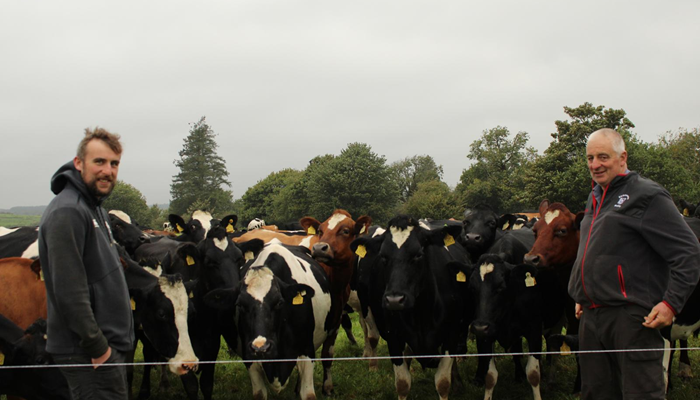
Spanning three generations of farming history in Betsboro, Co. Cork, Anthony Dineen, Climate and Sustainability Advisor, Teagasc Macroom, visits the Coombe family farm on the outskirts of Skibbereen, highlighting why developing the farm is every bit as important as developing the farmer.
The Coombes have been faming here since the early 1950’s. Frank Coombe purchased the farm in 1952 and farmed here for over thirty years, working dairy, beef, pigs, tillage and vegetables. Frank also did some contracting, including making hay and cutting corn.
In the mid 1980’s, Frank’s son Eric and his wife Regina took over the farm, where they concentrated on dairying and phased out the other enterprises. By 2015, Eric and Regina had developed the farm and built up the dairy herd from 65 cows to 140 cows.
Eric’s son Kevin came home farming and joined a farm partnership with his parents in 2018, and the dairy herd has grown further to now milk 180 cows. The purchase of two blocks of land in 1984 and 2010 allowed the expansion and development of the farm over the years.
Developing the farmer
As well as developing the farm, developing the farmer is a central theme for this family. Eric completed a 180-hour course with Teagasc, and he travelled to New Zealand in 2007.
Eric and Regina have four children, Gillian, Kevin, Gavin and Clare, and all have third level education completed. Kevin completed a dairy business degree in UCD and graduated in 2018. As part of Kevin’s degree, he travelled to New Zealand in 2017 and spent six months working on a dairy farm. From education and travelling, both Eric and Kevin have seen many different farming systems and new technologies working on other farms and have brought some of these technologies back to their own, such as grass measuring and crossbreeding.
A focus on soil fertility
The home block is generally low-lying, south-facing, free-draining land, but there is a section of the farm that will flood during high rainfall periods.
Soil fertility is very important to the Coombes. Soil sampling is done every two years on the grazing platform and every four years on the rest of the farm. Lime, phosphorous (P) and potassium (K) are generally very good on the grazing block. On the out blocks, there are some low P and K areas, and these are targeted with slurry and compound fertiliser to build up soil fertility. This farm is in derogation, and the grazing platform’s stocking rate is 3.9LU/ha. Due to this high stocking rate, soil fertility is very important, and slurry is targeted to silage ground and low P and K areas.
Focused on improvement
The Coombes are one of the eleven new monitor farms in the Carbery and Teagasc Joint Programme 2026–2030. Some of the main objectives of the recently launched joint programme will include a focus on improving farm profitability, grassland management, milk quality, herd genetics/fertility, and environmental sustainability.
The herd and grassland management
Producing 471kg of milk solids in 2025, the herd is crossbred with an EBI of €177. Calving starts in the last week of January. In this last spring, 88% of the herd calved in six weeks.
Cows normally start grazing by day from the first week of February and are out full time from the first week of March.
Eric and Kevin invested in Smaxtec boluses in 2022. This technology helps with health and heat detection, and they are very happy with how they have worked. Eric points out that any technology that “makes life easier” is very definitely a good investment.
Grass measuring has been carried out on this farm since 2015. Kevin walks and measures the grass weekly.
Reseeding is done each spring on the grazing platform with 2kgs of clover included in each grass mix. White clover has helped to reduce the amount of chemical nitrogen being used on the farm. The clover paddocks receive two rounds of nitrogen in March and April, but do not get any chemical nitrogen after that. Dairy washings, along with potash and sulphur, are applied.
Some red clover is also grown on some of the out blocks. These areas are cut for first-cut silage and used to fill a hole if grass gets tight for grazing. These areas receive no chemical nitrogen but do get P, K and slurry. This red clover silage is very good quality and as Kevin said “Cows love it and never leave it behind”.
Development and labour saving
A lot of investment has been undertaken in the farmyard over recent years. In 2017, new cow cubicles and a new calving shed were added. In 2022, a new triple slatted tank and additional cow cubicles were built.
Cows are milked through a 16-unit milking parlour. At present, there is a substantial amount of time spent each day milking cows and there are future plans to build a new parlour to reduce milking time.
This farm has changed dramatically over the years and will continue to develop in the years ahead. More work is being done by contractors, which is helping to save labour on the farm.
A good work-life balance is important to Kevin and Eric. Outside of farming, the Coombes are all involved in rugby. Kevin plays for Skibbereen and both Kevin and Regina are involved with the club. Kevin also plays some GAA with O’Donovan Rossa.
The Coombes farm has developed hugely over the years and every year new investments are added with the aim of ‘making life as easy as possible’ whilst improving farm profitability and sustainability.
The above was written by Anthony Dinneen, a Climate and Sustainability Advisor based in Teagasc Macroom. For more on the Teagasc Cork West Advisory Region, visit here.
Also read: Farm to fork in Kilmichael
Also read: Award winning oats in West Cork