
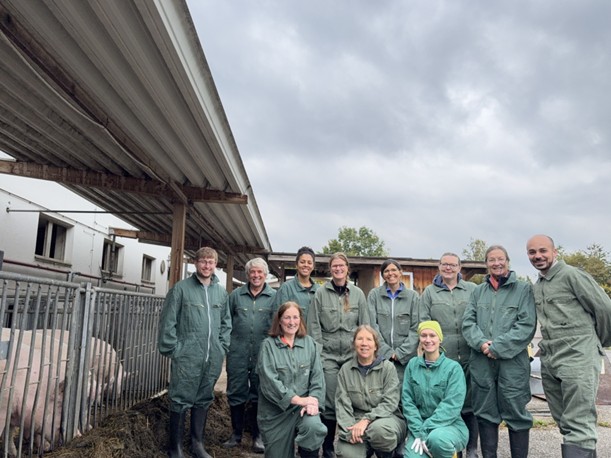
Neil Tirchett tells us about a recent study visit to Austria that formed part of the OneWelPig Project, focused on developing and evaluating high-welfare pig production systems.
Melissa Cupido and Neil Joseph Tirchett recently joined a group visit to Austria as part of the OneWelPig Project, which aims to develop and evaluate high-welfare pig production systems using a One Welfare framework. The visit took place from 29 September to 2 October 2025.
The study visit brought together representatives from University College Dublin (UCD), Animal Health Ireland (AHI), the Department of Agriculture, Food and the Marine (DAFM), Teagasc, and Irish pig farmers. The group explored a range of alternative pig housing systems, both outdoor and improved indoor setups, to learn how Austrian farmers manage pigs under different conditions while meeting welfare and sustainability goals.
Throughout the visit, participants had the opportunity to observe various farrowing systems, many of which were open and designed to allow greater freedom of movement for sows and piglets. These systems demonstrated practical ways to improve animal welfare through enhanced housing design and management.
The visit was guided by Dr. Christine Leeb from BOKU University, who provided expert insights and translation support to facilitate direct discussions with local farmers. These exchanges offered valuable perspectives on Austria’s approach to animal welfare, including their recent amendment to the Animal Protection Act, which will phase out fully slatted pens for pigs by 2034.
The visit also provided an excellent opportunity to compare current practices at Teagasc Moorepark’s Pig Research Facility with those observed in Austria. Given the similarities between production systems, the visit allowed for valuable reflection on housing and management approaches that could further enhance welfare and sustainability at Moorepark—supporting Teagasc’s ongoing commitment to continuous improvement in pig welfare and research-based innovation.
In addition to observing housing systems, participants discussed marketing schemes for high-welfare pork and how Austrian producers are aligning their practices with consumer expectations and national policies. A key driver of success is the bonus payment system that rewards producers for supplying pig meat from alternative housing systems.
Overall, the trip provided a valuable opportunity for knowledge exchange and for gathering insights that could inform the future development of alternative pig housing systems in Ireland—aligning animal welfare, environmental responsibility, and economic viability.