
Farming with Nature: Practical Ways to Enhance Farmland Biodiversity
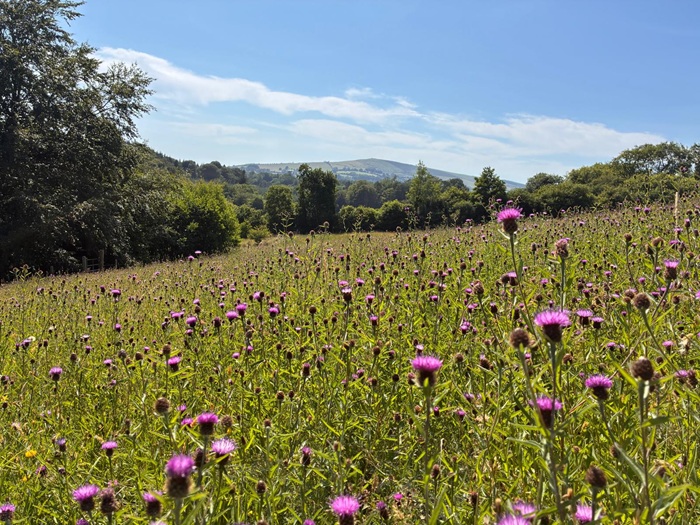
Declan Byrne and Ruth Dunne of Teagasc Tinahely recently hosted a farm walk on Paul and Kathleen Carberry’s farm in County Wicklow, offering attendees the opportunity to see first-hand how farming and nature can work together.
In this article, Claudia Barry, Biodiversity Research Technician, Mertixell Grau, FarmBioNet Project Manager, and Teagasc Advisors, Declan Byrne and Ruth Dunne explore the practical ways Paul and Kathleen Carberry enhance farmland biodiversity.
Practical ways to enhance farmland biodiversity
Through years of participation in agri-environment schemes, from REAP to the current ACRES scheme, the Carberrys have nurtured a farm that demonstrates how biodiversity-friendly management can support both wildlife and a resilient farming system. This is evident from the impressive habitats and variety of wildlife witnessed on the evening.
Creating ponds
The Carberry farm is home to three impressive ponds. Two were created more than a decade ago, while the newest was completed in October 2025 through the ReFarm Project.
Careful planning is essential when creating a pond. Choosing the right location is key, ensuring that valuable existing habitats are not disturbed, while also considering the site’s natural drainage to minimise the need for artificial lining. Paul stressed the importance of working with a contractor who understands the landscape and can shape the pond to suit the surrounding land.
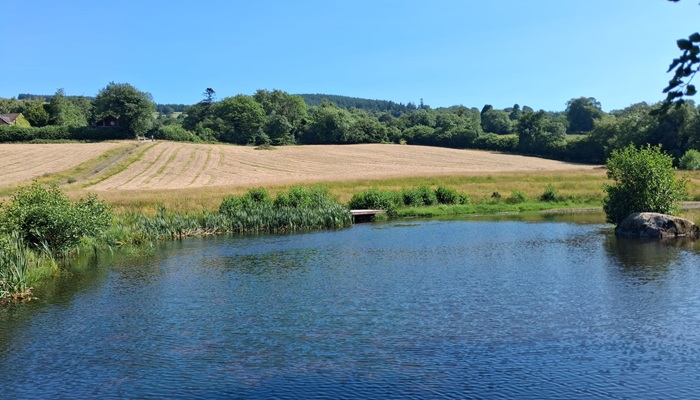
One of the Carberry’s three biodiversity-friendly ponds, this pond was established 15 years ago. Photographed by Claudia Barry
One of the biggest lessons learned through experience has been to let nature take the lead. Rather than introducing aquatic vegetation, Paul now recommends allowing ponds to colonise naturally.
While introducing plants may seem beneficial, it can sometimes result in introducing invasive species, or certain species taking over. Left to develop on their own, ponds establish a natural balance surprisingly quickly. Because the surrounding grasslands are managed without artificial fertilisers, the ponds remain clear, with little eutrophication or excessive algal growth. Even the algae that does develop is put to good use, with small amounts harvested and used as a natural fertiliser for saplings, as part of the farm’s woodland regeneration.
The ponds support an extraordinary diversity of wildlife and form an important network of habitats across the farm. They provide drinking water, shelter, hunting and breeding habitats for everything from foxes and birds to dragonflies and hoverflies. The farm recently hosted research for the Ponds for Pollinators Project, a Teagasc Walsh Scholarship project investigating the role that farmland ponds play in supporting pollinators.
If you are considering creating a pond on your own farm or land, Farming for Nature and An Taisce provide great guidance on planning and establishing ponds.
Managing species-rich grasslands
Explaining that the previous landowner had farmed in quite a biodiversity-friendly way, the Carberrys were happy to carry on that legacy on the farm. These meadows are managed to maximise their value for biodiversity.
Sheep and horses graze the fields during winter and early spring before they are closed off until mid to late summer. This extended flowering period allows a wide variety of wildflowers to bloom, providing abundant food for pollinators and other wildlife throughout their breeding seasons.
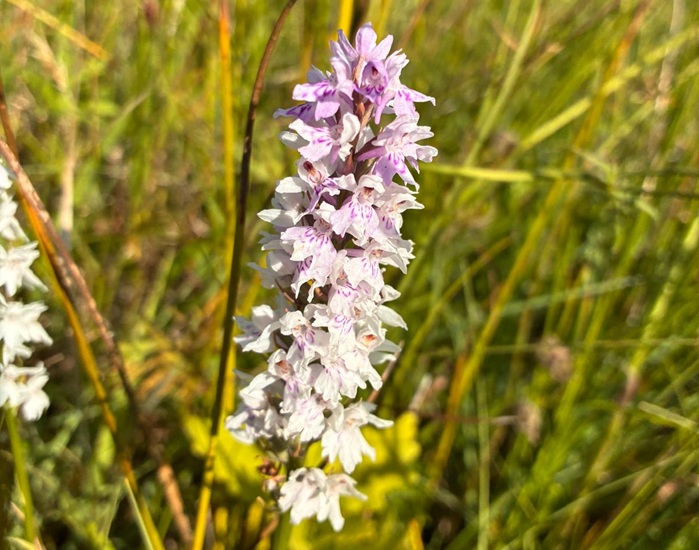
Common spotted orchid, one of the many flowering species found in the species-rich grasslands. Photographed by Claudia BarryHay is then harvested in stages, rather than all at once, to ensure that some fields remain in flower at any given time. The resulting hay can be utilised for hay strewing, helping to increase the diversity of wildflowers in other grassland. The meadows are rich in wildflower species, including yellow rattle, birds-foot trefoil, self-heal and various species of orchid.
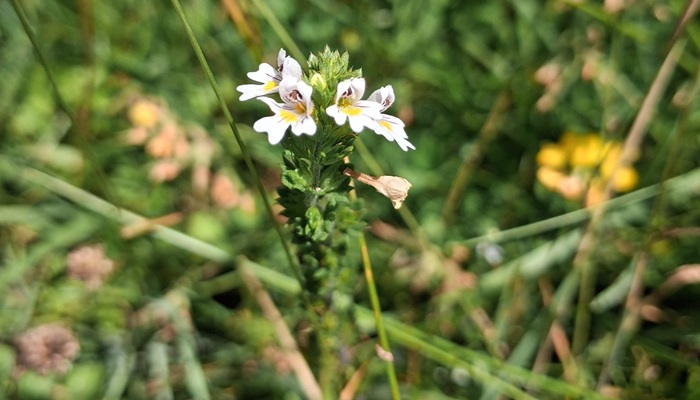
Eyebright found in the species-rich grasslands on the Carberry’s farm. Photographed by Claudia Barry
The farm also contains an important fen habitat – a spring-fed wet grassland which supports its own distinctive community of plants, including grass of Parnassus, marsh marigold, mints and woodrush. The devils-bit scabious is a particularly special plant that grows in the fen, as it is the sole larval food of Ireland’s only protected insect, the marsh fritillary butterfly.
The Carberry’s farm supports a breeding population of the marsh fritillary, which depend on wetlands with a varied sward structure. Different vegetation heights create the sheltered microhabitats that the caterpillars need to spin their silk webs.
This diverse sward structure is ideally maintained through light grazing by cattle or horses. To prevent scrub from taking over this sensitive habitat, it is periodically grazed by the Carberry’s two horses over the winter and into early spring. Paul would ideally like to graze with cattle also but currently has no cattle due to TB concerns in the area.
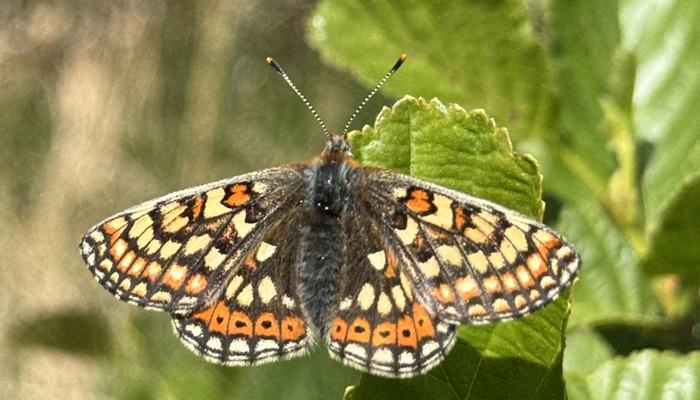
The Marsh Fritillary Butterfly, the only legally protected insect in Ireland. Photographed by Paul and Kathleen Carberry
Woodland regeneration and managing scrub
Natural regeneration is central to the Carberry’s approach to woodland management. Rather than relying on planting new trees, they encourage existing semi-natural woodlands to expand naturally by protecting self-seeded saplings from browsing by deer and hare using tree guards. These naturally regenerated saplings are also transplanted to other parts of the farm, where appropriate, reducing the need to purchase young trees and reducing the risk of introducing pests or disease through importing stock.
Scrub management
A visit to an area of gorse scrub bordering the woodland prompted an interesting discussion about scrub management. While scrub is often viewed as something to be removed, it actually provides valuable habitat, offering food, shelter and nesting sites for a wide range of wildlife.
The group discussed how traditional methods of scrub control, such as cutting or burning, can often lead to vigorous regrowth. In contrast, allowing selected areas of scrub to develop naturally can support the gradual expansion of native woodland. The gorse acts as a protective nursery, sheltering young trees as they establish. Over time, these saplings will outcompete the scrub, creating new areas of semi-natural woodland.
Across the farm, the mowing regime of the species-rich grasslands prevents unwanted scrub encroachment, striking a balance between maintaining open habitats and allowing woodland to regenerate where it provides the greatest ecological benefit. Mature hedgerows and treelines on the farm act as corridors between the various habitats, which is extremely important, as connected habitats support greater diversity than isolated habitats.
The farm walk highlighted that farming with nature is not necessarily about setting aside massive amounts of land for rewilding but managing the land you have thoughtfully. From ponds and flower-rich meadows to wetlands, scrub and semi-natural woodland, each habitat contributes to a connected landscape that supports biodiversity while maintaining a productive farm system.
More from Teagasc Daily: FarmBioNet becomes a partner in the All-Ireland Pollinator Plan 2026-2030