
Fertiliser use changes, impacts and key recommendations
Mark Plunkett, Teagasc Signpost Programme, takes a look at how fertiliser use changed on farms in 2025, examines the possible environmental impacts and shares key recommendations for the year ahead.
The National Fertiliser Use stats 2025, issued by Department of Agriculture, Food and the Marine Fertiliser Sales for the period 1/10/2024 to 30/9/2025, highlights the trends and developments in fertiliser usage in Ireland, reflecting shifts influenced by economic, environmental and climatic factors.
Key trends
The report presents trends in nitrogen (N), phosphorus (P) and potassium (K) fertiliser use, as well as lime application.
Nitrogen (N) use
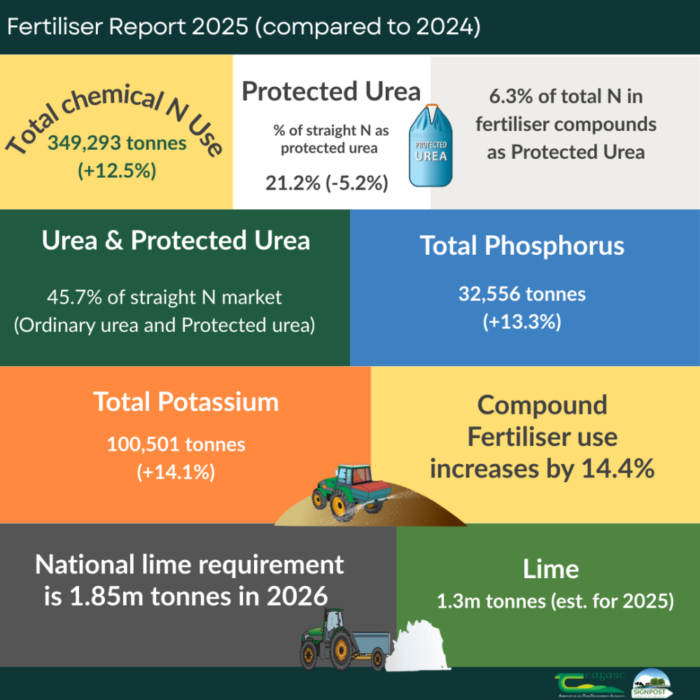
Total chemical N usage increased by 12.5% to 349,293 tonnes in 2025, compared to 2024, exceeding the Climate Action Plan target of 330,000 tonnes for 2025 by 5.8%.
Protected urea sales as a percentage of straight N decreased by 5.2% in 2025, with a falloff in usage seen in June to October reporting period compared to 2024. Reducing use of protected reduces our capacity to reduce greenhouse (GHG) emissions on intensive livestock farms. For example, full adoption of protected urea on a dairy farm reduces total farm emissions by 6 to 8% while reducing fertiliser N costs by 16%. Increased fertiliser N use, in the form of nitrate-based N (e.g. CAN), is of concern as it will make it more difficult to achieve emission reduction targets by 2030.
Phosphorus (P) and potassium (K) use
For the first time since the fertiliser price crisis in 2021, the use of P and K fertiliser has increased by 13 and 14%, respectively. This is a positive change but is still insufficient to halt the decline of both P and K soil fertility at farm level. Optimum soil fertility will be key to sustaining lower use of chemical N now and in the next 5 years.
Lime applications
Due to more favourable weather conditions in 2025, indications are that lime use will increase to an estimated 1.3 million tonnes. This is extremely positive as lime is a key technology to improve N use efficiency and help sustain reduced N use in the years ahead. Soils can release up to 70kg N/ha/yr where soil pH is correct on livestock farms.
More from Teagasc Daily: Lime – the low-cost fertiliser in 2026
Impact on greenhouse gas emissions
Because of the above changes, it is estimated that fertiliser-related greenhouse gas (GHG) emissions increased slightly (2.8%) in 2025 due to increased N usage and a change in fertiliser N type.
Recommendations
Nitrogen (N)
- Reduce the use of CAN based fertilisers and increase the use of NBPT protected urea, as it is the most cost effective technology available to reduce GHG emissions and improve sector sustainability.
- To sustain lower N usage now and in the years ahead, optimise soil pH, P and K levels, utilise N in cattle slurry and increase the adoption of clover and multispecies swards.
Phosphorus (P) & Potassium (K)
- Select suitable P compounds such as 18-6-12 / 10-10-20 etc. as they deliver a sustainable form of N and tend to be the most cost-effective way to purchase N, P & K.
- Avoid applying high Ns such as 24s and 27s as these products tend to be the most expensive way of purchasing P & Ks. The main source of N in these products is CAN which emits N₂O into the atmosphere thus increasing GHGs from fertiliser.
- Where possible return all cattle slurry to silage fields to replenish soil nutrients especially K reserves and valuable soil carbon.
- For silage fields select fertilisers such as 10-5-25 / 13-6-20 / 0-7-30, / 50% K (MOP) etc. to balance / build P & K.
Lime
- Apply lime based on recent soil test results
- Calculate farm lime requirements, plan and organise applications in 2026
- Take every opportunity to apply lime throughout the year, not just in the Autumn
- Optimising soil pH offers large benefits to reduce fertiliser N costs
For more insights on the Teagasc Signpost Programme, visit here.