
Not often an easy topic to broach, Enda Geoghegan, Teagasc Mayo, shares 5 key steps to starting the conversation around generational renewal.
One of the certainties in life is death. That’s right, none of us are going to live forever, no matter what we might think. With this in mind, and the fact that we can’t take our assets with us when we go – it is essential to face this reality head on. This applies to everyone, regardless of circumstance.
Having a plan in place for what happens after we pass away is crucial. Such planning offers immense benefits to the loved ones we leave behind. Whether that plan takes the form of a will or a lifetime transfer is a decision for the asset owner to make.
The importance of having a plan cannot be overstated. It brings peace of mind to everyone involved. The asset owner is the central figure in this process; the one who holds the power to begin the journey. While other family members can encourage and support, it is ultimately up to the asset owner to take the first step.
Key steps in generational renewal on Irish farms
1). Getting the conversation started
Begin by sitting down with the family to explore their hopes and expectations for the future. Starting this conversation can be a major hurdle; many people prefer to avoid potential conflict and seek to keep life simple. However, this may turn out to be one of the most important discussions you ever have. Managing expectations is key. Acknowledge everyone’s hopes and understand that while not all expectations may be fulfilled, a balanced outcome that works for everyone is often achievable. Clearly discussing aspirations, plans and expectations helps avoid future misunderstandings.
2). Legal and financial advice
Seek professional legal advice regarding wills and explore the tax implications of any transfers. Consider the various options available for lifetime transfers.
3). Development requirements for the Young Farmer
Evaluate the next generation’s readiness; this could include completing the Green Cert, exploring off-farm employment, or pursuing further education outside agriculture.
4). Planning for a gradual farm transfer
Consider options for a phased transfer of the farm, such as entering into a formal partnership arrangement.
5). Planning the asset owner’s role post-transfer
If a lifetime transfer takes place, a clear plan should be in place for the retiring farmer. This plan should define their role in the new setup and ensure financial security and emotional wellbeing.
The plan
In an ideal world, all the above steps are followed: a generational renewal plan is agreed upon by all family members, legal and financial guidance is sought, and a well thought out retirement plan is in place.
Of course, reality doesn’t always go according to plan. Still, progress is being made so what’s stopping more people from taking these steps, or even from simply making a will?
One of the main barriers is fear. A farmer’s connection to the land runs deep. To many, it’s not just an asset, it’s a legacy passed down through generations. This deep emotional attachment can become a major obstacle to transferring ownership.
There’s also the fear of losing identity. The idea of handing over the farm can bring fears of losing one’s purpose or standing within the community. ‘What will the neighbours think?’ is a common worry.
Generational pressure can also be a factor. The younger generation’s expectations may unintentionally create pressure, leaving the current owner feeling obliged to act, rather than making a free, unpressured choice.
Farm Succession and Inheritance Webinar
Today, September 9 at 7.30pm, Teagasc will host a Farm Succession and Inheritance Webinar. This webinar will focus on starting the conversation around Farm Succession and Inheritance with Claire O’Keeffe from Succession Ireland and Enda Geoghegan, Teagasc.
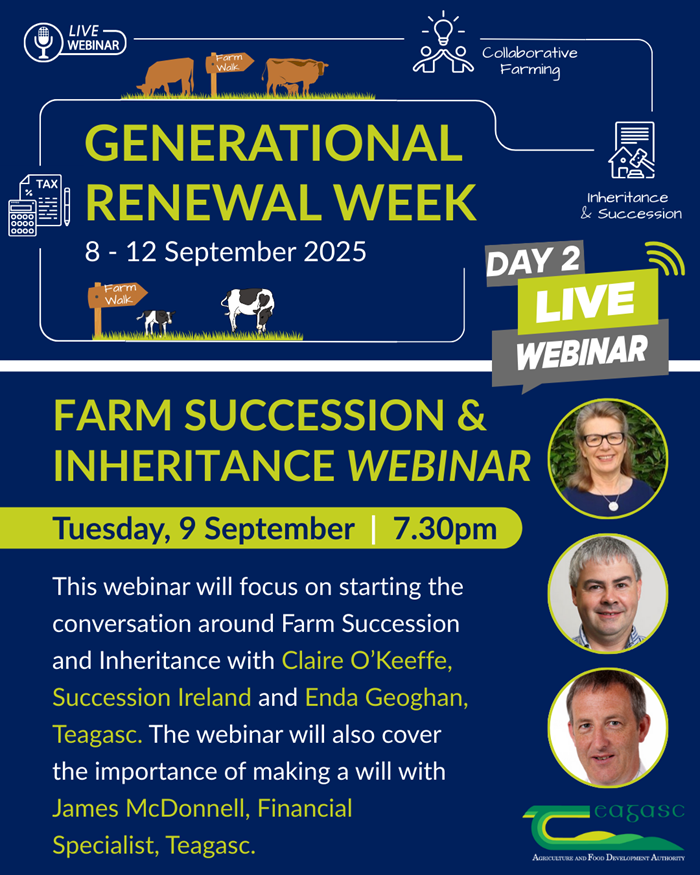
The webinar will also cover the importance of making a will with James McDonnell, Financial Specialist, Teagasc.
Register for the Farm Succession and Inheritance Webinar here.
More from Teagasc Daily: Generational renewal – why it matters
More from Teagasc Daily: Collaborative farming – find the model that works for you