
Managing herd intakes and nutrition as calving slows and peak lactation approaches
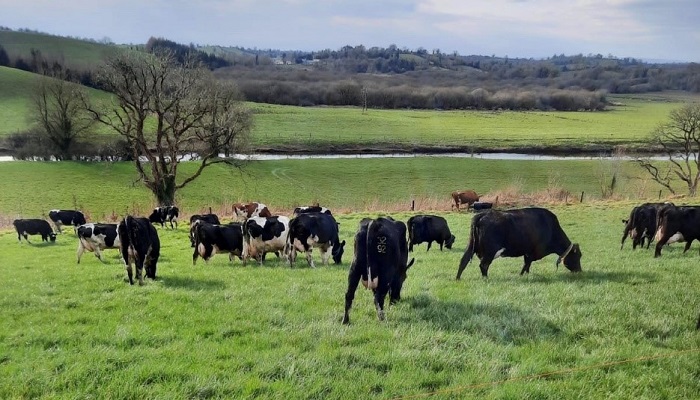
As calving begins to slow down and peak lactation approaches, Dr. Joe Patton, Teagasc Head of Dairy Knowledge Transfer, shares some key advice for managing the nutrition of your dairy herd over the coming weeks.
Most dairy herds are ‘over the hump’ of calving by this week. Daily milk solids output is rising steadily as the earliest calved cows move toward their peak production weeks.
Dry matter intake potential will also be increasing to 16-17kg DM, depending on average days calved. Optimising performance over this period means finding the most economic balance between direct milk productivity and feed costs, while setting the cows and swards up for the main production season.
Some points to consider are:
First rotation targets
Given the variable start to spring grazing and fertilizer this year, target date of first rotation completion may be closer to 12-15th April on many farms to allow sufficient re-growth to start the second round. Adjustments to grass budgets may be needed so speak to your advisor.
Priming grass for growth
The fertiliser market is volatile at present and concerns over price and availability are significant. However, swards need to be primed for growth into April. As soil temperature increases, response to N will approach 13-15kg grass DM per 1kg applied. This means that 30kg of N applied will grow 1.6 to 1.8 bales per acre equivalent of grass for grazing. A positive return.
Concentrate feeding
Assuming grass is available, the economics of concentrate feeding depends on the ratio of milk price to feed cost, but more importantly on the actual rate of milk response i.e. how much extra milk will 1kg more supplement fed deliver? This is variable and more difficult to predict.
An average response of 0.8kg milk per kg concentrate is typical on good quality pasture. However, research shows that marginal rate of response declines sharply as rate of meal feeding increases on grass (down to ±0.6kg milk per kg fed above 5kg).
Therefore, looking at milk price / feed cost ratio alone can be misleading because it assumes a constant milk return which is inaccurate. Feeding at a 3kg rate on grass will give a better economic response per kg fed than feeding at 6kg.
A common query at this time of year is ‘should I feed more meal to get cows to a high peak?’. It is a misconception that driving ‘high peak’ through concentrate feeding guarantees a higher milk yield later in the year, based on numerous feeding studies.
Feeding higher levels of concentrate now will result in a low immediate response for no gain later in the season. The priority now is to maximise intake of quality grass so that cows are on a rising plane of nutrition, and that body condition score is maintained.
Transition cow management
Finally, it is also important to maintain good protocols for transition cow management for the remaining cows to calve. Do not allow any April-May calving cows to gain excess condition. Revise daily mineral allocations to make sure 100-120g per cow is being allocated. Keep low potassium (K) forage with extra magnesium (if needed) in front of the cows on the point of calving. Fully clear the feed barriers in front of the dry cows and calving pen twice a week.
More from Teagasc Daily: Getting grazing back on track
More from Teagasc Daily: Staying ahead in the SCC game