
10 April 2025
Multi-species or grass/white clover for beef reseeds?
Beef farmers planning to reseed in the coming weeks have a decision to make – stick with the tried and tested grass/white clover mixes or venture for something more novel in multi-species swards.
In comparison to the perennial ryegrass dominated swards that have been a mainstay of grassland systems over recent decades, both of the above have the ability to provide farmers with their ‘own nitrogen factory’ on their farm, stemming from the biological nitrogen fixing ability of the legumes contained within.
Over recent years, more and more farmers have been testing the water with multi-species sward mixes, somewhat helped by the grant aiding of suitable seed mixtures, or the proposed benefits that they provide in terms of animal performance, anthelmintic resistance or drought tolerance.
With the exception of the latter, which has been proven in plot trials at Teagasc research centres in Johnstown Castle and Grange, the proposed animal performance benefits – particularly in terms of the potential benefits on beef farms – have been largely unconfirmed by Teagasc research. This, however, was the case until a grazing study was undertaken at Teagasc Grange over 2022 to 2023.
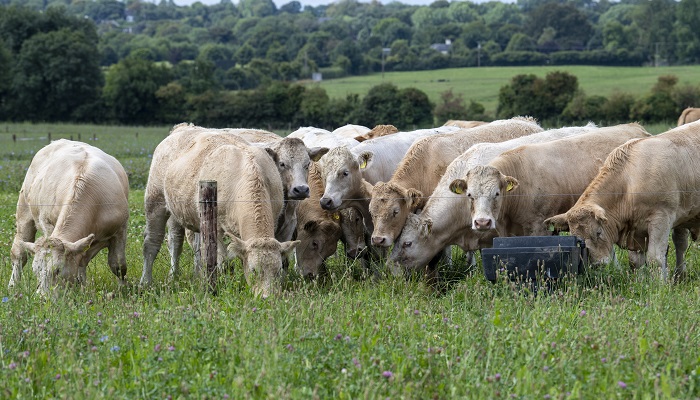
Joining Teagasc Beef Specialist, Catherine Egan on a recent episode of the Beef Edge podcast, Researcher, Sarah Burke outlined the key differences – or in this case lack of – witnessed between Charolais steers carried from weaning to finishing stage on either grass/white clover or multispecies swards.
“The objective of my study,” Sarah Burke explained, “was to compare growth and carcass characteristics of late maturing suckler bred steers grazed on either grass/white clover or multispecies swards and finished at 19, 23 or 26 months of age.”
Ran over two weanling to beef production cycles, 19 month steers were finished at the end of their second grazing season from pasture only; 23 month steers were finished at the end of the second winter after a finishing period of 5kg of concentrate and their respective grass/white clover or multi-species silages; and the 26 month steers, after being stored on a diet of their respective silage and 1kg of meal, returned to grass for approximately two months and were finished off grass.
Performance
Providing a brief summary of the study findings, Sarah Burke explained that within each finishing age cohort, the growth performance of cattle grazing grass/white clover and multi-species swards, or offered silages conserved from these pastures, was similar.
And although the pastures differed in physical appearance, especially in the summer months, and the included herbs – chicory and plantain – began to flower, herbage production and digestibility was similar for both swards.
“Even though they were very visually different, both swards produced a similar quantity of herbage. It was similar DMD in grazed conditions, pre-grazing herbage mass, rotation length and post-grazing sward height were similar for both,” Sarah Burke added.
A note of caution however, Sarah Burke did touch on the lower dry matter content of the multi-species swards, noting that it “posed an additional challenge when we were trying to make silage from the multi-species.
“You have to make sure wilting conditions are just right, as it is harder to wilt because of the lower dry matter.”
Sarah Burke also touched on work undertaken by Marie O’Rourke as part of this study, which confirmed that no differences in animal methane production or anthelmintic properties were witnessed between the Charolais steers grazed on the two sward types.
For further insights on this research, listen into the full episode of the Beef Edge podcast below: