
Native hedgerows – lifelines for nature at Kildalton College
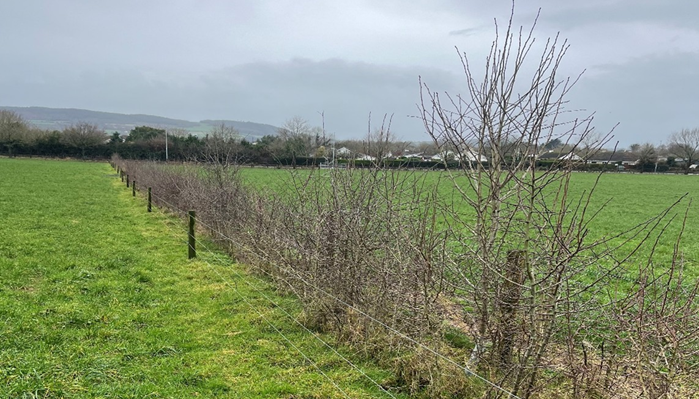
Planting new native hedgerows at Teagasc Kildalton College has proven to be an excellent investment in farm productivity, biodiversity, education and landscape quality, College Lecturer, Brian Clancy tells us more.
Kildalton College is recognised as a leader in practical and sustainable hedgerow management, frequently serving as a site for demonstrating best practices in hedgerow planting, maintenance and biodiversity enhancement.
In early January 2026, the college planted a further 400 metres of holly, blackthorn and whitethorn, with plans to add a similar amount of native hedgerow through 2027.
Native hedgerows provide shelter for livestock and crops, habitat and food for birds and pollinators, improved soil and water management, and teaching opportunities for students across agriculture, horticulture and ecology programmes.
Why plant native hedgerows at Kildalton College?
- Shelter – reduce wind exposure for livestock and crops and lower stress on young animals.
- Biodiversity – provide nesting, foraging and connectivity for birds, bats, insects and small mammals.
- Water and soil benefits – help reduce run-off, trap sediment and enhance soil structure.
- Carbon and landscape value – store carbon and improve the visual amenity of the college campus.
- Educational resource – a living classroom for plant identification, ecology, farm management and monitoring projects.
Best practice for planting new hedges
- Establishment method: Plants are traditionally set in a double staggered rows at a density of 7 plants per metre.
- Weather: Avoid waterlogged soil, very wet or frosty weather.
- Timing: Planting typically occurs during the dormant season, from October to March.
Species selection
Use a diverse mix of native species – such as Hawthorn (Whitethorn), Hazel, Holly, Dog Rose, Spindle, and Guelder Rose – to support birds and pollinators. At Kildalton College, species planted include Hawthorn (Whitethorn), Blackthorn, Holly and Hazel amongst others.
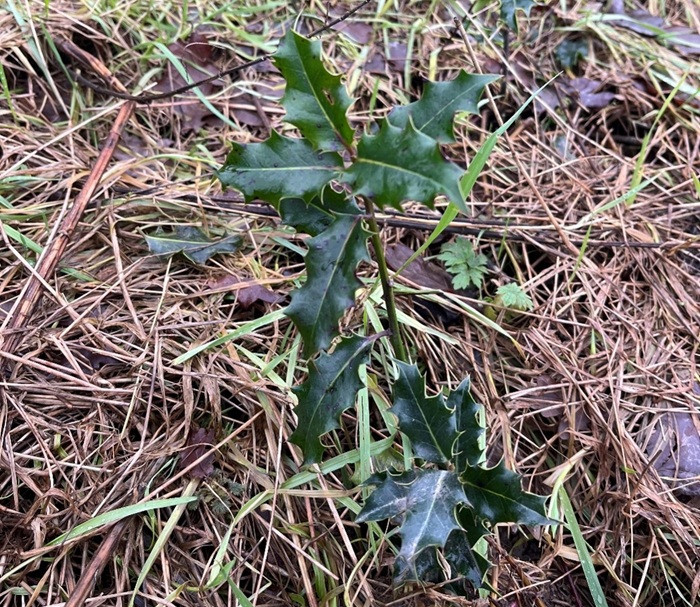
A Holly as part of a newly planted holly hedgerow on paddocks 13, 14 and 17 Kildalton College Drystock unit (Source: Brian Clancy, Kildalton College, January 2026).
Aim for a diverse mix of thorny fruiting and non-thorny species.
Suggested species and brief notes:
- Hawthorn (Crataegus monogyna) – backbone of many hedges; dense, thorny, spring blossom and autumn hips.
- Blackthorn (Prunus spinosa) – early blossom for pollinators and sloes for birds.
- Hazel (Corylus avellana) – good shrub layer and nut crop for wildlife.
- Holly (Ilex aquifolium) – evergreen shelter and winter berries for birds.
- Guelder-rose (Viburnum opulus) – attractive flowers and berries for birds.
- Spindle (Euonymus europaeus) – colourful autumn fruit, good for insects.
- Dog-rose (Rosa canina) – provides hips and nesting cover.
Fencing
All newly planted hedgerows should be fenced off from livestock to minimise damage to young plants.
Pruning – Dense Base technique
To prevent ‘leggy’ growth, new plants (except Holly) are pruned to within 3 inch (75 mm) of the ground immediately after planting. This encourages multiple stems to sprout, creating a wide stock-proof base.
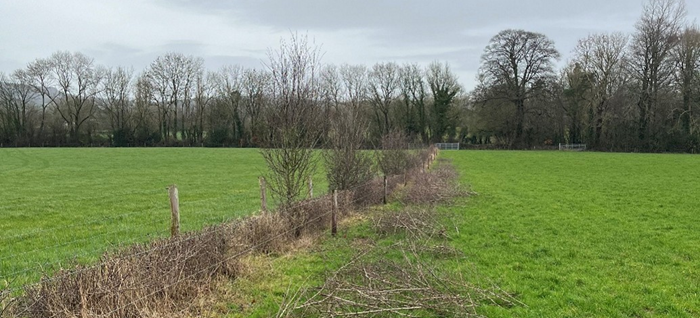
Mixed Whitethorn & Blackthorn hedgerow between paddocks 3 and 4 Kildalton College, Drystock unit. Plants were pruned in early January 2026 to encourage multiple stems to sprout, creating a wide stock-proof base. (Source: Brian Clancy, Kildalton College, January 2026).
Weed prevention
Compostable film (ideally a metre wide) is pushed over the cut stumps to prevent grass and weeds from smothering the young saplings. The plastic is kept in place using soil or by pressing the edges of the strip into the clay using a spade.
Ongoing maintenance
It is important to keep vegetation at the base of newly planted hedgerows under control for the first 1–2 years to minimise competition for water, light and nutrients with other plants.
Future trees
At Kildalton College, some young plants are identified, marked with a tree guard, and left unpruned to grow into a mature, flowering trees. Over time, they will provide many benefits to birds. Key benefits include providing secure, high-altitude nesting sites, serving as vantage points for hunting and territory defence, and acting as crucial food sources (insects, seeds, and berries).
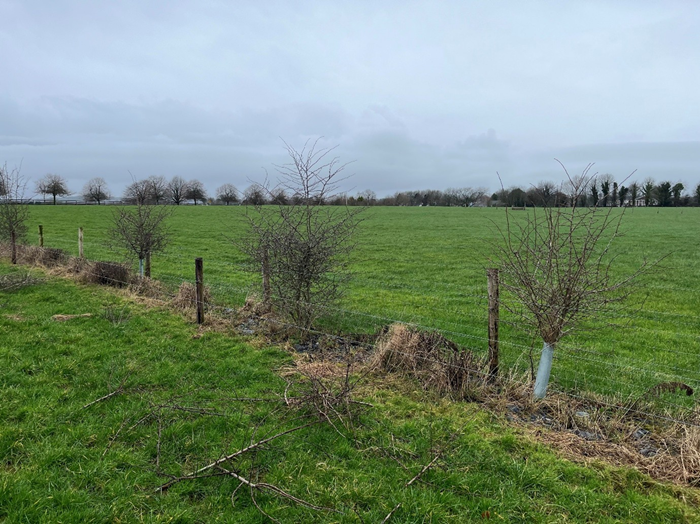
Paddocks 3 and 4 Kildalton College, Drystock unit. Some plants left to grow into mature trees. (Source: Brian Clancy, Kildalton College, January 2026).
Management and biodiversity
Kildalton College prioritises habitat conservation and connectivity by using existing and new hedgerows as wildlife corridors.
Previous surveys at Kildalton have identified 45 bird species and 7 native bat species that rely on these hedgerows for nesting and foraging.
For long-term maintenance, the college demonstrates techniques like hedge laying to rejuvenate older, thin hedges without losing their structure. This demonstration area is located in the lower cark park of the college.
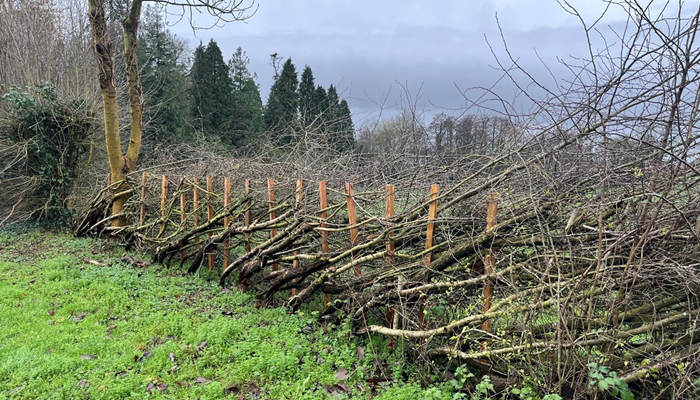
Newly layed section of hedgerow, Kildalton College, September 2025 (Source: Brian Clancy, Kildalton College, January 2026).
Biodiversity and educational opportunities at Kildalton
As part of their practical component at Kildalton College, students gain valuable hands‑on experience in habitat management, species identification, farm conservation planning (Biodiversity audits) and practical skills such as planting of new hedgerow on the farm and demonstration area.
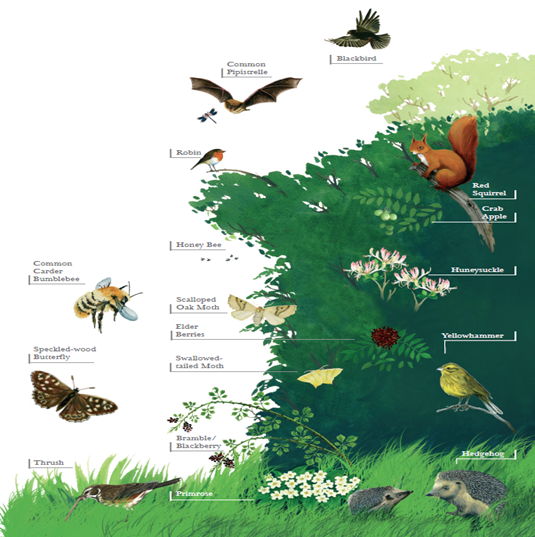
Students also take part in hedgerow evaluations on the college farm. Hedgerows are assessed on their structure, connectivity, diversity and associated features.
For more on hedgerow management, visit here.
For more from Kildalton College, visit here.
More from Teagasc Daily: Kildalton College’s long-haul summer guests
More from Teagasc Daily: Bats at Kildalton – nature on the farm and in the classroom
More from Teagasc Daily: Teagasc Kildalton College students thriving on overseas placements with the help of Waterford FRS
More from Teagasc Daily: Host farm placements proving valuable to Kildaton College students