
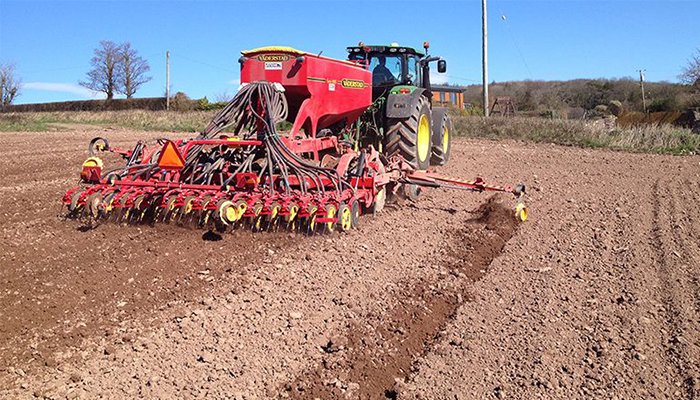
Good establishment is the foundation of a high yielding winter cereal crop. While nitrogen takes the spotlight in spring, it is phosphorus (P) and potassium (K) that do much of the heavy lifting during autumn and early growth, Crops Specialist at Teagasc, Ciaran Collins tells us more.
Getting these nutrients right at sowing supports rooting, tillering, stress tolerance and ensures that the crop is set up to make the best use of nitrogen later in the season.
Why P and K are important:
- Phosphorus (P): Drives root development and tiller formation, improving plant vigour and early growth. Crops with good P supply establish faster and are better placed to use nitrogen efficiently in spring.
- Potassium (K): Strengthens straw, reduces lodging risk and supports disease tolerance. It also plays a key role in regulating water movement within the plant, which improves winter hardiness and resilience against stress.
Use soil tests to guide the strategy
All nutrient decisions should begin with a soil test. Soil tests remain valid for up to four years from the 15th of September prior to sampling. Once you know your soil index, you can target fertiliser use where it will have the greatest impact.
New administrative requirement
From 14th September 2025, under SI 42 of 2025, a new rule applies to soil sample reports. Every soil analysis result must state the geo-reference (GPS co-ordinates) or the LPIS parcel number of the land represented by the sample. If this information is missing, the parcel will automatically default to P Index 4.
The LPIS number is the identifier shown on your BISS maps (a letter plus 10 digits). The most recent up-to-date parcel number must be used so it is important to only use current BISS maps when organising soil sampling. Geo-reference means GPS co-ordinates, linked to a soil sample. If one sample represents several small parcels, the printed report must include the LPIS number or geo-reference for each parcel.
Autumn applications of P and K
Winter cereals have a demand for P and K, which ensures that crops are well established in terms of rooting and tiller development entering the winter period. Index 3 soils will have a good supply of P and K for crop establishment; therefore, omit P and K applications until spring. For index 1 or 2 soils apply nutrients as shown in Table 1. A fertiliser product such as 0-10-20 or 0-7-30 will supply the correct balance of P and K at this stage. Apply at sowing and incorporate into the seedbed. Complete fertiliser P applications by October 31.
Table 1: Autumn P and K requirements for winter cereals (build-up)
| Soil Index | P (kg/ha) | K (kg/ha) | Suggested fertiliser product and rate (kg/ha) |
| 1 | 20 | 30 | 200kg 0-10-20 |
| 2 | 10 | 15 | 100kg 0-10-20 |
Note: On K-fixing soils (typically heavier clays), it is best to apply potassium closer to crop demand. Splitting K applications in spring alongside nitrogen reduces fixation losses and improves uptake.
Staying within the rules
Under the EU Nitrates Directive, all nutrient applications must be within the allowances set out in your Nutrient Management Plan (NMP). Key points to remember:
- P allowances are based on soil test results and crop requirements.
- Applications of P are only permitted up to October 31.
- Always check your farm’s current allowance with your advisor before spreading.
More from Teagasc Daily: Irish grain – a low-carbon, high value feed option