
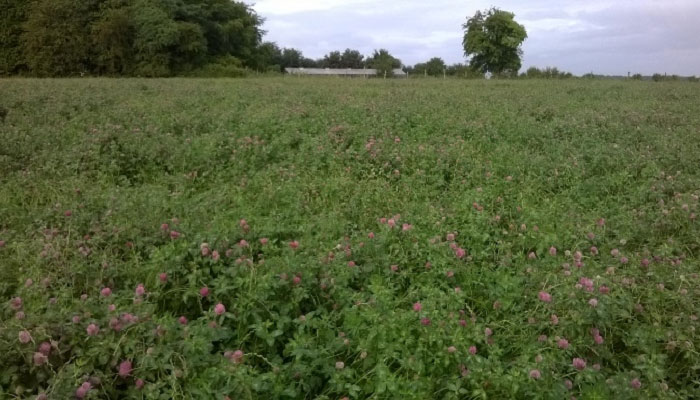
A late lactation or early lactation buffer? Researchers at Teagasc Moorepark have examined how dairy cows perform when offered grass-red clover silage within pasture-based systems.
Results of the study were presented by Mathilde Chaize, Michael Egan, Ricki Fitzgerald, Nicky Byrne, Tom O’Callaghan and Michael Dineen at the Moorepark 2025, read more below:
In 2023, we conducted experiments during early and late lactation to investigate the effect of supplementing grazing dairy cows with grass-red clover silage.
The early-lactation experiment
The early-lactation experiment (March-April) investigated the effects of silage type and concentrate crude protein (CP) level on milk production performance. The cows were fed pasture by day and were offered 7 kg of dry matter (DM) of either grass silage or grass-red clover silage at night.
The grass silage dry matter digestibility (DMD) was 74.2% and the CP concentration was 12.6%. The grass-red clover silage DMD was 72.6%, the CP concentration was 17.0% and the silage contained 64% of red clover.
All cows were supplemented with 4 kg of concentrates in the parlour, with a CP concentration of either 15 or 9.5% (on a fresh weight basis).
In early lactation, feeding grass-red clover silage did not affect milk yield or milk protein concentration (Table 1). However, there was a reduction in milk fat concentration and milk fat yield when grass-red clover silage was fed, compared with cows fed grass silage. Feeding a 9.5% CP concentrate reduced milk yield and milk solids yield when compared with cows fed a 15% CP concentrate.
Table 1: Effect of silage type and concentrate crude protein level on milk production during early lactation
| Silage type | Concentrate crude protein* | |||
| Grass | Grass-red clover | 15% | 9.5% | |
| Milk yield (kg/day) | 23.4 | 23.5 | 24.2 | 22.7 |
| Protein (%) | 3.37 | 3.39 | 3.38 | 3.38 |
| Fat (%) | 5.24 | 4.98 | 5.07 | 5.15 |
| Protein yield (kg/day) | 0.78 | 0.80 | 0.82 | 0.76 |
| Fat yield (kg/day) | 1.22 | 1.16 | 1.22 | 1.16 |
| Milk solids yield (kg/day) | 2.01 | 1.96 | 2.03 | 1.93 |
The late-lactation experiment
The late-lactation experiment (October-November) investigated the effects of silage type and silage feeding level on milk production performance. The cows were fed pasture by day and were offered silage at night.
The silage offered was either grass silage or grass-red clover silage (with a red clover content of 78%) and was fed either ad libitum or at a level of 8 kg DM/cow. The grass silage CP concentration was 12.7%, whereas the grass-red clover silage was 14.7% CP. Silage DMD analysis is currently underway. The cows were also supplemented with 3 kg of a 15% CP concentrate (on a fresh weight basis).
Feeding grass-red clover silage in late lactation tended to increase milk yield but reduced milk protein and fat concentrations, resulting in similar milk solids yield, when compared with cows fed grass silage (Table 2). There was no effect of silage feeding level at night on milk production, during late lactation.
Table 2: Effect of silage type and silage feeding level on milk production during late lactation
| Silage type | Silage feeding level | |||
| Grass | Grass-red clover | Ad libitum | 8 kg DM/cow | |
| Milk yield (kg/day) | 13.6 | 14.1 | 13.7 | 14.0 |
| Protein (%) | 4.47 | 4.35 | 4.44 | 4.38 |
| Fat (%) | 6.16 | 5.98 | 6.10 | 6.04 |
| Protein yield (kg/day) | 0.60 | 0.61 | 0.60 | 0.61 |
| Fat yield (kg/day) | 0.82 | 0.83 | 0.83 | 0.83 |
| Milk solids yield (kg/day) | 1.43 | 1.44 | 1.43 | 1.44 |
Conclusion
Due to inclement weather or pasture supply deficits, there are times when lactating dairy cows require silage supplementation. When cows were supplemented with grass-red clover silage in early lactation, milk fat percentage and milk fat yield were reduced. However, during late lactation, cows supplemented with grass-red clover silage maintained milk production performance when compared to cows supplemented with grass silage.
These results suggest that grass-red clover silages should be prioritised towards late-lactation dairy cows and that silages with low red clover content (such as first cut silages) should be prioritised towards early-lactation dairy cows, in order to optimise the benefits from grass-red clover silage production systems.
This experiment was funded by Teagasc Core Funding and Dairy Research Ireland.
For more insights from Moorepark 2025, view the full publication (PDF) here.
More from Teagasc Daily: Keep control of lameness this autumn
More from Teagasc Daily: Lessons on labour from the Aurivo Focus Farms