
Reducing Ammonia emissions: Assessing the costs and benefits for Irish farmers
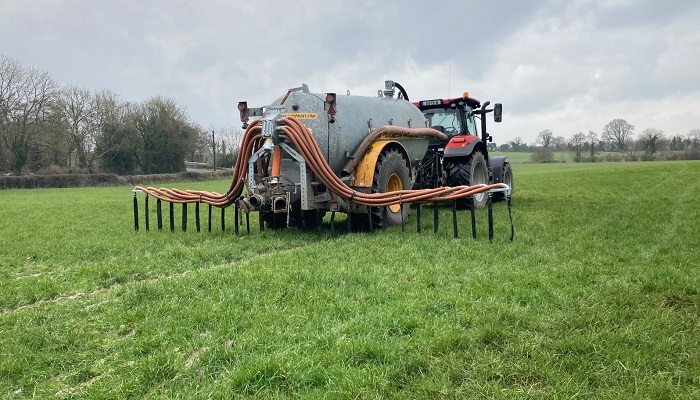
A new study led by Teagasc and UCD has analysed the cost-effectiveness of on-farm practices to reduce ammonia emissions.
Ireland and other EU member states have committed to reducing their ammonia emissions. The target for Ireland is a 5% reduction by 2030, as compared to a 2005 baseline.
Ammonia is an air pollutant and an indirect source of nitrous oxide, a potent greenhouse gas. It can also have negative effects on waterways and ecosystems through acidification and eutrophication, as well as negative health effects in humans and animals.
In Ireland, agriculture is responsible for 99% of ammonia emissions, primarily from livestock manure, followed by synthetic fertiliser use. Therefore, mitigation measures for ammonia focus on animal feeding and housing strategies, manure management and the use of low emission fertilisers.
The cost-effectiveness and mitigation potential of on-farm practices
This latest research, published in the Irish Journal of Agricultural and Food Research, used a Marginal Abatement Cost Curve (MACC) to measure the cost-effectiveness and mitigation potential of various on-farm practices.
The MACC has been used by Teagasc previously, most recently in 2023, to provide a roadmap towards a reduction in greenhouse gas emissions from agriculture.
In this study, the researchers developed a MACC using three technology uptake rates (low, medium and high) and three economic activity scenarios (i.e., business as usual scenario, lower activity and higher activity levels). Thirteen mitigation measures were examined for bovine, pig and poultry farms.
The greatest ammonia mitigating effect was found to be low-emission slurry spreading (LESS) on bovine farms. Practices such as use of protected urea, clover establishment on intensive dairy farms, liming and reduction of crude protein in bovine and pig diets were found to be cost-negative in all three adoption rates and economic activity scenarios.
A lot of these measures improve the overall nitrogen use efficiency on farm by making more nitrogen available for the growing plant, thus allowing to reduce emissions and cost associated with the use of synthetic fertiliser.
Amendments to bovine slurry were comparatively an expensive measure under all the economic activity scenarios.
Overall, the medium and high adoption rates were found to mitigate ammonia emissions to the required level in the business as usual and lower economic activity scenarios. In the higher economic activity scenario, the higher technology adoption rates will be required.
Given that medium to high adoption levels will be required for Ireland to meet its compliance targets, the study concludes that enhanced policy instruments could promote these practices. Some regulations are already in place mandating the use of LESS and prohibiting the use of unprotected urea. Further financial support to farmers may be required for the more expensive measures such as amendments to bovine slurry.
This research was performed as part of the Abating Ammonia in Agriculture (AAA) project funded by the Department of Agriculture, Food and the Marine.
Read the full paper here: Assessment of measures for ammonia mitigation in Irish agriculture using marginal abatement cost curve analysis
To read more about climate and biodiversity research in Teagasc, visit here.