
Removing the ‘guesswork’ with precision farming
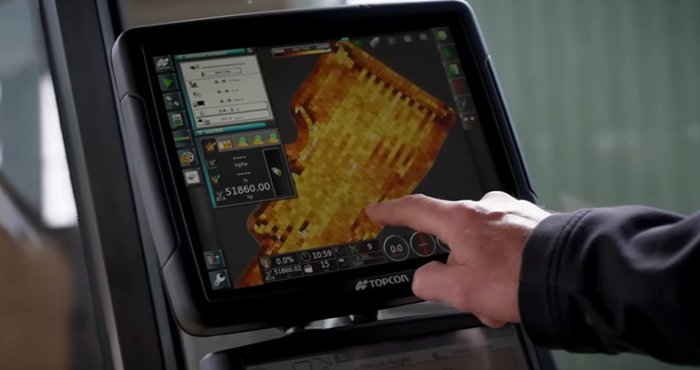
Precision farming, using technology, data and careful monitoring, helps farmers like Don Somers grow crops more efficiently. Siobhán Kavanagh and John Mahon, Teagasc Signpost, write on some of the technologies being utilised on his Wexford tillage farm.
Inputs are expensive on a tillage farm and precision technology helps to keep an eye on these and take the guess work out of farming. Don Somers, winner of the overall award for the Teagasc FBD Environmental Sustainability Awards 2025, uses precision technology to improve the efficiency of his farming practices but also to reduce the impact his farm is having on the environment.
Crop performance
For the past six years, Don has been using yield maps to see exactly how crops are performing across different parts of his fields. With this knowledge, he can target soil tests more accurately to see exactly what’s happening in parts of a field that may not be performing as well as other areas of the field.
This approach allows Don to vary fertiliser applications based on the precision soil analysis. He can spot issues like poor drainage or compaction – all based on how previous crops have performed. Instead of treating a whole field the same, he can give each part exactly what it needs.
Avoiding nitrogen waste
Nitrogen (N) is a vital plant nutrient on a tillage farm, but it’s also one that farmers need to manage carefully to avoid wasting money and causing pollution. To get it right, Don has been trialling a special N sensor on his winter wheat crops.
On the final field application, the sensor measures crop growth as he drives through the crop and directs the spreader to apply a precise amount of nitrogen to the variable growth.
On average, his fields received 50 kg of nitrogen per hectare in the final split, but this varied between 42 and 65kg – depending on growth conditions and predicted requirements. The result is increased efficiency; healthier crops and less nitrogen lost to the environment.
More accuracy
Don makes extensive use of GPS equipment; auto-steer on the tractor helps him sow crops accurately and subsequently apply fertiliser and pesticides accurately. This ensures there are no gaps or overlaps which saves money on input costs and saves the environment avoiding over application, and ensuring Don stays out the correct distance from drains and field margins so that fertiliser and pesticides doesn’t end up in the waterways around his farm.
More accurate spraying
Only this year, Don has invested in a sprayer that has the capabilities of using precision technology to only spray areas that need spraying e.g. weeds. Drone or satellite imagery are used to scan the field, the information is downloaded and a prescription map created which is then uploaded to the computer in the tractor. This will communicate to each individual sprayer nozzle when to turn on or off depending on the map. This should lead to significant savings on pesticides and liquid fertiliser applications, reducing the risk to the environment.
Read more on the use of precision spraying on Don Somers’ farm here.
Upcoming event
Join us on the 17th of June on Don Somers’ farm (Y21 TR80) for a Somers Evening Family Farm Walk at 6.30pm. It’s a great opportunity to visit an award-winning farm and see what Don is doing to remain profitable while at the same time looking after the environment.
For further details on the Somers Evening Family Farm Walk, visit here.
The above article first appeared in the Farming Examiner as part of a Signpost Programme update.