Resistance update on 2025 harvest samples of grass weeds
As part of the 2025 Teagasc resistance monitoring programme, growers/advisors submitted grass weeds suspected of herbicide resistance or considered difficult to control. Seed populations were grown in a glasshouse and tested with ACCase and ALS herbicides at the two- to four-leaf stage. Vijaya Bhaskar AV, Research Officer at the Teagasc Crops Research Centre, Oak Park shares key findings and insights.
Blackgrass
- Six of the nine populations tested (BG-01 to BG-06) were resistant (Figure 1).
- BG-01 showed resistance to both ACCase and ALS herbicides; BG-02 to BG-04 were ACCase-resistant and BG-05 and BG-06 were ALS-resistant.
- Centurion Max remained effective on all populations, except BG-02 which had some surviving plants.
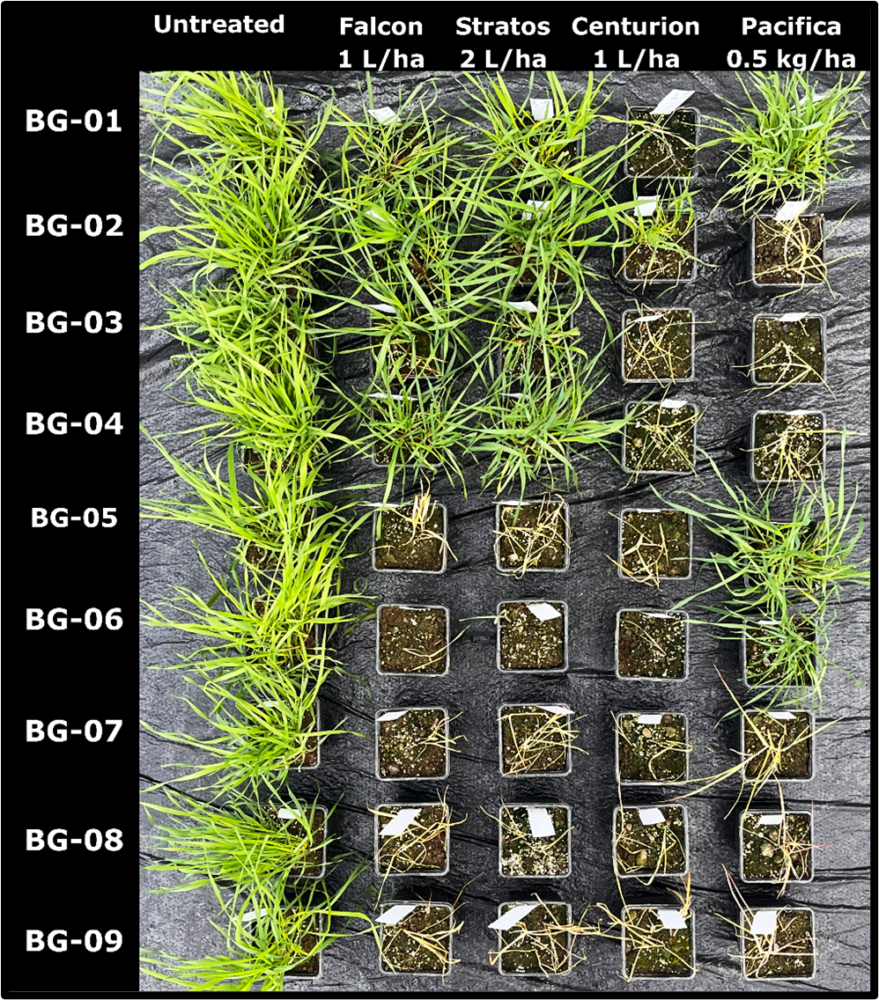
Figure 1: Symptoms of resistance-suspect blackgrass populations 30 days post-treatment with ACCase herbicides Falcon, Stratos Ultra and Centurion Max and the ALS herbicide Pacifica Plus, all applied at the recommended label rates. Where treated-plants are absent from a square full control was achieved.
Brome types
In recent years, submissions of rye, soft and meadow brome have increased. Accurate identification of these species is challenging and misidentification is common.
Nineteen brome populations were tested: eight sterile brome, two great brome and nine reported as eight soft brome and one rye brome. To verify these identifications, ripe seeds were cross-sectioned with a sharp blade. Rye brome seeds have a distinctive V or U-shaped cross-section, whereas soft and meadow brome seeds are saucer-shaped. The rye brome population was correctly identified; however, six of the eight populations reported as soft brome were actually rye brome (Figure 2). The remaining two populations need to be grown to confirm whether they are soft (hairy spikelets) or meadow (hairless spikelets).
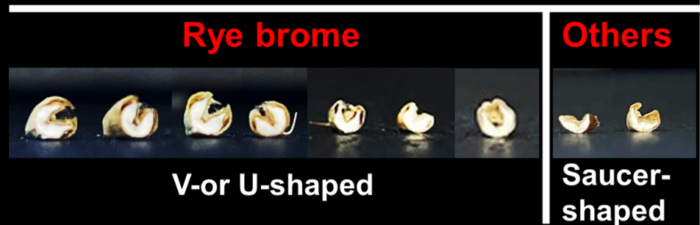
Figure 2: Six rye brome seeds with a V-shaped cross-section and two seeds of other brome types (soft or meadow) with a saucer-shaped cross-section.
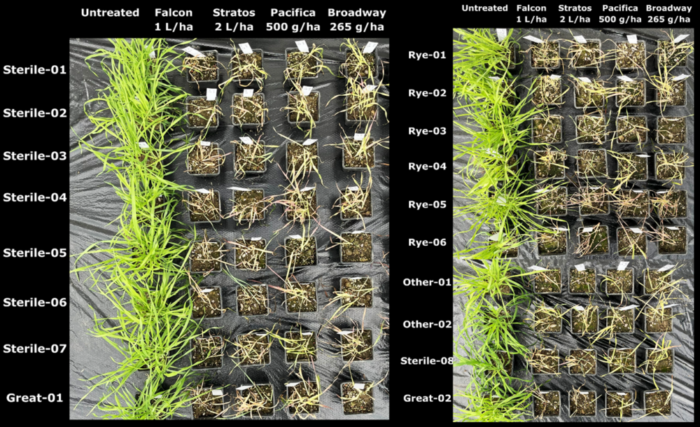
All populations tested with ACCase and ALS herbicides were effectively controlled (Figure 3), except for one rye brome population from County Wicklow, which showed full resistance to ALS herbicide Pacifica (Figure 4). Broadway had some effect but was insufficient to control the population. This rye brome population represents the first brome species in Ireland confirmed as resistant to ALS herbicides.
Figure 3: Symptoms of brome populations 30 days post-treatment with ACCase herbicides (Falcon, Stratos Ultra) and ALS herbicides (Pacifica Plus, Broadway Star), all applied at the recommended label rates. Where plants are absent from a square, full control was achieved.
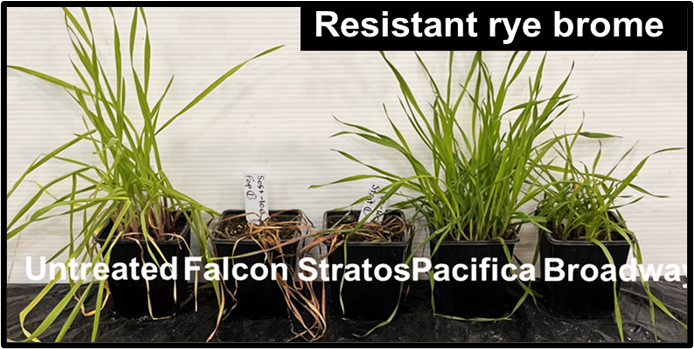
Figure 4: Symptoms of the resistant rye brome population 30 days post-treatment with ACCase herbicides (Falcon, Stratos Ultra) and ALS herbicides (Pacifica Plus, Broadway Star), all applied at the recommended label rates. Where plants are absent from a square, full control was achieved.
Meadow grass
- Four of the nine populations tested were ALS-resistant (Figure 5). Three annual meadow grass populations (AMG-05, AMG-06 and AMG-07) and one rough-stalked meadow grass population (RSMG-01) were resistant to Pacifica and also showed cross-resistance to Broadway, which is not labelled for meadow grass control.
- Unlike rough-stalked meadow grass, which was effectively controlled by ACCase herbicides, annual meadow grass showed natural tolerance to Axial and Stratos. However, ACCase-Centurion, used in winter oilseed rape or beet crops, remained effective.
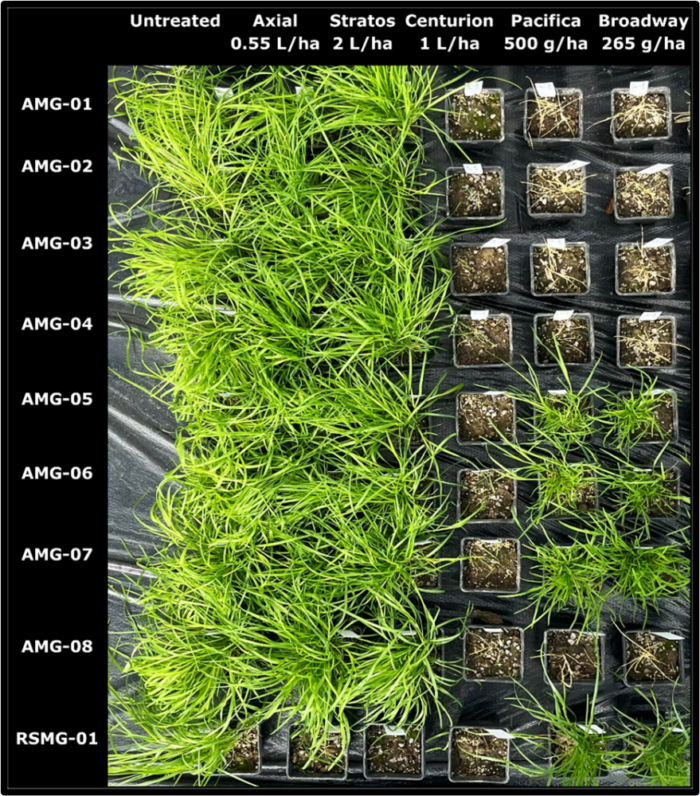
Figure 5: Symptoms of suspect populations of annual meadow grass (AMG) and rough-stalked meadow grass (RSMG) 30 days post-treatment with ACCase herbicides (Axial, Stratos Ultra, Centurion Max) and ALS herbicides (Pacifica Plus, Broadway Star), all applied at the recommended label rates. Broadway is not registered for meadow grass control. Where plants are absent from a square, full control was achieved.
Lesser canary grass
All populations tested with ACCase/ALS herbicides were effectively controlled (Figure 6).
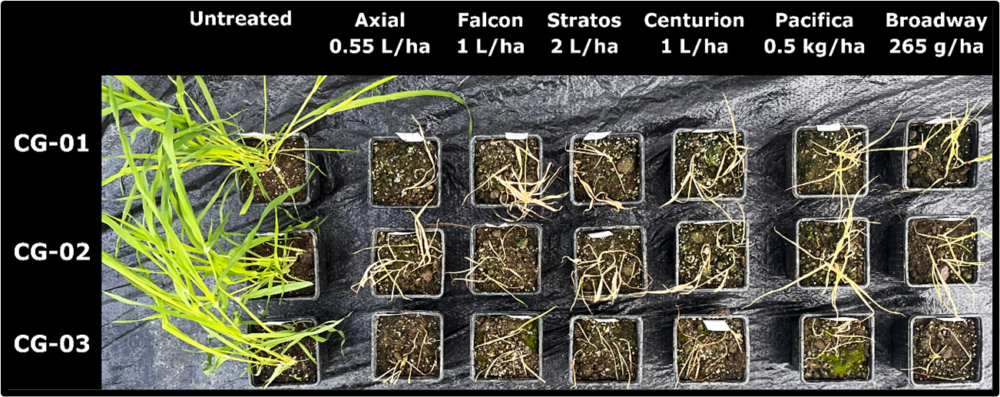
Figure 6: Symptoms of canary grass populations 30 days post-treatment with ACCase herbicides (Axial, Falcon, Stratos Ultra, Centurion Max) and ALS herbicides (Pacifica Plus, Broadway Star), all applied at the recommended label rates. Where plants are absent from a square, full control was achieved.
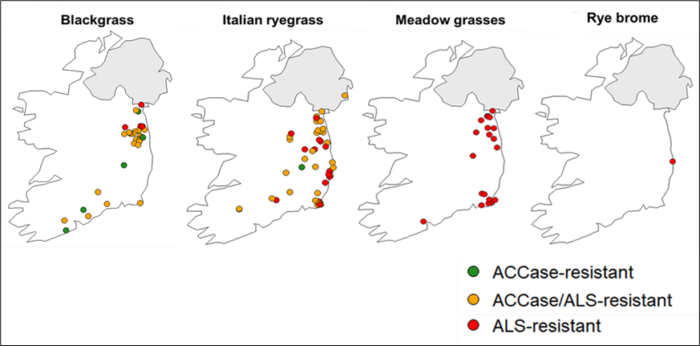
The increasing prevalence of resistant grass weeds poses significant weed control challenges on tillage farms (Figure 7). Of the suspect populations tested to date, 53 of 67 (79%) Italian ryegrass were ACCase and/or ALS-resistant, 36 of 56 (64%) blackgrass were ACCase and/or ALS-resistant, and 22 of 29 (76%) meadow grass were ALS-resistant, highlighting the need for ongoing vigilance.